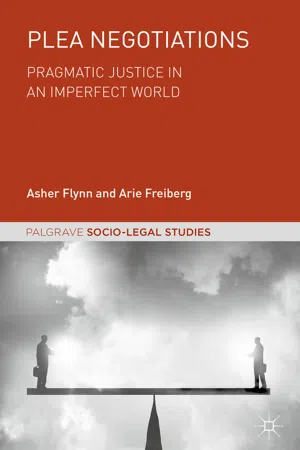
Despite a popular view that trials are the focal point of the criminal justice process, in reality, the most frequent way a criminal matter resolves is not through a fiercely fought battle between state and defendant, but instead through a process of negotiation between the prosecution and defence, resulting in a defendant pleading guilty in exchange for agreed concessions from the prosecution. This book presents an original empirical case-study of plea negotiations drawing upon interviews with legal actors and an analysis of defence practitioner case files, to shine light on the processes and ways in which an agreed outcome is reached in criminal prosecutions, within the setting of a jurisdiction, like many others world-wide, which is suffering major shifts in state resources. Plea negotiations, also referred to as "plea bargaining", "negotiated guilty pleas" and "negotiated resolutions" are neither an alloyed benefit nor a detriment for defendants, victims or the criminal justice system generally, and like all compromises, this book shows how the perfect "justice" outcome gives way to the good, or just the reasonably acceptable justice outcome.
- English
- ePUB (mobile friendly)
- Available on iOS & Android
eBook - ePub
About this book
Information
© The Author(s) 2018
Asher Flynn and Arie FreibergPlea NegotiationsPalgrave Socio-Legal Studieshttps://doi.org/10.1007/978-3-319-92630-8_11. Introduction
Asher Flynn1 and Arie Freiberg1
(1)
Monash University, Clayton, VIC, Australia
Asher Flynn (Corresponding author)
Arie Freiberg
Keywords
Plea negotiationsGuilty pleaPlea dealsPlea bargainingAn increasing climate of austerity and the growing influence of managerialist ideologies, across the Western world and elsewhere,1 have contributed to changing government priorities pertaining to the operation of criminal justice systems. As a result, there has been a renewed focus on “timeliness” and “efficiency ”. Within these “pragmatic” systems of justice, the most common way of resolving a case is through a defendant entering a plea of guilty. Whatever public perceptions may be regarding the centrality of a contested trial in the criminal justice process, the reality is that in many jurisdictions, including Australia, the most frequent method of case finalisation is not one that follows a fiercely fought battle between guilt and innocence, justice and injustice, and state and defendant, but by a plea of guilty. And in the majority of cases, the guilty plea is the result of a process of negotiation between the prosecution and defence, which takes place in the shadow of the trial (Bushway et al. 2014). In this regard, the negotiated guilty plea has become an everyday form of justice and “an accepted element of criminal prosecutions” (Royal Commission 2017a: 322). Indeed, negotiations are now regarded as “a legitimate means of resolving criminal litigation … fundamental to the efficient operation of an under-resourced system … [in which] the prosecution and defence exchange risks and benefits to achieve mutually satisfactory goals” (Leivore 2004, cited in Royal Commission 2017a: 322).
Negotiated guilty pleas,2 also referred to as “plea negotiations”, “charge bargaining”, “state-induced guilty pleas” (McConville and Marsh 2014) and “negotiated resolutions”, are processes whereby a defendant will plead guilty in exchange for agreed concessions from the prosecution. While commonly labelled “plea bargaining” in the United States (US), Canada and Europe, this term is generally not used and is strongly rejected by those within the Australian, New Zealand and British legal communities, on the basis that it connotes a covert bargain or trade that occurs outside the formalised rules and scrutiny applied at trial. Flynn (2011: 371) defines plea negotiations as:
A discussion between the prosecutor and the relevant defence practitioner regarding the accused person’s likely plea, the possibility of negotiating the charge(s) and/or case facts, and the Crown’s possible sentencing submission. The primary aim of discussions is to arrive at a mutually acceptable agreement, according to which the accused pleads guilty.
Plea negotiations have consistently and trenchantly been criticised for potentially undermining fundamental criminal justice principles, including the presumption of innocence and the defendant’s right to a contested trial (Johns 2002; McConville and Mirsky 2005; McConville and Marsh 2014; Woolard et al. 2016). As McConville and Marsh (2014: 216, emphasis in original) maintain, “because the process of State-induced guilty pleas is intended to replace in whole or part the promise of adversary justice, it challenges the foundations on which the claim of legitimacy of criminal courts has traditionally rested”. Concerns relating to plea negotiations have heightened in light of recent, ongoing austerity measures that have seen re-strategising of funding for government or state-funded legal services and a greater focus on increased efficiency and timely finalisations in the courts generally (Flynn and Hodgson 2017a); an outcome which has resulted in a system focused “on the immediate case facts and outcomes, with less time and attention reserved for discussions about rights, or long-term collateral consequences” (Fountain and Woolard 2017: 1). As Russell and Hollander (2017: 309) have argued, “the domestic and international normative frameworks on fairness in criminal justice have failed to keep pace with the growth in the use of trial waivers”. Plea negotiations have also been criticised on the ground that victims’ rights are not sufficiently considered in a process that focuses primarily on the relationship between the defendant and the prosecution (Johns 2002). Victims may be distressed if they feel that the charges to which the defendant pleads guilty do not reflect the harm done to them (Royal Commission 2017a: 322). In this context, plea negotiations may be seen to offer limited justice to victims and, in turn, the public (Flynn 2012). As Dixon (1996: 7) argues, “the rights of victims are often a forgotten factor in plea bargaining”. Accordingly, Clark (1986: 212) maintains that “it would probably be undesirable for plea bargaining to become the practice in all matters”.
It has also been argued that negotiated guilty pleas are problematic because they trade the contested trial, with its strict rules of procedure, for an informal method of case resolution, thereby removing the public’s access to a transparent process and creating uncertainty and misunderstanding about “justice” outcomes (Buckle and Buckle 1977; Euvrard and Leclerc 2017; JUSTICE 1993; Westling 1976). As Euvrard and Leclerc (2017: 526) observe, “because it takes place behind closed doors and in the absence of the main players (the victim and the defendant), it lacks the openness and transparency promised by the rule of law”.
Misapprehensions about plea negotiations can be problematic, particularly in light of the number of vulnerable people who come before the law. Indeed, the outcome of a negotiated guilty plea—in that an agreement is reached between the prosecution and defence, and a trial is avoided—creates a situation where all parties are unlikely to be entirely satisfied. United Kingdom (UK) law reform group, JUSTICE (1993), has argued that plea negotiations can adversely affect defendants by putting pressure on them to plead guilty in exchange for prosecutorial concessions. Utz (1978) and Morris (1977) likewise contend that plea negotiations create power imbalances between the prosecutor and the defendant , particularly where the possible benefits of the plea negotiation may, and generally will, outweigh the risks inherent to proceeding to contest the case. In this regard, it has been argued that defendants may plead guilty because they feel coerced to do so, with pressures arising from the threat of a more severe sentence, from the need to have the matter over and done with, and from the promise of a more certain outcome, compared with that of a trial. A plea of guilty is arguably a more expedient way to finalise one’s case, in that it enables the defendant to resolve the process, save money, get back to work and to their family (Redlich et al. 2017: 464). This argument is further strengthened if one considers the degrading process of the legal system as punishment in and of itself (Feeley 1979), whereby the quicker it comes to an end, the less is the punishment experienced by the defendant. But on the other hand, plea negotiations can be seen as a way to penalise those who believe that they are innocent and choose to “fight” their case, because if convicted, they will face a more severe sentence as a result of exercising their right to trial and forfeiting the benefits of a guilty plea.
The persistence and pervasiveness of plea negotiations in many jurisdictions points to an underlying utility and logic to the practice, which prevails over the often well-founded criticisms expressed by its critics. On its face, plea negotiation appears to derogate from the ideals of criminal justice : the presumption of innocence, the right to a fair and speedy trial before a jury of one’s peers and the existence of a public and op...
Table of contents
- Cover
- Front Matter
- 1. Introduction
- 2. Plea Negotiations in Context
- 3. Defining Plea Negotiations
- 4. Other Forms of Negotiations
- 5. The Negotiation Process
- 6. Negotiation Outcomes
- 7. Plea Negotiations and Sentencing
- 8. Pragmatic Justice: At Any Cost?
- 9. Building Trust and Confidence in the Criminal Justice System
- 10. Concluding Comments
- Back Matter
Trusted by 375,005 students
Access to over 1.5 million titles for a fair monthly price.
Study more efficiently using our study tools.
Frequently asked questions
Yes, you can cancel anytime from the Subscription tab in your account settings on the Perlego website. Your subscription will stay active until the end of your current billing period. Learn how to cancel your subscription
No, books cannot be downloaded as external files, such as PDFs, for use outside of Perlego. However, you can download books within the Perlego app for offline reading on mobile or tablet. Learn how to download books offline
Perlego offers two plans: Essential and Complete
- Essential is ideal for learners and professionals who enjoy exploring a wide range of subjects. Access the Essential Library with 800,000+ trusted titles and best-sellers across business, personal growth, and the humanities. Includes unlimited reading time and Standard Read Aloud voice.
- Complete: Perfect for advanced learners and researchers needing full, unrestricted access. Unlock 1.5M+ books across hundreds of subjects, including academic and specialized titles. The Complete Plan also includes advanced features like Premium Read Aloud and Research Assistant.
We are an online textbook subscription service, where you can get access to an entire online library for less than the price of a single book per month. With over 1.5 million books across 990+ topics, we’ve got you covered! Learn about our mission
Look out for the read-aloud symbol on your next book to see if you can listen to it. The read-aloud tool reads text aloud for you, highlighting the text as it is being read. You can pause it, speed it up and slow it down. Learn more about Read Aloud
Yes! You can use the Perlego app on both iOS and Android devices to read anytime, anywhere — even offline. Perfect for commutes or when you’re on the go.
Please note we cannot support devices running on iOS 13 and Android 7 or earlier. Learn more about using the app
Please note we cannot support devices running on iOS 13 and Android 7 or earlier. Learn more about using the app
Yes, you can access Plea Negotiations by Asher Flynn,Arie Freiberg in PDF and/or ePUB format, as well as other popular books in Social Sciences & Civil Rights in Law. We have over 1.5 million books available in our catalogue for you to explore.