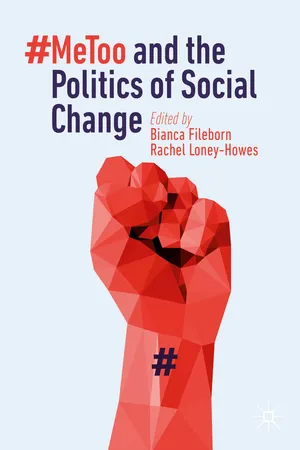
#MeToo has sparked a global re-emergence of sexual violence activism and politics. This edited collection uses the #MeToo movement as a starting point for interrogating contemporary debates in anti-sexual violence activism and justice-seeking. It draws together 19 accessible chapters from academics, practitioners, and sexual violence activists across the globe to provide diverse, critical, and nuanced perspectives on the broader implications of the movement. It taps into wider conversations about the nature, history, and complexities of anti-rape and anti-sexual harassment politics, including the limitations of the movement including in the global South. It features both internationally recognised and emerging academics from across the fields of criminology, media and communications, film studies, gender and queer studies, and law and will appeal broadly to the academic community, activists, and beyond.
eBook - ePub
#MeToo and the Politics of Social Change
- English
- ePUB (mobile friendly)
- Available on iOS & Android
eBook - ePub
#MeToo and the Politics of Social Change
About this book
Information
© The Author(s) 2019
B. Fileborn, R. Loney-Howes (eds.)#MeToo and the Politics of Social Changehttps://doi.org/10.1007/978-3-030-15213-0_11. Introduction: Mapping the Emergence of #MeToo
Bianca Fileborn1 and Rachel Loney-Howes2
(1)
University of Melbourne, Parkville, VIC, Australia
(2)
University of Wollongong, Wollongong, NSW, Australia
Keywords
#MeTooFeminist activismSexual violenceJusticeOnline activismSexual violence is an incredibly polarizing subject. On the one hand, sexual violence can incite outrage and moral indignation from the public and politicians alike. On the other hand, survivors who speak out about sexual violence routinely face scrutiny from their friends, family, police and the public. Many are accused of lying about their experiences, and others for not being ‘authentic’ victims or traumatized enough. Some are blamed for being assaulted: that they were ‘asking for it’.
At the same time, feminist activists have long sought to challenge these views, along with the assumption that rape, sexual assault and sexual harassment are the products of the random acts of individual men who are regarded as ‘sick’ or ‘social deviants’ and unknown to their victims. Instead, many feminists argue that these acts are a reflection of a ‘rape culture’, a highly contested term that refers to the social, cultural and political processes that condone violence against women but also blame women (and all other victim-survivors) if and when violence is perpetrated against them (Buchwald, Fletcher, & Roth, 1993). The flood of participation in #MeToo reaffirmed publicly just how widespread sexual assault and harassment actually are; that most victim-survivors know the offender; and, significantly, that these experiences are routine and normalized, in short, confirming many feminist arguments about ‘rape culture’.
Millions of individuals around the world used the #MeToo hashtag on social media within 24 hours of Alyssa Milano’s call to arms on 15 October 2017, generating a significant and overwhelming response in support of survivors of sexual harassment and violence. Yet, as contributors to this collection demonstrate, #MeToo also faced swift backlash and accusations of having gone ‘too far’. The testimony of Dr. Christine Blasey Ford, who, in September 2018, accused the now associate justice to the Supreme Court of the United States of sexually assaulting her when they were teenagers, further demonstrates our polarized responses to victim-survivors. The public and political backlash against Ford illustrated the depth of hostility and trepidation that remains within the American public toward survivors who speak out against powerful men. Such a response was indicative of the continued failure to hear and take seriously survivors when they speak out. This occurred despite the seemingly significant impact of the #MeToo movement and alongside Ford’s experience and testimony being heralded as credible and ‘believable’ (see Rosewarne, this collection). The backlash against Dr. Ford is reflective of the long-standing struggles, challenges and complexities within feminist activism and justice claims regarding sexual violence that have been prevalent since at least the 1970s. These challenges, intricacies and polarizing discourses that the #MeToo movement has once again given rise to are precisely what this edited collection seeks to address.
In this introductory chapter, we discuss the emergence of and responses to the #MeToo movement, placing it in dialogue with historical critiques of feminist efforts to raise awareness about sexual harassment and violence. Our intention here is to establish a critical framework through which to examine the #MeToo movement—and feminist activism and justice efforts to address sexual violence more broadly—and consider the potentials, limitations, complexities and necessities of social, cultural, political and legal changes.
#MeToo as a Moment of Reckoning
In October 2017, the hashtag ‘MeToo’ exploded on social media. In the wake of a string of sexual harassment and assault allegations against high-profile Hollywood producer Harvey Weinstein, broken by journalists Meghan Twohey and Jodi Kantor in The New York Times, actress Alyssa Milano took to Twitter, encouraging women to share their own experiences of sexual violence using #MeToo.
‘If you’ve been sexually harassed or assaulted write ‘me too’ as a reply to this tweet,’ Milano posted through her Twitter account accompanied by the following text:
Me Too. Suggested by a friend: “If all the women who have been sexually harassed or assaulted wrote ‘Me too’ as a status, we might give people a sense of the magnitude of the problem.”
The response, arguably, was nothing short of phenomenal with millions of survivors across the globe using the hashtag to disclose their own experiences of sexual harassment and violence. Some disclosed incidents and their aftermath in intimate detail; others simply marked themselves as survivors: ‘me too’ (see Gleeson & Turner; Mendes & Ringrose, this collection). With the hashtag used 12 million times in the first 24 hours, the ‘magnitude of the problem’ of sexual violence in women’s (and others’) lives was all too apparent.
The social media campaign quickly evolved across local contexts: French women used the #BalanceTonPorc (‘name your pig’) hashtag; #RiceBunny was used in China (see Zeng, this collection); Italian actress Asia Argento tweeted #QuellaVoltaChe (‘that time when…’), encouraging other Italian women to come forward with their stories of sexual harassment; and Spanish women joined in using the hashtag #YoTambien (Di Caro, 2017). Argentine women took advantage of the momentum of #MeToo to further advance the goal of legalizing abortion put on the agenda by the earlier #NiUnaMenos (‘not one woman less’) campaign (see Garibotti & Hopp, this collection). The movement generated substantive and sustained global media coverage and public debate (see Newman & Haire; Royal, this collection). Months of intensive media reporting culminated in the women who spoke out about Weinstein and others—the ‘Silence Breakers’—being named TIME’s people of the year in 2017.
Lest the social media campaign be viewed as all talk and no action, #MeToo drove the development of more tangible activist movements and support for those experiencing sexual harassment and violence, particularly in the workplace. Notably, the #TimesUp project, driven (at least initially) by Hollywood actresses, aimed to address ‘the systemic inequality and injustice in the workplace that have kept underrepresented groups from reaching their full potential’ by providing resources and legal support to women experiencing workplace harassment (Times Up Now, 2017). Similar efforts were established internationally, including the NOW campaign in Australia, spearheaded by journalist Tracey Spicer. In the wake of the movement, France passed new legislation to address public sexual harassment, with lawmakers passing a bill that outlawed catcalling in August 2018 (Masri, 2018). As we began preparing this collection, the Australian Human Rights Commission announced the first national inquiry into workplace sexual harassment.
At the time of writing, Weinstein had been accused of sexual assault by over 70 women, and in May 2018 he surrendered himself to police after being charged with rape, sexual misconduct, sexual abuse and committing a sex act against two women (ABC, 2018). Many other high-profile men were outed and publicly shamed as perpetrators, with varying degrees of consequence, including Louis C.K., Charlie Rose, Matt Lauer and Kevin Spacey. While the movement was initially focused on Hollywood, it quickly proliferated across other industries and contexts. One report estimated that more than 400 men (and a small number of women) across a range of industries spanning far beyond Hollywood had been ‘brought down’ by the movement (Green, 2018).
The Politics of Social Change
On the face of it, our brief overview suggests that the #MeToo movement was a highly successful one: an act of solidarity with and between survivors arguably on a scale that has not been witnessed before, a movement that has generated tangible action and consequences for some perpetrators, and driven substantive public debate on sexual violence. In addition, the use of social media was instrumental in spearheading discussion in new and nuanced ways.
Yet, to stop here would lead to an overly optimistic and simplistic rendering of the campaign. As the chapters in this edited collection highlight, a much more nuanced and critical unpacking of the movement in dialogue with broader discussions relating to gender, sexuality, race, geography, law, politics and history, is needed in order to understand the disruptive potential (and limits) of #MeToo and indeed question whether we can expect anything to change or be different moving forward (Alcoff & Gray, 1993). The development and circulation of #MeToo brought to a head a series of questions regarding who is able to speak and be heard, what constitutes sexual violence, whose experiences are included and perceived as worthy of redress, and how activist communities should go about the ‘business’ of generating change. Moreover, is it possible to conceptualize #MeToo in and of itself as a social movement, and is it capable of driving substantive change, and change for whom?
Importantly, many of the perceived issues and critiques of the movement are by no means limited to #MeToo, with the movement reproducing many historically problematic features of public feminism and anti-rape activism, which is discussed further in several of the chapters in this collection (see Loney-Howes; Ryan, this collection). It is vitally important that the movement be situated within a broader context and across the multiple histories and trajectories of anti-sexual violence activism and justice efforts. This collection seeks to complicate, critique and contextualize the #MeToo movement within this ‘bigger picture’ view of feminist agitation: we aim to examine the movement in its own right, while connecting it...
Table of contents
- Cover
- Front Matter
- 1. Introduction: Mapping the Emergence of #MeToo
- Part I. The Politics of Speaking out and Consciousness-Raising
- Part II. Whose Bodies Matter? #MeToo and the Politics of Inclusion
- Part III. Not All That Glitters Is Gold: #MeToo, the Entertainment Industry and Media Reporting
- Part IV. Ethical Possibilities and the Future of Anti-sexual Violence Activism
- 21. Conclusion: ‘A New Day Is on the Horizon’?
- Back Matter
Trusted by 375,005 students
Access to over 1.5 million titles for a fair monthly price.
Study more efficiently using our study tools.
Frequently asked questions
Yes, you can cancel anytime from the Subscription tab in your account settings on the Perlego website. Your subscription will stay active until the end of your current billing period. Learn how to cancel your subscription
No, books cannot be downloaded as external files, such as PDFs, for use outside of Perlego. However, you can download books within the Perlego app for offline reading on mobile or tablet. Learn how to download books offline
Perlego offers two plans: Essential and Complete
- Essential is ideal for learners and professionals who enjoy exploring a wide range of subjects. Access the Essential Library with 800,000+ trusted titles and best-sellers across business, personal growth, and the humanities. Includes unlimited reading time and Standard Read Aloud voice.
- Complete: Perfect for advanced learners and researchers needing full, unrestricted access. Unlock 1.5M+ books across hundreds of subjects, including academic and specialized titles. The Complete Plan also includes advanced features like Premium Read Aloud and Research Assistant.
We are an online textbook subscription service, where you can get access to an entire online library for less than the price of a single book per month. With over 1.5 million books across 990+ topics, we’ve got you covered! Learn about our mission
Look out for the read-aloud symbol on your next book to see if you can listen to it. The read-aloud tool reads text aloud for you, highlighting the text as it is being read. You can pause it, speed it up and slow it down. Learn more about Read Aloud
Yes! You can use the Perlego app on both iOS and Android devices to read anytime, anywhere — even offline. Perfect for commutes or when you’re on the go.
Please note we cannot support devices running on iOS 13 and Android 7 or earlier. Learn more about using the app
Please note we cannot support devices running on iOS 13 and Android 7 or earlier. Learn more about using the app
Yes, you can access #MeToo and the Politics of Social Change by Bianca Fileborn, Rachel Loney-Howes, Bianca Fileborn,Rachel Loney-Howes in PDF and/or ePUB format, as well as other popular books in Social Sciences & Law Theory & Practice. We have over 1.5 million books available in our catalogue for you to explore.