eBook - ePub
Traumatic Memories of the Second World War and After
- English
- ePUB (mobile friendly)
- Available on iOS & Android
eBook - ePub
Traumatic Memories of the Second World War and After
About this book
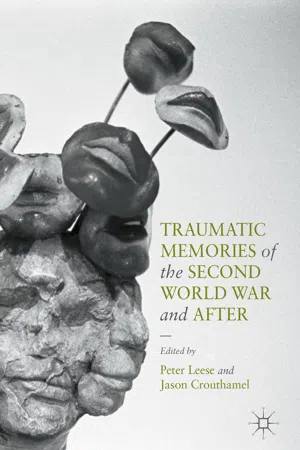
This collection investigates the social and cultural history of trauma to offer a comparative analysis of its individual, communal, and political effects in the twentieth century. Particular attention is given to witness testimony, to procedures of personal memory and collective commemoration, and to visual sources as they illuminate the changing historical nature of trauma. The essays draw on diverse methodologies, including oral history, and use varied sources such as literature, film and the broadcast media. The contributions discuss imaginative, communal and political responses, as well as the ways in which the later welfare of traumatized individuals is shaped by medical, military, and civilian institutions. Incorporating innovative methodologies and offering a thorough evaluation of current research, the book shows new directions in historical trauma studies.?
Information
© The Author(s) 2016
Peter Leese and Jason Crouthamel (eds.)Traumatic Memories of the Second World War and After10.1007/978-3-319-33470-7_11. Introduction
Peter Leese1 and Jason Crouthamel2
(1)
University of Copenhagen, Copenhagen, Denmark
(2)
Grand Valley State University, Allendale, MI, USA
The defining event of Jonas Mekas’s life was the moment in July 1944 when, to escape arrest for anti-German resistance activities, he was forced to leave his village, his family and his beloved Lithuania. Travelling towards Vienna, he was quickly arrested by a German patrol; the next 5 years he lived in Displaced Person camps before being “dumped” in New York, as he put it, by the United Nations High Commissioner for Refugees. Robert Vas, likewise, was compelled to leave Budapest and his homeland following the failure of the Hungarian Uprising in the autumn of 1956. He travelled to London and found another life, but was unable to forget his departure. The Cold War had hardly begun to thaw when he died in 1978; he never returned home.
Neither Mekas nor Vas was directly involved in Second World War combat, though both became active propagandists against their respective occupiers. Neither was clinically diagnosed with any kind of traumatic condition, although Vas’s failure to conform did land him in a Soviet-style mental institution not long after the war. Yet both were undoubtedly damaged by their experiences of forced migration in the aftermath of armed conflict, and their respective careers as filmmakers in New York and London are, among other things, vivid, artful explorations of traumatic memory played out in film. Their fuller stories are explored later in this collection. Their sufferings, and remarkable achievements, are evoked here to illustrate the elusive, life-changing effects of traumatic experience, to suggest that clinical labels and pension files can hardly do justice to the psychological aftereffects of war. These two lives also raise other historical questions: about who has the right to be called “traumatized”, how past and present definitions map accurately onto each other or fall beyond a boundary and whether those whose experiences and psychological reactions are not recognized can be reconciled with their past. 1
Since the early 1980s, when post-traumatic stress disorder (PTSD) was named, defined, and institutionalized by the American Psychiatric Association, public awareness and academic interest in trauma have dramatically risen. Several related phrases, Gulf War syndrome for instance, circulate widely in public discourse; PTSD is no longer a mere clinical designation, it is widely used as the name of a disease. Soldiers who returned from Afghanistan or Iraq suffering prolonged battlefield exposure are viewed compassionately, but often are misunderstood or feared as irrational and dangerous. Scholars in the humanities, historians among them, know well that those who have experienced violent circumstances and are subsequently troubled by them have often been subjected to this odd mix of curiosity, sympathy and anxiety. Research into the social and cultural histories of trauma can shed much light on the emergence of these present-day responses. Yet, while there has been an extensive discussion of trauma as a theoretical concept, surprisingly little attention has been given to particularities of time or place, to varieties of response beyond the English-language conception of PTSD.
The Second World War and the changing meanings of trauma in the second half of the twentieth century are a particularly rich setting for case studies on the subject, as we discovered when these essays were first presented as research papers in Copenhagen at the “AfterShock: Post-traumatic Cultures since the First World War” conference (May 2013). The extent and variety of recent research and thinking in the field of historical trauma studies led us to a follow-up Copenhagen University meeting on “Comparing Traumatic Cultures” (hosted by Peter Leese, November 2013). On this second occasion, a group of scholars gathered to consider the current state of historical trauma studies: Mark Micale (University of Illinois, Champaign-Urbana), Susan Derwin (University of California, Santa Barbara), Jessica Meyer (University of Leeds), Bill Niven (Nottingham Trent University), Adam Lowenstein (University of Pittsburgh), Irina Reyn (University of Pittsburgh), Robert Dale (Kings College London), Stefan Schilling (King’s College London) and Birthe Hoffmann (University of Copenhagen). We also discussed methodological questions and considered future research directions. Important to our thinking on this occasion were two papers, Susan Derwin’s “The Embattled Mind of the Veteran” and Mark Micale’s “Historical Trauma Studies: Recent Work, Future Agendas”. A group of new themes emerged from these debates, including the ways and extent to which traumatic responses vary, and by implication how we ought to define trauma, the gendered nature of traumatic experience, recognition and diagnosis, and the malleable forms of traumatic memory and traumatic symptoms across time; the distinctions between non-perpetrator and perpetrator trauma also emerged as a subject of particular current interest.
Many of the essays in Traumatic Memories incorporate these themes, but this also led to another consideration: the need to place varied methodological approaches from the humanities (historical, literary and visual media readings) in proximity to each other as a way to tackle the complexities of the past. 2 This proximity reflects the remarkable variety of approaches which are now brought to bear on the subject of trauma, but, in our view, also the need to think beyond the various historically bound clinical definitions of what constitutes traumatic experience. Historical documents—medical records, pension appeals and civil service memos—appear as the product of medical, state and financial negotiations. They are defined by the limits of state and bureaucratic interest, and not least by financial liability. While these engagements with the state are themselves of intrinsic interest, they in no way coincide with the human experience of trauma, which historically extends far beyond that which can be recorded in official documentation, or for that matter in family memoirs or intergenerational memory. There is an urgent need, then, for a broader cultural and historical analysis of trauma, which takes account of social dynamics, politics, and medical conceptualization, but which is not confined to them. Hence, the deliberately eclectic approach and choice of subjects, authors and disciplines included in this collection. This is also a question of how trauma is defined. Overwhelmingly, attention to the history of trauma has focussed on male experience, particularly in wartime. This important subject fully deserves the attention it has received, but is possible because soldiers and ex-servicemen leave relatively traceable paper trails, while others caught up in trauma-inducing events and their consequences, non-combatant women, for example, are far less visible in the historical record. Because of selective memories, traumatic war experiences are made predominantly male by definition. Yet, it is equally important that there are limits on what constitutes a traumatic experience, that current media definitions, which incorporate the aftereffects of any mildly disturbing or upsetting “bad event” into the definition of trauma, do not dissipate the usefulness of the term.
Historiography and Methods
Historical trauma studies are today an expanding, urgent subject for scholars and students, yet despite widespread attention in academia and mass media, comparative, interdisciplinary and historically grounded studies remain few. Moreover, discussions of the subject do not often bring together varied approaches in order to examine a particular historical moment. Among the earlier collections that have used this approach, we would cite Mark Micale and Paul Lerner’s edited volume Traumatic Pasts. History, Psychiatry and Trauma in the Modern Age, 1870–1930 (2001) as a rich attempt to contextualize trauma at a particular moment, and within its particular set of social and cultural conditions. Richard Bessel and Dirk Schumann’s Life after Death: Approaches to a Cultural and Social History of Europe During the 1940s and 1950s (2003) is also an exemplary investigation into many aspects of the human, often mental fallout from the Second World War. A closer attention to specifically psychological aftereffects is explored in The Politics of War Trauma. The Aftermath of War in Ten European Countries, edited by Jolande Withuis and Annet Mooij (2010), which was written by an interdisciplinary group of scholars across the humanities and social sciences and which attempts a systematic survey of war-related trauma after 1945. 3 To date, this account remains a rarity in historical trauma studies because it attempts a comparative investigation beyond the borders of Western Europe.
The First World War and the Holocaust have between them been the most sustained subjects of historical trauma studies. 4 A fleshed-out historical and theoretical framework that can link different times and places, interpret the dynamic relations between patients, medics and financial institutions, or understand the interrelationship between memory, representation and ideology remains to be fully developed. 5 There are, of course, already several detailed studies on particular aspects of postwar traumatic experience, among them Ben Shephard’s study A War of Nerves (2002), which was the first to survey the entire twentieth century and which delineated its subject through a detailed study of patients, but especially their medics. The only comparable volume is Jones and Wessely’s Shell Shock to PTSD: Military Psychiatry from 1900 to the Gulf War, which takes a more narrowly defined thematic approach, concentrating on the connections between clinical practice, evolving medical conceptualization, and the experience of soldiering. 6 Traumatic Memories complements these earlier studies by concentrating in several essays on personal experience, by focussing on a relatively narrow time frame, and by expanding as far as possible the comparative scope. This arrangement captures the present lively state of investigation, with its recently expanded geographies, thematic interests and more radical questioning of the origins and significance of trauma before and after the current post-1980 iteration of PTSD.
There is also an overlap between our collection and the more abstract investigation of “trauma theory”, which includes historically oriented work by practitioners, questions about the clinical and ontological status of trauma as well as the broad area incorporating literary and cultural theory. 7 Likewise, there are various investigations into “trauma and culture”, which cover more anthropological and sociological themes. These are often related to both recent past and present, including lively debates around cinema, popular literature and the arts as they relate to the cultural conditions which produce traumatic discourse and clinical practice. 8 One methodological puzzle that has yet to be solved is how to research and write a history of trauma which concentrates not on one particular gender experience but on the instability of gender categories. This instability is present in many kinds of traumatic experience, but matters greatly in wartime, when normative roles (nurturer, warrior) assume much greater prominence: when gender roles are patrolled so actively, traumatized men may be either unmanly or heroic, while traumatized women become symbolic or invisible. The question remains as to how these sets of circumstances and representations might be connected. Likewise, we have not yet managed to historicize the wider dynamics of traumatic memory within families and between generations.
Gathered in this collection are essays which begin to address some of these themes, and which together highlight the possibilities of a comparative and interdisciplinary approach to trauma, an approach which is grounded in the local particularity of past attitudes. Our common purpose is to investigate how trauma changes, diagnostically, politically, discursively, according to the social and cultural milieu in which it is manifested. As it turns out, “the return of the soldier”, to take one example, is “universal” in that it happens everywhere, but despite this, it is never unproblematically the same. Many soldiers never return, many are very different, and so is the society into which they arrive. In this sense, it is not the “bad event” which makes trauma, but the material, emotional and communal context within which it is remembered. At many times, and in many places, potentially traumatizing events do not result in chronic or acute symptoms. Rather, such symptoms tend to emerge and to persist when there is inadequate clinical consideration, when acknowledgement and recognition are not forthcoming from the receiving community, or when families and employment fail. The ways in which the sick role is sanctioned or censured are also highly variable. It is in the intricacy of particular historical circumstances that the unstable, malleable formation of trauma takes on a certain appearance.
Themes
There is then no straightforward or easily described relationship between culture, trauma, and history; social psychologies are differently inflected according to time and place. This collection tries to explore how these variations change origins and symptomatology as well as medical and social responses. Within this research area, there are a number of sub-questions, among them: whose traumatic experiences gain attention and why? By implication, whose experiences are ignored? What are the particular, localized mechanisms of recognition or non-acknowledgement? How do collaborations and antagonisms between doctors, patients and social institutions vary and with what consequences? How do different groups such as doctors, patients or the public define and claim the authority to understand traumatic conditions? How and why does collective memory and representation of traumatic experience change?
That such questions are only now beginning to be asked is no surprise given the very gradual acknowledgement of trauma, which is still stigmatized as “mental illness” or “disorder” even in the late twentieth and early twenty-first centuries rather than understood as legitimate responses to extreme circumstances. Some of these questions have already been raised in relation to the First World War and the Holocaust. These two particular instances continue to provoke new questions, to be explored from new angles, as the essays by Sophie Delaporte and Lisa Pine in this collection show. But there are now also several specialist studies in various European countries, and attention is increasingly turning to the wider history of the Second World War and to other, later wars, precisely because they provide such instructive contrasts.
The Second World War is a critical moment because its trauma cases become more recognizably connected to present-day definitions of PTSD, historical sources are greater in number as well as more varied in type, and the possibilities to compare military, medical or social aspects are all greater. Predating current definitions of PTSD, the trauma cases of the Second World War and after are viewed very differently than in current medical aetiology. These past definitions of trauma are less driven by medical, insurance, or pharmaceutical industry profits, or the recent medicalization of emotional states. 9 In short, the Second World War and its aftermath constitute a formative moment in the social, cultural, and political history of trauma. A focussed examination makes it possible to investigate anew given concepts, diagnoses, and moral assumptions. Comparing specific, localized instances, this collection of essays rethinks the history of war trauma at an interim moment: after its first large-scale appearance during the First World War, but before the current socio-medical paradigm of PTSD.
The terms of the reinvestigation, to give three examples, include looking beyond existing studies of male experience among active combatants, considering varieties of personal experience and their wide-ranging implications for the medicalization and social positioning of psychological conditions, and examining various cultural inflections of traumatic experience and diagnosis. Finally, taken together, the essays in this collection ask critical questions about what we now call PTSD. They do so at a time when the usefulness and legitimacy of the diagnosis are increasingly questioned. The issues here include the diagnostic, gender and institutional biases of trauma definition—the ellipses, blind spots and taboos on describing certain forms of traumatic experience (rape, non-compassionate responses, forgetfulness); the requirements and methods by which perpetrators and victims are identified and categorized; the trauma archive: witness, testimony and the erasure of “inconvenient” versions of traumatic experience; trauma, voyeurism and sexual violence; and the clash between private histories and public representations.
Organization
The collection is divided into five parts, respectively, on the “Archive” of trauma, on “Wartime” and “Postwar” experiences, then on “Recollection” and “Representation”. Each part addresses a theme that has emerged in recent thinking on historical trauma studies; any of these headings might be the basis for more sustained investigations.
“Archive”, Part I, explores some of the recent thinking on alternative sources, but also on why and how this research area might be reconfigured. Both of the authors here consequently look at important ways in which historical trauma studies can be enriched and expanded to create a fuller cultural history of trauma. Sophie Delaporte’s essay, “Making Trauma Visible”, by one of the leading French scholars of war trauma in the twentieth century, puts forward an alternative history of diagnosis and treatment. By contextualizing its history anew—initial conceptualization, competing schools of interpretation and treatment—Delaporte challenges fundamental assumptions ab...
Table of contents
- Cover
- Frontmatter
- 1. Introduction
- 1. Archive
- 2. Wartime
- 3. Postwar
- 4. Recollection
- 5. Representation
- 6. A Coda on Trauma
- Backmatter
Trusted by 375,005 students
Access to over 1.5 million titles for a fair monthly price.
Study more efficiently using our study tools.
Frequently asked questions
Yes, you can cancel anytime from the Subscription tab in your account settings on the Perlego website. Your subscription will stay active until the end of your current billing period. Learn how to cancel your subscription
No, books cannot be downloaded as external files, such as PDFs, for use outside of Perlego. However, you can download books within the Perlego app for offline reading on mobile or tablet. Learn how to download books offline
Perlego offers two plans: Essential and Complete
- Essential is ideal for learners and professionals who enjoy exploring a wide range of subjects. Access the Essential Library with 800,000+ trusted titles and best-sellers across business, personal growth, and the humanities. Includes unlimited reading time and Standard Read Aloud voice.
- Complete: Perfect for advanced learners and researchers needing full, unrestricted access. Unlock 1.5M+ books across hundreds of subjects, including academic and specialized titles. The Complete Plan also includes advanced features like Premium Read Aloud and Research Assistant.
We are an online textbook subscription service, where you can get access to an entire online library for less than the price of a single book per month. With over 1.5 million books across 990+ topics, we’ve got you covered! Learn about our mission
Look out for the read-aloud symbol on your next book to see if you can listen to it. The read-aloud tool reads text aloud for you, highlighting the text as it is being read. You can pause it, speed it up and slow it down. Learn more about Read Aloud
Yes! You can use the Perlego app on both iOS and Android devices to read anytime, anywhere — even offline. Perfect for commutes or when you’re on the go.
Please note we cannot support devices running on iOS 13 and Android 7 or earlier. Learn more about using the app
Please note we cannot support devices running on iOS 13 and Android 7 or earlier. Learn more about using the app
Yes, you can access Traumatic Memories of the Second World War and After by Peter Leese, Jason Crouthamel, Peter Leese,Jason Crouthamel in PDF and/or ePUB format, as well as other popular books in History & Military & Maritime History. We have over 1.5 million books available in our catalogue for you to explore.