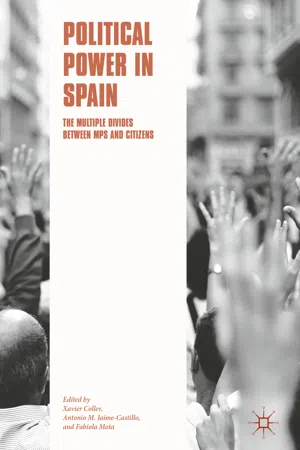
This book explores why some people become politicians, how they represent citizens in parliaments, and what they think about democracy and its institutions. It analyses the results of the first survey of a representative sample of Spanish MPs (580 cases) and citizens. The study covers areas such as: social profiles; recruitment and selection; women in parliaments; motivation for politics; perception of the representative function and how this is affected by corruption, disaffection and mistrust; national and regional identities; ideology; the functioning of parliamentary groups, and perceptions about the EU. The case of Spain is used to demonstrate how MPs' values, opinions and attitudes conflict and complement with those of the citizens they are supposed to represent. Through a systematic comparison between MPs and citizens, the contributions deal with topics that are key to understanding how democracies work and the role played by MPs.
eBook - ePub
Political Power in Spain
The Multiple Divides between MPs and Citizens
- English
- ePUB (mobile friendly)
- Available on iOS & Android
eBook - ePub
Political Power in Spain
The Multiple Divides between MPs and Citizens
About this book
Information
© The Author(s) 2018
Xavier Coller, Antonio M. Jaime-Castillo and Fabiola Mota (eds.)Political Power in Spainhttps://doi.org/10.1007/978-3-319-63826-3_11. The Need for the Study of Parliamentarians in Spain
Xavier Coller1 , Antonio M. Jaime-Castillo2 and Fabiola Mota3
(1)
Department of Sociology, Pablo de Olavide University, Sevilla, Spain
(2)
Faculty of Economics and Business, Universidad de Málaga, Málaga, Spain
(3)
Department of Political Science and IR, Universidad Autónoma de Madrid, Madrid, Spain
Xavier Coller (Corresponding author)
Antonio M. Jaime-Castillo
Fabiola Mota
Contributed equally
Keywords
Political elitesStudy of parliamentariansPolitical alienationDisaffectionXavier Coller, Antonio M. Jaime-Castillo and Fabiola Mota contributed equally to this work.
1.1 Why Study Parliamentarians?
Justifying the need for a book such as this is relatively easy if we consider two interrelated phenomena: alienation and lack of knowledge. Firstly, the early years of the 21st century have been marked by growing public discontent with politics in Europe. Although this is not an entirely new phenomenon, as can be seen from the literature on political trust dating back several decades (Crozier et al. 1975), the alienation between politicians and citizens in Spain appears to have reached a dimension previously unknown. The surveys of the CIS (Centro de Investigaciones Sociológicas, Spain’s Center for Sociological Research) consistently reflect a progressive alienation of the citizens from their representatives which is manifested in the perception that “politics” (parties, government, politicians) has become one of the three most important problems. This situation has lasted too long for it to be considered circumstantial and its most evident expression is heard in the cries of “they do not represent us” that have accompanied many mass public demonstrations which began with the 15-M movement and were followed in Spain by other voices of protest, such as “Real Democracy, Now!”, the demonstrations around the Congress and the Catalonian Parliament, the “green tide” of protests over education, the “white tide”, over health, and the movement of the platform of persons affected by mortgage foreclosures. The results of the different regional and national elections which have taken place in 2015–16 have brought to light the expressions of this discontent in different options which confront “old” and “new” politics. “New” politics is epithomized in the emergence of Podemos (left) and Ciudadanos (center or center-right), while “old” politics is represented mainly by traditional parties like socialdemocrat PSOE (Spanish Socialist Workers Party) and right or center-right PP (Popular Party). In general, as Maravall (2016) suggests, there has been a growing demand on democracy (the quality of representation, redistribution via public policies, and institutions of political competition) that politicians and their parties had hardly anticipated and were mostly unable to cope with successfully.
Secondly, although the first index of parliamentary transparency elaborated by Transparency International does not give a poor score to the 19 Spanish parliaments (in comparison with local councils, for example),1 the lack of transparency in political activity, the lack of public interest and disengagement from public affairs may have led to widespread ignorance about who the politicians are, where they come from and what they do. In some postgraduate social science courses, we have carried out the following experiment: social science students (who are supposed to be among the most educated population concerning politics) were asked to explain, for example, what the members of parliament (MPs) in the different legislative assemblies did, why they thought that they were involved in politics, what they were like in general, or what they believed the politicians thought about a possible reform of the constitution. The generalized lack of knowledge that they displayed could well be shared by less educated sectors of the population. It is not that Spaniards are ignorant in general. The problem is that the number of studies about politicians is very scarce and usually limited to works about some institutions or they take the form of newspaper articles, generally with little supporting empirical evidence. There is a black hole in the knowledge about political elites in Spain.
Nevertheless, a glance at the scientific literature on political elites allows us to state that academic interest in studying this power group has increased lately, although there still exists a number of voids which are, little by little, being covered. We have a slightly better understanding of the social profile of MPs at certain times and in some legislative assemblies, and of their evolution,2 but we do not yet know if they resemble the society that elects them, although instruments do exist to establish comparisons based on the Electoral Bias Index or the Social Disproportion Index (Coller et al. 2016). Thanks to diverse contributions,3 we are relatively well aware of the late, progressive and differentiated incorporation of women into institutional politics, although the effect that this is having remains to be determined, especially as regards legislative action. Neither do we know much about the criteria that are applied in the selection of one person rather than another to form part of an electoral list, other than the rules that appear in party bylaws or from studies of the executive.4 There are partial gaps in our knowledge of the motivation that leads some persons to enter politics and to make it their professional career, especially at the regional level.5 Although there have been some studies, we have hardly any knowledge of whether professional or ideological reproduction exists in the families of politicians, whether the MPs of the non-statewide parties in general behave differently from parties operating on a statewide scale, or whether there are differences between the representatives of parties with experience of government and those without.6 Neither do we know much about what they do in parliaments, how they do it, the relationships which are established between parliamentarians of rival groups and even between members of the same group when influenced by hierarchy and decision-making discipline.7 We are also largely unaware of the beliefs and attitudes of political representatives, their cognitive schemata or their opinions on relevant questions such as the reform of the constitution, the organization of the State in autonomous communities, the European Union (EU) or corruption in politics. And above all, despite some progress, we know little of whether MPs and their constituents coincide on aspects which are relevant to the political dynamics in a multilevel Spain.8 In short, we still know little of many facets of political representatives at all levels of representation, of those persons whom the citizens have entrusted with the government of society and with decisions that affect them.
The studies which partially cover some of these vacuums in Spain are generally focused on a specific assembly or a particular period or legislature. As Linz predicted with respect to the studies of Spain, the federalization of the country has meant that the State has lost its pre-eminence as an object of study and the center of attention has shifted to the regions, but there has been no effort to make comparisons (Newell 2011, p. 71). This book largely attempts to fill these gaps, taking into account the fact that the institutional evolution has made MPs of Congress and Senate and those of the 17 regional legislative assemblies to share political responsibilities. Our purpose is to improve our knowledge of who the persons occupying a seat in any of the 19 representative chambers in Spain are and what they think.
1.2 Studies of Parliamentarians
Studies of MPs are not new. They make a long-standing tradition in the social sciences for at least two reasons. Firstly, in comparison with studies of other types of elites, parliamentarians are easily identifiable since they occupy a visible position in the institutional power structure in any country. Secondly, they are a relevant part of the population and make up a segment of what Mills (1956) called the “power elite” insofar that their decisions are important to the lives of the citizens and for the quality of democracy. For these two reasons, there have been myriad studies of parliaments and parliamentarians.
Since it focused on the study of US legislative assemblies, especially the rigid seniority rules of the Senate (Shils 1982, p. 20, in Von Beyme 1995, p. 16), the theorization of the “power elite” contributed to the consolidation of the institutional anchorage in the study of the political elite. The work of Pols...
Table of contents
- Cover
- Frontmatter
- 1. The Need for the Study of Parliamentarians in Spain
- 2. The Composition of Spanish Parliaments: What are the MPs Like?
- 3. Gender and Parliament: The Impact of the Political Presence of Women
- 4. Political Socialization and Motivation
- 5. Recruitment and Selection
- 6. Professionalization and Parliamentary Careers
- 7. Parliamentary Groups and Institutional Context
- 8. Parliamentary Political Representation
- 9. Political Disaffection
- 10. National and Regional Identity
- 11. National Identity and Political Representation: Rival “Top-Down” National Projects
- 12. Ideology: The Reasons Behind Placement on the Left-Right Scale
- 13. The Organization of Spain: Ideology, Territory and Representation in the State of Autonomies
- 14. MPs Representing Nationalist and Regionalist Parties
- 15. Parliaments and the European Union
- 16. The Distant Politician?
- Backmatter
Trusted by 375,005 students
Access to over 1.5 million titles for a fair monthly price.
Study more efficiently using our study tools.
Frequently asked questions
Yes, you can cancel anytime from the Subscription tab in your account settings on the Perlego website. Your subscription will stay active until the end of your current billing period. Learn how to cancel your subscription
No, books cannot be downloaded as external files, such as PDFs, for use outside of Perlego. However, you can download books within the Perlego app for offline reading on mobile or tablet. Learn how to download books offline
Perlego offers two plans: Essential and Complete
- Essential is ideal for learners and professionals who enjoy exploring a wide range of subjects. Access the Essential Library with 800,000+ trusted titles and best-sellers across business, personal growth, and the humanities. Includes unlimited reading time and Standard Read Aloud voice.
- Complete: Perfect for advanced learners and researchers needing full, unrestricted access. Unlock 1.5M+ books across hundreds of subjects, including academic and specialized titles. The Complete Plan also includes advanced features like Premium Read Aloud and Research Assistant.
We are an online textbook subscription service, where you can get access to an entire online library for less than the price of a single book per month. With over 1.5 million books across 990+ topics, we’ve got you covered! Learn about our mission
Look out for the read-aloud symbol on your next book to see if you can listen to it. The read-aloud tool reads text aloud for you, highlighting the text as it is being read. You can pause it, speed it up and slow it down. Learn more about Read Aloud
Yes! You can use the Perlego app on both iOS and Android devices to read anytime, anywhere — even offline. Perfect for commutes or when you’re on the go.
Please note we cannot support devices running on iOS 13 and Android 7 or earlier. Learn more about using the app
Please note we cannot support devices running on iOS 13 and Android 7 or earlier. Learn more about using the app
Yes, you can access Political Power in Spain by Xavier Coller, Antonio M. Jaime-Castillo, Fabiola Mota, Xavier Coller,Antonio M. Jaime-Castillo,Fabiola Mota in PDF and/or ePUB format, as well as other popular books in Politics & International Relations & European Politics. We have over 1.5 million books available in our catalogue for you to explore.