Draws from multiple perspective of the Gorkha earthquake in 2015 to inform Disaster Risk Reduction research and practice
Provides reflections and interviews from people caught up in the Gorkha 2015 earthquake and involved in managing emergency response and immediate recovery efforts
Includes an investigation on earthquake damage and inappropriate post-disaster responses as well as noting the limited protection offered to monuments and their subsurface heritage
Louise Bracken, Hanna A. Ruszczyk and Tom Robinson (eds.)Evolving Narratives of Hazard and Riskhttps://doi.org/10.1007/978-3-319-65211-5_1
Begin Abstract
1. Introduction to the Gorkha Earthquake
Hanna A. Ruszczyk1 and Tom Robinson1
(1)
Department of Geography, Durham University, Durham, UK
Keywords
EarthquakeDisaster riskEarthquake preparedness and responseDisciplinary perspectives.
End Abstract
1.1 The Earthquake
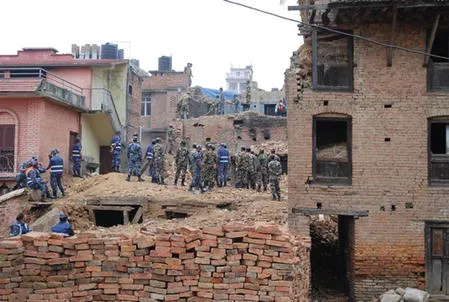
On 25 April 2015 at 11:56 a.m., the first jolts of a major earthquake were felt in the small town of Gorkha in central Nepal. Almost 9000 people died, over 22,000 injured, 1 million homes either destroyed or damaged (Government of Nepal, Ministry of Home Affairs and Disaster Preparedness Network-Nepal 2015), thus resulting in a further 2.8 million people homeless across 14 districts of Nepal. Although felt in India, China and as far away as Bangladesh, the Gorkha earthquake, as it became known, and the aftershocks that followed, gave the brunt of its devastation in Nepal. The earthquake, with a magnitude of 7.8 (USGS 2015) and the subsequent magnitude 7.3 aftershock in Sindhupalchok district on 12 May, was the largest earthquake and worst natural hazard to strike the country in 81 years. Not since the devastating 1934 Nepal-Bihar earthquake, estimated to have had a magnitude of 8+, had Nepal suffered such a devastating event (Fig. 1.1).
Fig. 1.1
Efforts post-earthquake to help affected people and to assess damage (Source: NSET)
Yet this was not the big one that many scientists, humanitarians, politicians and members of the public had feared and discussed in the years before 2015. This was not the feared mega-quake that would unzip several hundreds of kilometres of the main Himalayan Fault and strike the direct hit on Kathmandu (Feldl and Bilham 2006). The Gorkha earthquake was certainly big—not just the worst disaster in Nepal in recent memory but the worst natural disaster of 2015 globally. But the threat of the big one remains, thus not alleviating fear of further destruction.
Disasters do not occur in political, social or economic vacuums. National and local geographies of inequality, ethnicity, caste, gender relations and social and economic marginalisation shape response and long-term recovery for those who remain (Hyndman 2011; Sidaway et al. 2008) to rebuild their lives, communities and country. Only five months after the Gorkha earthquake, the long-discussed but never agreed constitution was unexpectedly approved with a large majority by the constituent assembly. This was greeted with controversy, especially in southern Nepal along the border with India, where protests had already been visible during the summer months and even more so after the signing in September. Within 48 hours of the passage of the constitution, there were sit-ins on the key border crossings, and India ceased all movement of trade into Nepal through these routes, through which 85% of all goods enter Nepal.
The impact of the Gorkha earthquake and subsequent political and economic crisis has thus been felt in many different ways across different communities throughout Nepal. The World Bank (2016a, 1) appropriately stated that ‘2015 will be remembered as the year of twin shocks for Nepal’. The impact of the dual disasters will continue to be felt for many years.
1.2 Background
Nepal is a land-locked Himalayan country located between the Asian giants of China and India. Nepal has a population of over 26 million people according to the most recent census (Government of Nepal, National Planning Commission 2012), although difficulties with data collection means the World Bank estimates the population is closer to 30 million (World Bank 2013). Over 80% of Nepal is mountainous, and the remaining 20% is made up of flat, low-lying fertile land along the Indian border, known in Nepal as the Terai. Effectively a closed nation until the mid-twentieth century, this former kingdom has seen significant changes in the past 60 years. In 1950, Nepal had few roads, now 43% of the rural population has access to an all-season road and over 17,000 km of roads exist (World Bank 2017). Adult literacy has increased from 21% in 1980 to 60% in 2010 (Rigg et al. 2016), while the percentage of people living below the national poverty line declined from 42% in 1996 to 25% in 2010 (Government of Nepal, National Planning Commission and the UNDP 2011).
Nepal was governed by royal dynasties until the early 1990s, when several political parties launched a popular prodemocracy movement. The political changes raised expectations of social and economic progress for most Nepalese, in a country highly managed by caste and other hierarchies that left most people very poor. Since democracy was adopted in 1990, Nepal has had over 23 governments. In 1995, the Community Party of Nepal made plans to launch an armed struggle, the People’s War, with the goal to better the standard of living for Nepalese people. In 1996, the armed insurgency against the government began. This Maoist-led insurgency lasted a decade, ending in 2006, and resulted in over 13,000 deaths and significantly stifled national socioeconomic development. A Maoist-dominated government was democratically elected in August 2007. Long-term political instability has reigned, and the country is struggling to overcome the legacy of the conflict. As of early 2017, politicians continue to disagree on the new promulgated constitution of September 2015 and discussions leading to a federal state for Nepal continue.
Along with agriculture, which contributes 30% of the gross domestic product (GDP), remittances and the service sector have emerged as major contributors to the economy. Today, Nepal’s economy relies on a combination of agriculture (predominantly rice and wheat), tourism and remittances from its young men who work mainly in Malaysia, Qatar, Saudi Arabia, UAE and Kuwait (Government of Nepal, Ministry of Labour and Employment 2014, 6). In 2014, remittances contributed 29% of the GDP (ibid., 36; World Bank databank 2016b) and currently are one of the leading factors behind Nepal’s remarkable successes in human development in the last 40 years, contributing significantly to the reduction of poverty since 1995 (United Nations 2011). It is these remittances that are fuelling people’s ability to rebuild post-earthquake.
Despite the contribution to the economy and poverty reduction, this reliance on remittances has notable downsides. The number of Nepalese households receiving remittance has increased from 23% in 1995–96 to 56% of all households in 2010–11 (Government of Nepal, Central Bureau of Statistics 2011). Of the households receiving remittances, such monies make up 31% of the household’s total income (ibid.), and daily consumption uses 79% of total remittances received. It is clear Nepal’s households depend heavily on its young male international migrants rather than on the country’s own economy. This leaves many young Nepalese men with a difficult choice: stay and help rebuild after the earthquake or leave and send back their earnings.
1.3 Disaster Risk in Nepal
Over the last five centuries, deaths from earthquake disasters globally have consistently averaged 100,000 per year, with some experts suggesting this rate is increasing (Bilham 2004). With more than 90% of all earthquakes affecting the Asia-Pacific region (hence the colloquial term Pacific ‘Ring of Fire’), it is not surprising that the largest number of deaths from earthquakes each year is in Asia (International Federation of Red Cross 2009). Nepal is ranked 11th in the world in terms of vulnerability to earthquakes (UNDP 2004). Situated in the middle portion of the Hindu Kush Himalayan region, a high seismic risk zone, Nepal has a long history of destructive earthquakes (Mugnier et al. 2013; Government of Nepal, Ministry of Home Affairs 2011). It is prone to other natural hazards as well, such as flooding and landslides, both of which occur annually during the summer monsoon, and the latter of which occur in the thousands during a major earthquake (Kargel et al. 2016). This combination of ‘multiple hazard events poses a severe threat to national development processes’ (ADPC et al. 2010, xii), and the World Bank (Dilley et al. 2005) considers Nepal one of the global hot spots for natural disasters.
While strong earthquakes in Nepal are infrequent, they almost always result in some level of loss. In 1833, two major earthquakes were experienced in the Kathmandu Valley, causing widespread damage. In 1834, four major earthquakes occurred in just two months. On 16 January 1934, perhaps Nepal’s most infamous earthquake occurred: the great Nepal-Bihar earthquake, which, as the name suggests, also affected Bihar, India. This earthquake had an estimated moment magnitude (Mw) of 8.4 and according to Rana (1935, translated into English Lall 2013) killed 8519 people across eastern Nepal. In the recent past, on 18 September 2011, an earthquake of Mw 6.8 struck Nepal’s eastern region as well as the capital Kathmandu, in the central region. This resulted in damage to houses, buildings and schools in 13 districts.
1.4 Scope of the Book
Disasters are not natural; they are human made (O’Keefe et al. 1976). Building codes, zoning policies, environmental regulations and enforcement of laws all influence outcomes of major events such as earthquakes (Hyndman 2011). Earthquakes are a particularly special hazard event: There is a rupturing that earthquakes create that is beyond our control and understanding (Simpson 2013; Hyndman 2011). An earthquake is more than the physical shaking. The ramifications are complex and interconnected. The impact of an earthquake is expressed in fits and burs...
Table of contents
Cover
Front Matter
Part I. Earthquake Preparedness and Response
Part II. Disciplinary Perspectives
Trusted by 375,005 students
Access to over 1.5 million titles for a fair monthly price.
Study more efficiently using our study tools.
Frequently asked questions
Yes, you can cancel anytime from the Subscription tab in your account settings on the Perlego website. Your subscription will stay active until the end of your current billing period. Learn how to cancel your subscription
No, books cannot be downloaded as external files, such as PDFs, for use outside of Perlego. However, you can download books within the Perlego app for offline reading on mobile or tablet. Learn how to download books offline
Perlego offers two plans: Essential and Complete
Essential is ideal for learners and professionals who enjoy exploring a wide range of subjects. Access the Essential Library with 800,000+ trusted titles and best-sellers across business, personal growth, and the humanities. Includes unlimited reading time and Standard Read Aloud voice.
Complete: Perfect for advanced learners and researchers needing full, unrestricted access. Unlock 1.5M+ books across hundreds of subjects, including academic and specialized titles. The Complete Plan also includes advanced features like Premium Read Aloud and Research Assistant.
Both plans are available with monthly, semester, or annual billing cycles.
We are an online textbook subscription service, where you can get access to an entire online library for less than the price of a single book per month. With over 1.5 million books across 990+ topics, we’ve got you covered! Learn about our mission
Look out for the read-aloud symbol on your next book to see if you can listen to it. The read-aloud tool reads text aloud for you, highlighting the text as it is being read. You can pause it, speed it up and slow it down. Learn more about Read Aloud
Yes! You can use the Perlego app on both iOS and Android devices to read anytime, anywhere — even offline. Perfect for commutes or when you’re on the go. Please note we cannot support devices running on iOS 13 and Android 7 or earlier. Learn more about using the app
Yes, you can access Evolving Narratives of Hazard and Risk by Louise Bracken, Hanna A. Ruszczyk, Tom Robinson, Louise Bracken,Hanna A. Ruszczyk,Tom Robinson in PDF and/or ePUB format, as well as other popular books in Biological Sciences & Environment & Energy Policy. We have over 1.5 million books available in our catalogue for you to explore.