This handbook offers a critical assessment of the African agenda for conflict prevention, peacemaking, peacekeeping, and peacebuilding; the challenges and opportunities facing Africa's regional organisations in their efforts towards building sustainable peace on the continent; and the role of external actors, including the United Nations, Britain, France, and South Asian troop-contributing countries. In so doing, it revisits the late Ali Mazrui's concept of Pax Africana, calling on Africans to take responsibility for peace and security on their own continent. The creation of the African Union, in 2002, was an important step towards realising this ambition, and has led to the development of a new continental architecture for more robust conflict management. But, as the volume's authors show, the quest for Pax Africana faces challenges. Combining thematic analyses and case studies, this book will be of interest to both scholars and policymakers working on peace, security, and governanceissues in Africa.
eBook - ePub
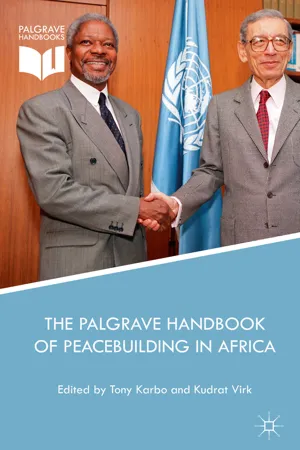
The Palgrave Handbook of Peacebuilding in Africa
- English
- ePUB (mobile friendly)
- Available on iOS & Android
eBook - ePub
The Palgrave Handbook of Peacebuilding in Africa
About this book
Information
© The Author(s) 2018
Tony Karbo and Kudrat Virk (eds.)The Palgrave Handbook of Peacebuilding in Africahttps://doi.org/10.1007/978-3-319-62202-6_11. Introduction: Towards a New Pax Africana
Tony Karbo1
(1)
N’Zarama Centre for Peacebuilding, Abidjan, Côte d’Ivoire
Tony Karbo
[T]he peace of Africa is to be assured by the exertions of Africans themselves. The idea of a “Pax Africana” is the specifically military aspect of the principle of continental jurisdiction.Ali A. Mazrui, Towards a Pax Africana
Peace and stability have been elusive for most of Africa’s post-colonial experience. The problems associated with violence in Africa have a long history, but since the end of the Cold War (1945–1990), the nature and dynamics of conflicts have changed. Most conflicts since the end of the Cold War have been internal, caused primarily by ethnic (identity), economic, political, and demographic reasons (see also Deng in this volume). Meanwhile, the continent’s abundance of large deposits of natural resources has ignited a new search for spheres of influence by former colonial powers, such as Britain and France , and in recent years, emerging powers, like India and China , have also entered the fray. Since 2000, Africa, through its continental and regional organisations, has made significant progress in its efforts to address the problems associated with violent conflict. The African Union (AU) has developed legal and institutional frameworks to guide and promote democratic governance , peace and security, and socio-economic development on the continent. These include: the 2000 Constitutive Act of the AU; the 2002 Protocol Relating to the Establishment of the Peace and Security Council (PSC); and the 2007 African Charter on Democracy, Elections, and Governance . Generally speaking, African states have made notable progress towards greater democratisation, peace, and human security, which merits acknowledgement. This has been reflected in, among other things, the holding of regular elections, the end of several major conflicts (such as in Angola , Liberia , Mozambique , and Sierra Leone ), and the acceleration of economic growth. However, this progress has been slow and fragile,1 with the AU continuing to grapple with challenges in the implementation of its various legal and policy instruments, as well as institutional weaknesses.2
A lethal combination of weak and fledgling states with inherited problems, pervasive poverty, and fragile economies that remain largely dependent on former colonial powers, along with a complex web of inherent contradictions within the African state, have contributed to the plethora of violent conflicts that have plagued the continent since independence (see also Omeje in this volume). From West Africa (Côte d’Ivoire , Guinea , Guinea-Bissau , Liberia , Sierra Leone ); to the Horn of Africa (Djibouti , Eritrea , Ethiopia , Somalia ); to Eastern Africa (Kenya , South Sudan , Uganda ); to the Great Lakes region (Burundi , the Democratic Republic of the Congo [DRC], Rwanda ); to North Africa (Algeria , Egypt , Libya , Tunisia); and to Southern Africa (Angola , Lesotho, Mozambique , Zimbabwe ), the African state has not been able completely to shake off the vestiges of colonialism . The wars since the end of the Cold War have been devastating, leading to the loss of thousands of lives—not including the estimated 800,000 people killed during the 1994 Rwandan genocide3—with many more displaced and rendered refugees outside their countries. For example, about 70,000 people were killed and 2.6 million displaced during the conflict in Sierra Leone from 1991 to 2002,4 while around 250,000 people lost their lives in Liberia’s civil war between 1989 and 2003.5 Thus, while most African countries at independence had expectations of stability, peace, and socio-economic development, what several newly independent states experienced instead were massive outbreaks of violence on a scale and magnitude that had hitherto not been experienced on the continent.
The late Kenyan scholar Ali Mazrui in his seminal work Towards a Pax Africana : A Study of Ideology and Ambition 6 outlines some of the long-term ideological influences, and indeed consequences, of Africa’s imperial experience, but also articulates a concept of “Pax Africana” that lies at the heart of this collection of essays. The ambition of Pax Africana, as Mazrui suggests, is an agenda for peace in Africa, with this peace to be guaranteed by Africans themselves. Pax Africana is not an idea that seeks to force compliance with principles and norms for a peaceful Africa, but rather to guarantee collective security on the continent by having African countries contribute to the creation and sustenance of that peace. In other words, a Pax Africana in Mazrui’s view is one in which Africans secure the peace for the continent themselves—with their own material and financial resources. It is about both who participates (nationality) and where the participation occurs (jurisdiction). As Mazrui argues, armaments for Africans should be procured only for protection against imperial powers, and not against each other. Against the backdrop of the Cold War , Mazrui—writing in 1967—also discusses questions related to disarmament, non-violent resistance, security cooperation, and the role of the United Nations (UN) as an enforcer of international peace and security. The fundamental question raised by Mazrui was: Who is responsible for keeping the peace in Africa after all colonial powers would have withdrawn from the continent? And so it remains.
As Nigerian scholar Adekeye Adebajo has observed: “Ali Mazrui … was one of the earliest analysts to articulate the need for Africans to take on the responsibility of keeping, building and consolidating peace on their own continent.”7 This book seeks to assess progress towards the realisation of this African vision of taking responsibility for the maintenance of peace and security on the continent, as one belonging to all member states of the African Union. More specifically, the volume aims to examine the progress being made in peacemaking, peacekeeping, and peacebuilding by the AU and Africa’s regional economic communities (RECs), including the Economic Community of West African States (ECOWAS), the Southern African Development Community (SADC), the Intergovernmental Authority on Development (IGAD), the Arab Maghreb Union (AMU), the East African Community (EAC), and the Economic Community of Central African States (ECCAS). It also seeks to assist these regional bodies in building peace in countries emerging from conflict. Towards that end, the book explores issues related to the prevention, management, and resolution of conflicts; relations between Africa’s regional organisations and the UN on matters of peace and security; the role of major powers such as the United States (US), France , and Britain ,8 and their contributions to African peacekeeping efforts; and the regional and international dimensions of challenges related to peacebuilding, state-building, and post-conflict reconstruction on the continent. The book further considers the lessons that can be drawn from UN peacekeeping and peacebuilding experiences in Africa, and how these could inform a more effective division of labour between Africa’s fledgling security organisations and the world body.9
The Concept of Pax Africana
Contrary to expectations, the removal of the imperial yoke—as just mentioned—did not usher in an era of peace, stability, and socio-economic development in Africa. The cost in human life, resulting from combat, as well as the suffering and starvation brought on by war, has been striking, with over 10 million Africans having been killed and about as many made refugees since 1960.10 The acquisition of political independence also did not significantly change economic relationships between the European colonial powers (such as Britain and France ) and their former African colonies, which continued to be dependent on the former through partnerships that can best be described as exploitative. Several decades on, many African countries—for example, Burundi , the Central African Republic (CAR), Guinea-Bissau , Liberia , Madagascar , and Malawi 11—continue to have large segments of their populations living below the international poverty line of $1.90 a day.12 Indeed, between 1990 and 2010, Africa excluding North Africa made the least progress in reducing the incidence and intensity of poverty compared to other major regions of the wo...
Table of contents
- Cover
- Front Matter
- Part I. The Theory and Practice of Pax Africana
- Part II. Conflict Prevention and Peacemaking
- Part III. The Practice of Peacekeeping
- Part IV. Themes in Peacekeeping
- Part V. Peacebuilding
- Part VI. The Role of External Actors
- Back Matter
Trusted by 375,005 students
Access to over 1.5 million titles for a fair monthly price.
Study more efficiently using our study tools.
Frequently asked questions
Yes, you can cancel anytime from the Subscription tab in your account settings on the Perlego website. Your subscription will stay active until the end of your current billing period. Learn how to cancel your subscription
No, books cannot be downloaded as external files, such as PDFs, for use outside of Perlego. However, you can download books within the Perlego app for offline reading on mobile or tablet. Learn how to download books offline
We are an online textbook subscription service, where you can get access to an entire online library for less than the price of a single book per month. With over 1.5 million books across 990+ topics, we’ve got you covered! Learn about our mission
Look out for the read-aloud symbol on your next book to see if you can listen to it. The read-aloud tool reads text aloud for you, highlighting the text as it is being read. You can pause it, speed it up and slow it down. Learn more about Read Aloud
Yes! You can use the Perlego app on both iOS and Android devices to read anytime, anywhere — even offline. Perfect for commutes or when you’re on the go.
Please note we cannot support devices running on iOS 13 and Android 7 or earlier. Learn more about using the app
Please note we cannot support devices running on iOS 13 and Android 7 or earlier. Learn more about using the app
Yes, you can access The Palgrave Handbook of Peacebuilding in Africa by Tony Karbo, Kudrat Virk, Tony Karbo,Kudrat Virk in PDF and/or ePUB format, as well as other popular books in Politics & International Relations & African Politics. We have over 1.5 million books available in our catalogue for you to explore.