This book explores the history of wildlife television in post-war Britain. It revolves around the role of David Attenborough, whose career as a broadcaster and natural history filmmaker has shaped British wildlife television. The book discusses aspects of Attenborough's professional biography and also explores elements of the institutional history of the BBC—from the early 1960s, when it was at its most powerful, to the 2000s, when its future is uncertain. It focuses primarily on the wildlife 'making-of' documentary genre, which is used to trace how television progressively became a participant in the production of knowledge about nature. With the inclusion of analysis of television programmes, first-hand accounts, BBC archival material and, most notably, interviews with David Attenborough, this volume follows the development of the professional culture of wildlife broadcasting as it has been portrayed in public. It will be of interest to wildlife television amateurs, historians of British television and students in science communication.
- English
- ePUB (mobile friendly)
- Available on iOS & Android
eBook - ePub
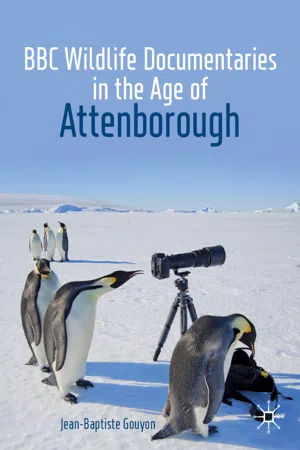
BBC Wildlife Documentaries in the Age of Attenborough
About this book
Information
© The Author(s) 2019
J.-B. GouyonBBC Wildlife Documentaries in the Age of AttenboroughPalgrave Studies in Science and Popular Culturehttps://doi.org/10.1007/978-3-030-19982-1_11. Introduction
Jean-Baptiste Gouyon1
(1)
Department of Science and Technology Studies, University College London, London, UK
‘Pleasure. Only Pleasure.’
Identity Fashioning
Summary of the Argument
The Age of Attenborough
Animals, Television and Natural History
References
David Attenborough is no doubt too modest to mention his own name, but in Britain at any rate it is largely due to his own work for the BBC that the lay public has been guided gently from simple programmes about animals to complex and sometimes quite profound essays on primitive societies and the nature of human co-operation.1
‘Pleasure. Only Pleasure.’2
At its peak, the audience for the 2017 BBC wildlife series Blue Planet 2 reached 14.1 million viewers, making it the year’s most watched television programme in Britain.3 And, commentators claimed, ‘many of the programme’s marvels are new not just to television but to science itself’.4 Given the large number of viewers wildlife television programmes command today, and the claims associated with them, these documentaries are a key part of the apparatus through which our increasingly urbanised societies obtain their knowledge of the natural world.
Wildlife documentaries fulfil a very primordial need: to know about the world we live in and the other life forms sharing it with us. Some of the earliest figurative pictorial representations humans produced some 15,000 years ago were paintings on the walls of such caves as Lascaux in south-western France and Altamira in Cantabria (Northern Spain). They mainly show animals moving, hunting, feeding, and reproducing (Azéma 2006). What were these paintings for? Nobody knows for sure. And although we cannot be certain about what they meant to those who produced them, one thing is beyond doubt: they were part of early humans’ attempts at making sense of the world they inhabited, recording their knowledge of other life forms which, to them, signified life or death. Likewise, wildlife documentaries are meant to help us understand the world we inhabit and find our place in it. But, as such, they deserve to be scrutinised, for, often straddling boundaries—between nature and culture, or human and animal—they unsettle these boundaries only to re-draw them in ways which naturalise specific orders of things. For example, they use the spectacle of anthropomorphised animals, or of humans in the wild, to naturalise social norms (e.g. heteronormativity, the nuclear family as the basic unit of social structure, etc.; Chris 2006; Haraway 1989). This book explores the genealogy of wildlife television in Britain and provides readers with some elements to make sense of how television programmes and documentaries about wildlife have contributed to fashioning how we see ourselves and where we stand in the world over the past five decades. These are essential conversations to have in light of our current environmental predicaments.
Wildlife documentaries are about knowledge. They are premised on ‘an epistemology which itself is grounded in the recording of the particular, physical real by camera and microphone’ (Corner 1996: 3). But although, as any kind of documentary work, they have—or claim to have—evidential value, they also are intrinsically artificial. As David Attenborough noted in an interview in 1984, just after the release of The Living Planet (Chapter 9):
In fact, there is precious little that is natural … in any film. You distort speed if you want to show things like plants growing, or look in detail at the way an animal moves. You distort light levels. You distort distribution, in the sense that you see dozens of different species in a jungle within a few minutes, so that the places seems [sic.] to be teeming with life. You distort size by using close up lenses. And you can equally well distort sound. What the film-maker is trying to do is to convey a particular experience in as vivid a way as he can.5
Wildlife documentaries contain and generate knowledge of nature for their audiences. At the same time, they obey one imperative: the necessity of spectacle (Gouyon 2016).6 The artifice of film-making Attenborough describes in this quote is enrolled in creating a spectacular experience for viewers, one from which they will derive not only knowledge but also a sense of wonder, and ultimately pleasure. For, still in Attenborough’s words: ‘It seems to me that science, fundamentally, is concerned with defining man’s relationship with the natural world—making sense of it. And when it does that, it brings great pleasure.’7 The consumption of such visual spectacle and entertainment as wildlife films is a subjective experience steeped in emotions (Mitman 1999). For this reason, wildlife documentaries are traditionally conceived of as ill-suited to convey objective knowledge and educate their audiences (Shapin and Barnes 1976; Greenhalgh 1989). If wildlife documentary makers are to be able to achieve their aim, which is to be recognised as trustworthy sources of knowledge about nature, they therefore need to deploy strategies that enable them to resolve this tension between knowledge and entertainment—evidence and artifice —which lies at the heart of the wildlife documentary.
Identity Fashioning
A way to look at the history of wildlife television is to follow the strategies wildlife broadcasters have deployed through time fashioning their public identity as reliable sources of knowledge about nature and constructing the film-making apparatus as a legitimate tool to produce knowledge of the world. A key device in this joint process of identity fashioning is the wildlife ‘making-of documentary’ (MOD). MODs are now a staple of every high-profile nature series, each episode ending with a ten-minute segment revealing secrets about the shooting of iconic scenes in that episode. As a subgenre of the wildlife television programme, however, MODs are quite a recent addition to wildlife broadcasters’ repertoire and are not self-evident. When asked why they were made in the first place, David Attenborough provides a two-fold explanation blending epistemological concerns with preoccupations associated with the material aspects of television broadcasting. Wildlife broadcasters began producing MODs, he explains, when they needed audiences to trust them. He also hints at the fact that these ten-minute add-ons at the end of episodes are convenient to introduce some flexibility in the length of programmes. They make it easier for television executives to sell the programmes to countries where the default length of programmes is fifty minutes and not sixty.8 However, some wildlife film-makers do think that those concluding segments are not unproblematic. Peter Jones, for instance, who was the executive producer for the third mammoth Attenborough series, The Trials of Life (1990), whose last episode, Once More into the Termite Mound, is a MOD (Chapter 9), remarked:
now the MOD is a ten-minute segment added to the main programme without even a pause, something that I personally dislike. My understanding is that the controllers and planners find an hour-long programme much more suited to their scheduling. At the time of Trials, the customary length for each programme in the 13-part series was precisely fifty minutes so we are really dealing with changing conventions—but I still do not like the customary current outcomes, as they undermine the momentary emotional and intellectual catharsis when you reach the end of well-constructed films.9
This short incursion into the topic of wildlife MODs brings up three essential facets of wildlife documentaries: (1) they are about knowledge; (2) they are commodities; (3) they are well-crafted storytelling devices.
There is nothing necessary about MODs in the first place, nor about their format: a ten-minute concluding segment or self-contained episode. A question which motivated me to research this book early on was how, when and why did the MOD become a genre in wildlife television? The answer lies in the history of wildlife television in Britain, which is what this volume explores. Although wildlife MODs ended up appearing only episodically in the book, when they do so, they stand as milestones in the slow process of accretion of the public identity of wildlife film-makers. The question of how wildlife film-makers construct their public identity, present themselves and their practice to audiences—what could be called the making-of impulse—is central to the argument. Having had a chance, several years ago, to be a science journalist, I have had a long standing desire to understand how scientific knowledge exists in the public realm and how these public forms of existence in turn contribute to shaping the public culture of science. A claim central to this volume is that looking at the history of wildlife television shows how hard British wildlife broadcasters have worked to make their practice, programme making, a part of the production of knowledge of the natural world. In doing so, they not only presented themselves as knowledge producers but also contributed to shaping our common understanding of what it means to study wild animals in the field, and what scientists’ findings in the field mean to all of us.
Summary of the Argument
Wildlife MODs and other forms of disclosure...
Table of contents
- Cover
- Front Matter
- 1. Introduction
- 2. Live from Alexandra Palace, Wildlife Comes to Television
- 3. David Attenborough: The Early Years—Fashioning Zoological Expertise On-Screen
- 4. Wildlife Television, Empathy and the End of the British Empire
- 5. Wildlife Television and Progressivism in 1960s Britain: Rise of the Professional Broadcaster and Downfall of the Amateur Naturalist Film-Maker
- 6. Showcasing Science, Showcasing Nature on BBC2
- 7. From Oxford to Bristol and Back: The Invention of Scientific Wildlife Television
- 8. Oxford Scientific Films: From Field Craft to Film Craft
- 9. Life on Earth and Beyond: Producing the Wildlife Blockbuster
- 10. Afterword
- Back Matter
Trusted by 375,005 students
Access to over 1.5 million titles for a fair monthly price.
Study more efficiently using our study tools.
Frequently asked questions
Yes, you can cancel anytime from the Subscription tab in your account settings on the Perlego website. Your subscription will stay active until the end of your current billing period. Learn how to cancel your subscription
No, books cannot be downloaded as external files, such as PDFs, for use outside of Perlego. However, you can download books within the Perlego app for offline reading on mobile or tablet. Learn how to download books offline
Perlego offers two plans: Essential and Complete
- Essential is ideal for learners and professionals who enjoy exploring a wide range of subjects. Access the Essential Library with 800,000+ trusted titles and best-sellers across business, personal growth, and the humanities. Includes unlimited reading time and Standard Read Aloud voice.
- Complete: Perfect for advanced learners and researchers needing full, unrestricted access. Unlock 1.5M+ books across hundreds of subjects, including academic and specialized titles. The Complete Plan also includes advanced features like Premium Read Aloud and Research Assistant.
We are an online textbook subscription service, where you can get access to an entire online library for less than the price of a single book per month. With over 1.5 million books across 990+ topics, we’ve got you covered! Learn about our mission
Look out for the read-aloud symbol on your next book to see if you can listen to it. The read-aloud tool reads text aloud for you, highlighting the text as it is being read. You can pause it, speed it up and slow it down. Learn more about Read Aloud
Yes! You can use the Perlego app on both iOS and Android devices to read anytime, anywhere — even offline. Perfect for commutes or when you’re on the go.
Please note we cannot support devices running on iOS 13 and Android 7 or earlier. Learn more about using the app
Please note we cannot support devices running on iOS 13 and Android 7 or earlier. Learn more about using the app
Yes, you can access BBC Wildlife Documentaries in the Age of Attenborough by Jean-Baptiste Gouyon in PDF and/or ePUB format, as well as other popular books in Social Sciences & Film & Video. We have over 1.5 million books available in our catalogue for you to explore.