Michael HuemerParadox Losthttps://doi.org/10.1007/978-3-319-90490-0_1
Begin Abstract
1. Introduction
Michael Huemer1
(1)
Philosophy Department, University of Colorado Boulder, Boulder, CO, USA
Michael Huemer
End Abstract
1.1 What Is a Paradox?
First, some words about what a paradoxisn’t. Some people understand the word “paradox” to refer to a case in which reality is contradictory, that is, a situation that you would correctly describe by contradicting yourself. I do not use the word this way, because I find it inconvenient. If we use “paradox” to denote a situation containing a true contradiction, then we will have to say that, by definition, there are no paradoxes, since contradictions are necessarily false – thus apparently depriving this book of its subject matter. I should then have to say that this is a book about “apparent paradoxes”, that the next chapter is about “the Liar Pseudo-paradox”, and so on. This would be tedious. So I won’t understand “paradox” that way.
Some people use “paradox” simply to refer to a contradictory statement, or apparently contradictory statement, such as “Nobody goes to that restaurant anymore because it is too crowded.” That also is not what I mean by “paradox”. Such statements are either false, or simply have an alternate meaning that is different from the most superficial interpretation (as in the statement, “I am nobody”, which really just means “I am unimportant”). In either case, there is no real puzzle.
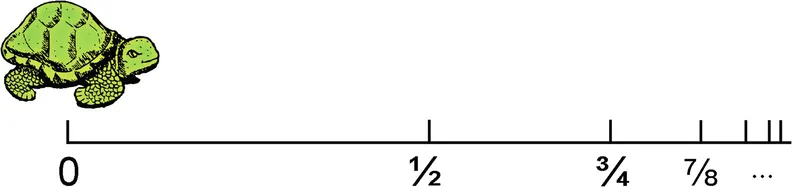
I understand a paradox, roughly, as a situation in which we have seemingly compelling reasoning for a contradictory or otherwise absurd conclusion.1 We feel that we cannot accept the conclusion, but nor can we readily identify a flaw in the reasoning. For example, consider Zeno’s famous paradox of motion (figure 1.1):
Fig. 1.1
Zeno’s paradox
In order for an object to move from point A to point B, the object must first travel half the distance. Then it will have to travel half the remaining distance. Then half the remaining distance again. And so on. This is an infiniteseries. An infiniteseries has no end; hence, it is impossible to complete an infinite series. Therefore, it is impossible for the object to reach point B. Thus, no object can move anywhere.
The conclusion is absurd, so the reasoning must be wrong. Nevertheless, the reasoning has a certain obvious, intuitive force, and it is difficult to say exactly what is wrong with it.
To count as “paradoxical”, the reasoning for the absurd conclusion must have widespread appeal – that is, the reasoning must be of a sort that would seem compelling to typical human reasoners; an idiosyncratic error that I personally can’t seem to shake does not qualify. Thus, if I make a calculation error in multiplying a string of numbers, which results in my deriving a logically impossible conclusion, this will not count as a paradox – not even if I personally cannot find the error after many tries.
To count as “paradoxical”, a piece of erroneous reasoning must also have a certain sort of robustness: paradoxes bear extended contemplation and discussion. Paradoxes can have solutions and attempted solutions, but the correctness of a given solution will be a matter of debate, at least for some time, even among the experts. A paradox is not merely a problem whose solution, though known to experts, is unknown to most non-experts.
Thus, for example, I do not consider the Monty Hall Problem to be a paradox. The Monty Hall Problem goes like this:
You are a contestant on the game show Let’s Make a Deal, with host Monty Hall. You know how the game works: at a certain point in the game, Monty shows the contestant three closed doors. One of the doors has a nice prize behind it (say, a new car); the other two have goats behind them (assume that no one wants a goat). The contestant is allowed to choose one of the doors, and will be allowed to have whatever is behind it. After the contestant chooses, but before he reveals what is behind the chosen door, Monty opens one of the other two doors and shows the contestant a goat.2 He never opens the door with the car behind it; he always shows the contestant a goat.3 Monty then asks if the contestant would like to change their choice, that is, to switch to the other closed door. Thus, suppose you initially choose door #1. Monty then opens, say, door #3 and shows you a goat behind it. He then asks if you would like to change your choice from door #1 to door #2. Should you switch?
Most people have a strong intuition that it doesn’t matter whether you switch to door #2 or stick with door #1; that’s because most people think that the prize is now 50% likely to be behind door #1 and 50% likely to be behind door #2. The correct answer, however, is that you should definitely switch to door #2: door #1 has a 1/3 probability of having the real prize behind it, and door #2 now (after you saw the goat behind door #3) has a 2/3 probability of having the real prize.
It can be difficult to convince people of this. In fact, almost everyone, on first hearing the problem, gives the wrong answer, and persists in that answer until bludgeoned for a while with probability calculations or experiments.4 In this case, there are compelling arguments (discussed below and in fn. 3) for a highly counter-intuitive answer. Nevertheless, I do not consider this a paradox. One reason is that this problem is not robust enough to bear debate among experts. The Monty Hall Problem has a well-known, objectively correct solution that can be shown to be so in a fairly brief span of time; it does not, for example, bear years of reflection.
Why does the prize have a 2/3 probability of being behind door B? This is beside my present point (which, remember, was just to define “paradox”); however, in case you can’t sleep until you know, an explanation follows. (You can also do a calculation employing Bayes’ Theorem, but the following is probably going to be more satisfying.)
Suppose Monty runs the game 300 times. Each time, the location of the good prize is randomly selected from among the three doors. We would expect that in about 100 of these games, the contestant’s initial guess is correct, that is, the first door they pick has the prize behind it. The other 200 times, the initial guess is wrong. Therefore, if the contestants always stick with their initial guess, then 100 of the 300 will win the real prize, and 200 will receive goats. (The 200 who initially selected a goat door can’t possibly improve their result by sticking with that choice!)
Now, on the other hand, suppose that the contestants always switch doors. Then the 100 contestants who initially picked the correct door will lose, as they give up that door. But the other 200, the ones who initially picked wrong, will all switch doors. And they will all switch to the correct door, since the correct door will be the only remaining door, after rejecting the door they initially picked and the goat door that Monty just opened.
So the “switch doors” strategy wins 2/3 of the time, whereas the “stick with your door” strategy wins only 1/3 of the time.
Now, back to our main point: a paradox is a piece of reasoning, or a situation about which such reasoning is constructed, that has widespread and robust appeal, but that leads to a contradictory or absurd conclusion, where even experts have difficulty identifying the error in the reasoning. This account of paradoxicality makes it species-relative: perhaps a superintelligent alien species would find our “paradoxes” so easy to see through that the aliens would not consider these puzzles paradoxical at all. Nevertheless, for humans at the present time, there are many paradoxical situations and pieces of reasoning.
1.2 What Is a Solution?
Paradoxes trade on intellectual illusions: cases in which something that is actually wrong seems correct when considered intellectually. It is characteristic of illusions that what seems to be the case is not necessarily what we believe – often, in fact, we know that things cannot be as they appear, yet this does not stop them from appearing that way. We know, for instance, that the reasoning in Zeno’s Paradox is wrong, since we know that objects move. But this does not stop the reasoning from exerting its intellectual pull: each step in the reasoning still seems correct and the steps seemingly lead to the conclusion that nothing moves.
Intellectual illusions, however, are at least somewhat more tractable than sensory illusions. Sensory illusions (for example, the illusion whereby a straight stick appears bent when half-submerged in water) virtually never respond to reflection or additional evidence-gathering. No matter how much you understand about the actual situation, the half-submerged stick still looks bent. Intellectual illusions are not that way. Admittedly, as noted, they do not respond immediately to the knowledge that the conclusion of a piece of reasoning is wrong – the mere fact that we know that objects move does not dispel the force of Zeno’s reasoning. But usually, there is some degree of understanding, of the right points, that dispels the illusion. It is often possible for someone to identify the particular point at which the fallacious reasoning goes wrong, and to explain wh...
Table of contents
Cover
Front Matter
1. Introduction
Part I. Semantic Paradoxes
Part II. Paradoxes of Rational Choice
Part III. Paradoxes of Probability
Back Matter
Trusted by 375,005 students
Access to over 1.5 million titles for a fair monthly price.
Study more efficiently using our study tools.
Frequently asked questions
Yes, you can cancel anytime from the Subscription tab in your account settings on the Perlego website. Your subscription will stay active until the end of your current billing period. Learn how to cancel your subscription
No, books cannot be downloaded as external files, such as PDFs, for use outside of Perlego. However, you can download books within the Perlego app for offline reading on mobile or tablet. Learn how to download books offline
Perlego offers two plans: Essential and Complete
Essential is ideal for learners and professionals who enjoy exploring a wide range of subjects. Access the Essential Library with 800,000+ trusted titles and best-sellers across business, personal growth, and the humanities. Includes unlimited reading time and Standard Read Aloud voice.
Complete: Perfect for advanced learners and researchers needing full, unrestricted access. Unlock 1.5M+ books across hundreds of subjects, including academic and specialized titles. The Complete Plan also includes advanced features like Premium Read Aloud and Research Assistant.
Both plans are available with monthly, semester, or annual billing cycles.
We are an online textbook subscription service, where you can get access to an entire online library for less than the price of a single book per month. With over 1.5 million books across 990+ topics, we’ve got you covered! Learn about our mission
Look out for the read-aloud symbol on your next book to see if you can listen to it. The read-aloud tool reads text aloud for you, highlighting the text as it is being read. You can pause it, speed it up and slow it down. Learn more about Read Aloud
Yes! You can use the Perlego app on both iOS and Android devices to read anytime, anywhere — even offline. Perfect for commutes or when you’re on the go. Please note we cannot support devices running on iOS 13 and Android 7 or earlier. Learn more about using the app
Yes, you can access Paradox Lost by Michael Huemer in PDF and/or ePUB format, as well as other popular books in Philosophy & Analytic Philosophy. We have over 1.5 million books available in our catalogue for you to explore.