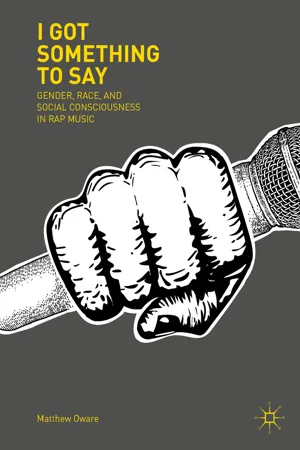
What do millennial rappers in the United States say in their music? This timely and compelling book answers this question by decoding the lyrics of over 700 songs from contemporary rap artists. Using innovative research techniques, Matthew Oware reveals how emcees perpetuate and challenge gendered and racialized constructions of masculinity, femininity, and sexuality. Male and female artists litter their rhymes with misogynistic and violent imagery. However, men also express a full range of emotions, from arrogance to vulnerability, conveying a more complex manhood than previously acknowledged. Women emphatically state their desires while embracing a more feminist approach. Even LGBTQ artists stake their claim and express their sexuality without fear. Finally, in the age of Black Lives Matter and the presidency of Donald J. Trump, emcees forcefully politicize their music. Although complicated and contradictory in many ways, rap remains a powerful medium for social commentary.
- English
- ePUB (mobile friendly)
- Available on iOS & Android
eBook - ePub
About this book
Information
© The Author(s) 2018
Matthew OwareI Got Something to Sayhttps://doi.org/10.1007/978-3-319-90454-2_11. Introduction: Started from the Bottom…
Matthew Oware1
(1)
Sociology, DePauw University, Greencastle, IN, USA
“Fuck Donald Trump ” pulsates throughout the chorus of the song, encouraging the listener to lip-sync and head nod. This emphatically anti-Trump refrain comes from the rapper YG’s (featuring Nipsey Hussle) song entitled “FDT”; that is, Fuck Donald Trump . The song hit the charts the April preceding the November 2016 presidential election in the United States. After the track went viral, white rap artists Macklemore and G-Eazy added verses to a remix released that August. In the song, the rappers criticize Donald Trump ’s controversial statements regarding American foreign policy. During his run for the White House, President Trump argued that weak immigration laws allow Mexican “rapists” and “criminals” free entry into the U.S. 1 Trump based his candidacy on erecting a “wall” between the two countries, which he claimed Mexico would pay for in full—a position that was viewed as racist and xenophobic by some in the rap world. Rapper Nipsey Hussle vehemently asserts in “FDT” that “[i]t wouldn’t be the U.S.A. without Mexicans,” rebuking Trump’s only somewhat coded appeal to a strictly Anglo-American conception of the United States. In response to Trump’s denigrating characterization of Mexicans, the artist calls for black and Hispanic unity, rapping “black love, brown pride in the sets again”—lyrics that stand in stark contrast to Trump’s divisive rhetoric.
The artists also challenge the forced removal of black teenagers from a 2016 rally for Donald Trump in Georgia. Using sound bites from an interview in the song’s introduction, a teen explains: “I think we got kicked out [of the rally] because we’re a group of black people…and like they’re afraid we’re gonna say something or do something.” In response to this expulsion, YG exclaims in “FDT” that “…your racist ass did too much” by removing the rally attendees. He goes on to condemn Trump, questioning the Republican candidate’s fitness for the office. In rap convention, this song reads as politically-oriented, drawing attention to language perceived as discriminatory and jingoistic from then-candidate Donald Trump . However, YG characterizes himself as “non-political.” 2 Indeed, scores of seemingly “non-political” rap artists referenced Donald Trump and Hillary Clinton in the 2016 presidential election. According to an analysis performed by CNN, there were a total of 83 songs by 70 different rappers in 2015 that mention Donald Trump by name with the vast majority denouncing him for his “hateful” comments (I discuss rappers’ responses to Trump in the last chapter). In contrast, there were 18 songs from 17 different artists in 2015 and early 2016 that referenced Hillary Clinton . 3
Anti-Trump discourse pervaded the rap world, significantly eclipsing pro-Clinton lyrics. Clinton received endorsements from artists such as Jay-Z , Young Jeezy , Snoop Dogg , and Chance the Rapper , 4 but she also attracted critics. Rap mogul Sean “Diddy” Combs encouraged blacks to “hold” their vote until she appropriately addressed matters pertinent to those in the black community. 5 Her most strident detractor was Killer Mike , an Atlanta-based rapper from the music group Run the Jewels, who supported Bernie Sanders during the Democratic primaries. While publically endorsing Sanders during a rally at Morehouse College in February 2016, Killer Mike shared a remark by white activist Jane Elliot. According to Mike, Elliot told him: “Michael [aka Killer Mike ], a uterus doesn’t qualify you to be president of the United States…you have to have a policy that is reflective of social justice.” 6 For both, Clinton’s sex was not enough to support her; in their estimation, she failed to espouse social policies that helped people of color. In fact, she received criticism from and was reprimanded by members of the (BLM) movement for referring to blacks as “superpredators” —presumably a racially loaded term—during the 1990s. 7 Although not as irreverent as YG , Killer Mike made his voice heard. He felt like he had something to say.
“Fuck tha Police,” a social commentary on policing, was an instant classic released in 1988 from the California rap group Niggaz Wit Attitudes (NWA). In it, group members Ice Cube, MC Ren, and Dr. Dre narrate a faux trial where they play the protagonists, recounting their negative interactions with police officers. During their testimony, they chronicle their experiences with racial profiling and police brutality . Indeed, a powerful scene from the 2015 movie Straight Outta Compton (a semiautobiographical account of the rise of NWA) perfectly captures their encounters with California police officers and the anguish they express in their music. In the scene, police officers approach the artists in front of their recording studio and tell them to drop to the ground and place their hands behind their backs. When the rappers question these actions, the cops threaten them with arrest. In a verse from “Fuck tha Police” that addresses the harassment and brutality from the police —just before the reverberating and concussive chorus—Ice Cube adamantly proclaims, “Yo Dre, I Got Something to Say.”
Rap artists have been expressing their thoughts since the art form began in the 1970s, not only on matters like the presidency and police brutality, but on a broad range of topics including interpersonal relationships, sexuality, poverty, wealth, partying, and dance, among other themes. In her seminal monograph, Black Noise, Tricia Rose writes that rap music “…is the central cultural vehicle for open social reflection on poverty, fear of adulthood, the desire for absent fathers, frustrations about male sexism, female sexual desires, daily rituals of life as an unemployed teen hustler, safe sex, anger, violence , and childhood memories.” 8 She continues that the music simultaneously offers “…innovative uses of style and language…and ribald storytelling.” 9 Albeit often saturated with misogynistic, sexist, hyperviolent, homophobic, and hypermasculine themes, rap artists quite often articulate subversive, creative, political and sometimes contradictory messages, in their music. Moreover, record companies and market forces may dictate, temper, or mute what artists express in their songs. This book explores these dynamics in contemporary rap music for millennial emcees.
Although quite insightful, many of the past reflections on rap music rely on impressionistic claims, whether through personal narratives and observations or uncritical speculation. Such an approach can be useful and necessary, but may also be short-sighted. 10 More of the compelling and ground-breaking work on hip hop and rap comes from ethnographies; for example, Anthony Harrison ’s Hip Hop Underground, Jooyoung Lee ’s Blowin’ Up, Marcyliena Morgan ’s The Real HipHop, and Geoff Harkness ’ Chicago Hustle and Flow. 11 These monographs offer critical insights into the everyday lives of rap artists while also contributing to our understanding of race, gender, and class dynamics. Yet, these works focus on select populations of individuals on the West Coast and the Midwest. Also, they explore the hip-hop scene in the late 1990s or early 2000s. Drawing on a larger sample of current artists and their lyrics offers the possibility for a broader, more detailed and fine-grained examination of rap music that is far-reaching and more timely in its analysis. Future studies must critically analyze bigger samples of rap music from the millennial generation rigorously and systematically. This book fills this gap while complementing previous research on hip hop culture.
Using an empirically-driven approach to examining rap music from 2005 to 2015, I note the continuities from its birth, but also reveal important and progressive differences. The genre remains male-dominated but moves beyond the hegemonic tropes of misogyny and violence , and to varying degrees addresses male vulnerability, female empowerment, same-sex desire, white privilege , and black liberation. Most noteworthy are artists’ who challenge the current occupant of the White House through their politicized songs. As a result, this book highlights the presence of social commentary—anchored in the deconstruction of masculinity, femininity, sexuality, and black activism—in rap over the last ten years and provides a signpost for the next generation of artists.
Applying an interdisciplinary approach that uses sociological research methods, I first focus on the larger social forces surrounding rap’s birth. Before delving into a systematic lyrical analysis in the following chapters, I historicize and contextualize what artists say in their music by examining the volatile sites of their experiences—large, segregated urban cities. At the very moment when hip hop and rap emerged, these locations experienced drastic changes due to shifts in the economy, as well as investments in suburban growth at the expense of urban de...
Table of contents
- Cover
- Front Matter
- 1. Introduction: Started from the Bottom…
- 2. Urban Spaces and Bodies
- 3. The Hybrid Rapper
- 4. Bad Bitches?
- 5. Coming Straight from the Underground
- 6. The Queer Emcee
- 7. Black Lives Matter and Political Rap
- 8. Conclusion: Future Intersections of Rap and Politics
- Back Matter
Trusted by 375,005 students
Access to over 1.5 million titles for a fair monthly price.
Study more efficiently using our study tools.
Frequently asked questions
Yes, you can cancel anytime from the Subscription tab in your account settings on the Perlego website. Your subscription will stay active until the end of your current billing period. Learn how to cancel your subscription
No, books cannot be downloaded as external files, such as PDFs, for use outside of Perlego. However, you can download books within the Perlego app for offline reading on mobile or tablet. Learn how to download books offline
Perlego offers two plans: Essential and Complete
- Essential is ideal for learners and professionals who enjoy exploring a wide range of subjects. Access the Essential Library with 800,000+ trusted titles and best-sellers across business, personal growth, and the humanities. Includes unlimited reading time and Standard Read Aloud voice.
- Complete: Perfect for advanced learners and researchers needing full, unrestricted access. Unlock 1.5M+ books across hundreds of subjects, including academic and specialized titles. The Complete Plan also includes advanced features like Premium Read Aloud and Research Assistant.
We are an online textbook subscription service, where you can get access to an entire online library for less than the price of a single book per month. With over 1.5 million books across 990+ topics, we’ve got you covered! Learn about our mission
Look out for the read-aloud symbol on your next book to see if you can listen to it. The read-aloud tool reads text aloud for you, highlighting the text as it is being read. You can pause it, speed it up and slow it down. Learn more about Read Aloud
Yes! You can use the Perlego app on both iOS and Android devices to read anytime, anywhere — even offline. Perfect for commutes or when you’re on the go.
Please note we cannot support devices running on iOS 13 and Android 7 or earlier. Learn more about using the app
Please note we cannot support devices running on iOS 13 and Android 7 or earlier. Learn more about using the app
Yes, you can access I Got Something to Say by Matthew Oware in PDF and/or ePUB format, as well as other popular books in Social Sciences & Music. We have over 1.5 million books available in our catalogue for you to explore.