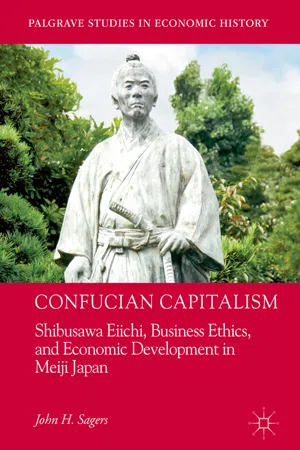
With the life story of Shibusawa Eiichi (1840–1931), one of the most important financiers and industrialists in modern Japanese history, as its narrative focal point, this book explores the challenges of importing modern business enterprises to Japan, where the pursuit of profit was considered beneath the dignity of the samurai elite. Seeking to overturn the Tokugawa samurai-dominated political economy after the Meiji Restoration, Shibusawa was a pioneer in introducing joint-stock corporations to Japan as institutions of economic development. As the entrepreneurial head of Tokyo's Dai-Ichi Bank, he helped launch modern enterprises in such diverse industries as banking, shipping, textiles, paper, beer, and railroads. Believing businesses should be both successful and serve the national interest, Shibusawa regularly cautioned against the pursuit of profit alone. He insisted instead on the 'unity of morality and economy' following business ethics derived from the ConfucianAnalects. A top leader in Japan's business community for decades, Shibusawa contributed to founding the Tokyo Stock Exchange, the Tokyo Chamber of Commerce, and numerous educational and philanthropic organizations to promote his vision of Confucian capitalism.
This volume marks an important contribution to the international debate on the extent to which capitalist enterprises have a responsibility to serve and benefit the societies in which they do business. Shibusawa's story demonstrates that business, government, trade associations, and educational institutions all have valuable roles to play in establishing a political economy that is both productive and humane.
John H. SagersConfucian CapitalismPalgrave Studies in Economic Historyhttps://doi.org/10.1007/978-3-319-76372-9_1
Begin Abstract
1. Introduction: Shibusawa Eiichi and the Idea of Confucian Capitalism
John H. Sagers1
(1)
Linfield College, McMinnville, OR, USA
John H. Sagers
End Abstract
With the life story of Japan’s most prominent business leader as a narrative focal point, this book explores the challenges of importing, from Europe and America, modern business enterprises to Japan, where the pursuit of profit was considered beneath the dignity of samurai gentlemen. Financier Shibusawa Eiichi (1840–1931) worked strenuously to enhance the prestige of commerce and industry by establishing many joint-stock companies and contributing to educational and philanthropic organizations. He also gave countless speeches emphasizing that business careers, which promoted the welfare of the nation, were indeed consistent with older Confucian values of loyalty and public service. Throughout his career, Shibusawa promoted a vision of capitalism where shareholders and managers were legitimate in their pursuit of private profit in the marketplace only to the extent that their enterprises benefited the nation.
Living ninety-one years, Shibusawa was first an activist against the Tokugawa shogun’s government. When the futility of attacking foreign settlements and the shogun’s forces became apparent, Shibusawa switched sides and became an official hoping to reform the government from within. He then became an adviser to the shogun’s brother on his journey to Europe for the 1867 Paris International Exposition. In Europe, Shibusawa became convinced of the importance of entrepreneurship and the ability to pool capital through joint-stock companies in stimulating a nation’s economic development. With this in mind, Shibusawa returned to Japan on a personal mission to elevate the formerly low status of merchants in Japanese society and encourage talented young people to consider careers in business. Serving in the new Meiji government’s Ministry of Finance, Shibusawa worked on land tax reform and presented a proposal for organizing joint-stock companies. Leaving government, he became the head of the First National or Dai-Ichi Bank, a post he held until the early twentieth century. Active in the TokyoChamber of Commerce and a number of philanthropic institutions, he helped establish the public-minded civilian business leader as a new archetype in Japanese society. An analysis of his life and work highlights many of the challenges and conflicting objectives that business and government leaders faced in importing capitalist institutions to Japan.
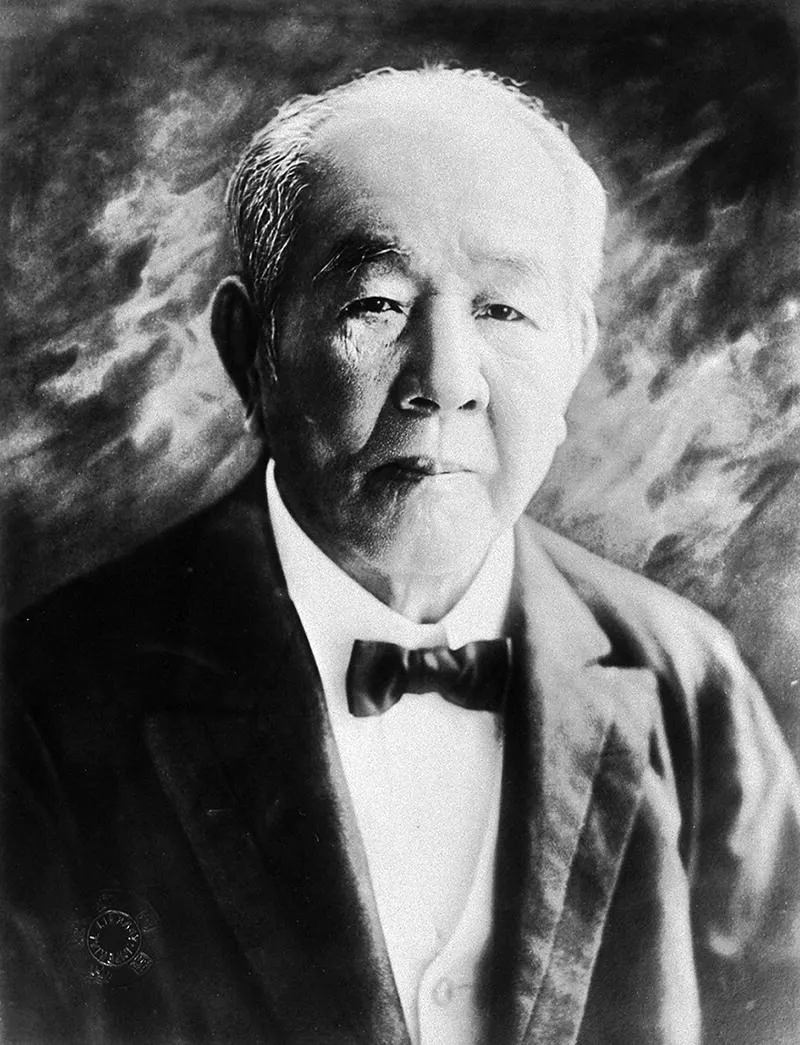
Shibusawa has long been held up as a model of both highly successful entrepreneurship and ethical business management. As a capitalist organizer credited with helping to establish nearly 500 new enterprises, he has few rivals in Japanese business history. He was particularly adept in assembling teams of talented managers and lining up investors to found corporations that he believed necessary to Japan’s developing economy. He was also relentless in arguing that his businesses must profit not only shareholders but also the nation as a whole. Citing the Analects of Confucius as his moral guide, Shibusawa maintained a reputation for ethical leadership that inspired trust and encouraged investment in his enterprises. Although Shibusawa would argue that one should behave ethically no matter what the consequences in the marketplace, it is clear that his promotion of what he called the “unity of morality and economy” did not hurt his business success (Fig. 1.1).
Fig. 1.1
Shibusawa Eiichi
The relationship between ethics and business has been long debated and the legitimacy of the profit motive has been questioned in many religious and philosophical traditions. With corporate scandals and cases of political influence-peddling perennial features in the daily news, people worldwide are demanding that business and government leaders be held more accountable and that ethical education be strengthened to give the next generation of leaders a greater sense of their duty and responsibility to the public. Yet, few can agree on what exactly constitutes a business’s “corporate social responsibility” or CSR. Some argue that a firm’s main responsibility is to use resources efficiently to earn profits for shareholders while operating within legally defined limits. Others suggest that businesses have a responsibility to go beyond simple legal compliance, and should contribute resources and be proactive in improving working conditions for employees, reducing the impact of business activities on the natural environment, and considering the wider social implications of business decisions.
The project, therefore, is not only of importance to the scholarly field of Japanese history. It also seeks to contribute to today’s international debate on the extent to which capitalist enterprises have a responsibility to serve and benefit the societies in which they do business. The book argues that attention to ethical issues in the education and training of future business leaders is essential in establishing appropriate limits on the pursuit of profit, but recognizes that education and moral suasion require additional support. Self-regulating business associations and government institutions are also necessary to establish and enforce rules, which further encourage business leaders to make decisions consistent with the public interest. Shibusawa’s story demonstrates that business, government, trade associations, and educational institutions all have valuable roles to play in establishing a political economy that is both productive and humane.
Global Concern for Business Ethics and Corporate Social Responsibility
Capitalism has had a turbulent history and following the worldwide financial crisis of 2008, there have been renewed calls for greater attention to business ethics and CSR. Put simply, movements for business ethics and CSR argue that business should have some priorities other than maximizing short-term profits for shareholders. These priorities may include providing services to improve the surrounding communities, investing in technologies that reduce resource use or pollution or contributing to social welfare organizations. They may also include adhering to ethical norms of an industry that go beyond compliance with legal requirements. Arguments in favor of business ethics and social responsibility usually fall into two categories.
Most commonly, proponents of CSR argue that ethical behavior is good for business and contributes to the long-term sustainability and viability of an enterprise by generating goodwill among various stakeholders. For example, Carly Fiorina, CEO of Hewlett-Packard said, in November 2003,
I honestly believe that the winning companies of this century will be those who prove with their actions that they can be profitable and increase social value – companies that both do well and do good…Increasingly, shareowners, customers, partners, and employees are going to vote with their feet – rewarding those companies that fuel social change through business. This is simply the new reality of business – one that we should and must embrace. (Kotler and Lee 2005, 6–7)
This perspective is relatively easy to deploy in an organization because initial costs of more ethical or sustainable practices can be justified in terms of future benefits.
Another line of argument calls for ethical behavior because it is simply the right thing to do, based on religious and moral beliefs. Even if there is no future benefit to the organization’s bottom line, ethical and sustainable practices should still be followed because they are good in their own right. Religious organizations generally advocate ethical principles based on a deity’s moral law as revealed in sacred texts. This moral law encourages justice in economic activity and prohibits deceit and exploitation of weaker parties. Property in many religious traditions is considered a gift from God and human beings are required to act as good stewards of the goods with which they have been entrusted.
Secular arguments can also be made in terms of serving the general needs of society. Stanley Bergmann, CEO of Henry Schein Inc., argues,
Our task, in concert with government, academia, NGOs and civic society, is to work together to underpin the capitalist model with a strong ethical base. We must infuse the public dialogue with the understanding that self-interest and the interest of society are integrally intertwined. It is as simple as this: The success of businesses depends on a healthy, thriving society. (Bergman 2014)
In this formulation, there are benefits to the firm for ethical behavior, but there are more indirect benefits that come from upholding ethical principles and sustaining the community and environment in which one does business.
Whether justified in terms of long-run sustainability or religious and moral principles, following ethical business practices can be difficult in competitive markets. Business ethics, therefore, runs into the serious problem of how to encourage practices that may benefit employees, the environment, and wider society when the marketplace rewards producing goods and services at minimum cost. Managers in competitive environments sometimes have extreme incentives to cut costs and even falsify reports to maximize profits for shareholders. How to overcome the pressure for short-run profits and motivate managers to work for not only the good of their firms and their own careers but also the benefit of wider society is the principal challenge for leaders who would like to develop a more ethical form of capitalism.
Although Japanese corporations have long had their own set of management principles, Western-style CSR is a relatively new topic of debate. With globalization, there has been a backlash against the costs to natural environments and human societies. Faced with political opposition and threats of increased regulation, many multi-national companies have worked on reforming their business practices to be a more beneficial presence in the communities where they do business. Since 2003, Japanese companies have been developing CSR initiatives and seeking to comply with international norms on environmental impact and socially responsible investments. David Vogel has outlined several approaches that Japanese firms can use to manage their CSR programs. First, there are firms that see CSR as a defensive mechanism of insuring against risks to the company’s reputation by addressing issues for which similar firms have been criticized in the past. Furthermore, firms have examined their environmental impact and have made changes in suppliers and production processes accordingly. Finally, firms can also look for ways to contribute to solving basic problems in the societies in which they operate. Vogel concludes that there are positive benefits for CSR programs in enhanced reputation, happier employees, and customer loyalty. However, he also notes that companies actively pursuing CSR do not perform dramatically better in the marketplace than companies that do not have CSR agendas. The modest effect of CSR on business results can be a limiting factor and initiatives that are most likely to succeed are those that have both moral and economic rationales (Vogel 2014). Faced with competitive pressure, firms cannot afford to invest much in CSR initiatives if there is not also an economic benefit. Shibusawa long ago believed that moral considerations were top priority, but he also recognized that business leaders were not religious ascetics and that new enterprises needed to become economically viable to survive.
With the growth of interest in CSR as a way of negotiating between the sometimes-competing demands between profit maximization and wider ethical concerns, scholars in Japan and abroad have taken a renewed interest in Shibusawa Eiichi’s life and thought as a historical example of combining moral leadership and successful economic entrepreneurship. In the initial stages of Japan’s economic development in the late-nineteenth century, before there were adequate institutions to enforce contracts and property rights, business leaders like Shibusawa formed networks of managers, sponsors in government, technicians, and investors to reduce the risk and costs associated with economic transactions. In economies with more mature institutional enforcement, these personal ties have become less essential, as contracts facilitate transactions between parties who do not know each other. Nevertheless, a reputation for ethical behavior remains important as companies face increased regulation and public backlash whenever fraud or mismanagement is exposed. Shibusawa’s career is of interest as a historical example of pioneering efforts in establishing a reputation for ethical leadership.
Virtue Versus Compliance in the East Asian Tradition
Shibusawa Eiichi regularly c...
Table of contents
Cover
Front Matter
1. Introduction: Shibusawa Eiichi and the Idea of Confucian Capitalism
2. Economic Change and Intellectual Innovation in Tokugawa Japan
3. Government Bureaucrats and Capitalist Institutions in 1870s Japan
4. The Ethical Entrepreneur as a Servant of Japan’s National Interest
5. Competing Priorities of Infrastructure Investment and Military Expansion in Late Meiji Japan
6. Business Leaders as Civilian Diplomats in Early Twentieth-Century Japan
7. Confucian Capitalism and the Search for Economic Prosperity and Social Harmony in Early Twentieth-Century Japan
8. Purposeful Preservation of Shibusawa Eiichi’s Legacy
Back Matter
Trusted by 375,005 students
Access to over 1.5 million titles for a fair monthly price.
Study more efficiently using our study tools.
Frequently asked questions
Yes, you can cancel anytime from the Subscription tab in your account settings on the Perlego website. Your subscription will stay active until the end of your current billing period. Learn how to cancel your subscription
No, books cannot be downloaded as external files, such as PDFs, for use outside of Perlego. However, you can download books within the Perlego app for offline reading on mobile or tablet. Learn how to download books offline
Perlego offers two plans: Essential and Complete
Essential is ideal for learners and professionals who enjoy exploring a wide range of subjects. Access the Essential Library with 800,000+ trusted titles and best-sellers across business, personal growth, and the humanities. Includes unlimited reading time and Standard Read Aloud voice.
Complete: Perfect for advanced learners and researchers needing full, unrestricted access. Unlock 1.5M+ books across hundreds of subjects, including academic and specialized titles. The Complete Plan also includes advanced features like Premium Read Aloud and Research Assistant.
Both plans are available with monthly, semester, or annual billing cycles.
We are an online textbook subscription service, where you can get access to an entire online library for less than the price of a single book per month. With over 1.5 million books across 990+ topics, we’ve got you covered! Learn about our mission
Look out for the read-aloud symbol on your next book to see if you can listen to it. The read-aloud tool reads text aloud for you, highlighting the text as it is being read. You can pause it, speed it up and slow it down. Learn more about Read Aloud
Yes! You can use the Perlego app on both iOS and Android devices to read anytime, anywhere — even offline. Perfect for commutes or when you’re on the go. Please note we cannot support devices running on iOS 13 and Android 7 or earlier. Learn more about using the app
Yes, you can access Confucian Capitalism by John H. Sagers in PDF and/or ePUB format, as well as other popular books in Economics & Business Ethics. We have over 1.5 million books available in our catalogue for you to explore.