Adam Smith was a missionary. He wanted to use economic growth to improve the living standards of the ‘servants, labourers and workmen’ who make up the ‘far greater part of every great political society’: ‘What improves the circumstances of the greater part can never be regarded as an inconveniency to the whole’ (Smith 1961 [1776]: I, 88). Alfred Marshall was a missionary. He looked to industry and science to empower all classes not only to purchase ‘more food and clothes, more and better supplies of water, artificial light and heat’ but to share to the full in ‘an increase of intelligence and energy and self-respect’ that had never been equalled before the white heat of steel: ‘The consumption of tea is increasing very fast, while that of alcohol is stationary’ (Marshall 1949 [1890]: 75n, 450, 574). Both Smith and Marshall had contemplated a career in the church. Both had decided in the end that they would contribute more to material and moral betterment if they went into economics instead.
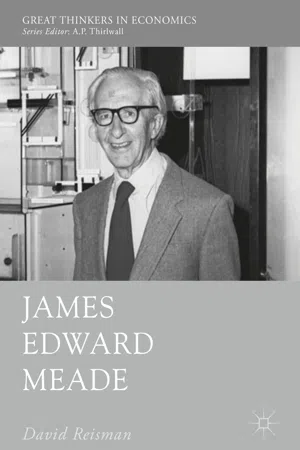
James Meade followed in the footsteps of giants. He became an economist ‘because he abhorred mass unemployment’ (SWF, 13). He remained an economist because he abhorred the ‘huge and growing disparities of wealth’ (SWF, 13) that were distancing the haves from the excluded at home and abroad. Master as he was of abstract theories, restrictive assumptions, logical a prioris and mathematical models, Meade was politically and socially engaged. He called himself ‘an inveterate explorer of improvements in economic arrangements’ (CP III, 275). If he studied the differential equations and the simultaneous techniques, it was, in his perception, because of ‘the contribution which pure economic analysis can make to the formation of economic policy’ (BOP, vii). Meade pursued economic theory ‘not as an end in itself’ but as a means for ‘improving the economic and social organisation of the country’ (Cairncross 1995: 12). He was widely respected not just for the depth and breadth of his scholarship but because he had a commitment to the big issues.
Meade wanted to do good, and to do good through economics. The passion came first . Alec Cairncross and Nita Watts, who knew him well, describe him as ‘both a scholar and a prophet, with a vision of how the economy should work and a clear understanding of what made it work as it did’ (Cairncross and Watts 1989: 54). His principal concern, as he declared in 1957 in his LSE Inaugural Lecture , had always been with ‘the contribution which economic analysis has to make to the solution of problems of practical economic policy’ (PPM, 101).
In the introduction to his Balance of Payments he alerted the reader to the service, the duty and the relevance that would be guiding him through the maze: ‘This volume is the work neither of a tool-maker nor of a tool-user but of a tool-setter’ (BOP, vii). He would be making the tools and using the tools. Most of all, he would be selecting the tools. He would be choosing the tools in the light of the work which was there to be done: ‘It is my settled conviction that modern economic theory—so far from being a frivolous or merely academic study—can lead to certain important and beneficial truths’ (MP 2/12). Economics has consequences. Meade has consequences. Good works are always a good thing.
Meade came to economics, like Smith and Marshall, first and foremost because he was ‘interested in the possible improvement of society’ (SWF, 13). He never allowed the means to crowd out the end or the pyrotechnics to crowd out the priorities. Solow was only one among many to recognise what Meade was trying to do: ‘Book after book is directed at urgent issues of economic policy, at Making Things Better. If you have to be obsessed by something, maximising real National Income is not a bad choice’ (Solow 1987: 986).
Meade wanted economic reasoning to be applied productively for the good of all. It was not economics for the sake of economics but rather economics because the real-world problems of ‘full employment’, ‘social equity’, ‘economic efficiency’ and ‘personal freedom’ (CP II, 285) were ongoing challenges to the specialist who had the skill. Meade, Atkinson writes, ‘had a vision as to how social and economic institutions could be reformed to make the world a better place, and he believed in the power of rational argument as a means to bring about these reforms’ (Atkinson 1996: 90).
Of course the temptations were there. Meade knew that he was being pulled in one direction by high theory, in the other by reality and commitment. Looking back on his life, he recalled that he had ‘tried in his time to be an Economist; but Commonsense would keep breaking in’ (SWF, 22). Smith and Marshall had stood at the same crossroads. They had opted for both turnings because each turning was the best. Meade sought to follow his giants not just into the mixed economy but into the mixed economics which does what it has to do in order to do good. If a manifesto is required, it would have to be this: ‘There is a place now for the modern equivalent of the old Political Economist’ (SE, 8).
1.1 Oxford and Cambridge
James Edward Meade was born on 23 June 1907 at Swanage, Dorset. He died in Little Shelford, Cambridgeshire , on 22 December 1995. Meade’s father was a man of independent means. Brought up in a High Church family, the biblical catechism by his early 1920s had given way to agnosticism: ‘I do not believe in all the Christian theology and dogma’ (CP IV, 268). As a Newtonian and a scientist, he found it difficult to take any idea or ideology on trust. The religious values of service, duty and compassion did, however, linger on. Once he had married into a Quaker family, he was exposed to Quaker values and the Quakerly way of life. It suited his secular egalitarianism well.
Meade’s childhood was spent in Bath. Thereafter it was preparatory school, public school and ancient university. Educated at Lambrook School and Malvern College , he went on an open scholarship to Oriel College, Oxford, in 1926, where he obtained a First in Classical Honour Moderations (‘Greats’) in 1928 and then another First in Philosophy, Politics and Economics (PPE) in 1930.
Even as a student of classics, Meade was anxious to probe beneath the ideas of Plato , Aristotle, Euripides and Xenophon (all of them studied and cited in Greek) to uncover the ‘economic basis’ of the Hellenic slave society that made the cultured democracy possible. An undergraduate essay from 1927, written in his elegant copperplate script, shows that Meade had read and understood Smith, Mill and Rousseau before the age of 20. In it he wrote that freedom in ancient Athens was essentially the freedom of the few: ‘It was the very existence of slavery which enabled the citizens to devote so much of their time to politics and art’ (MP 2/1). Freedom was built on unfreedom. Demosthenes’s father grew rich on fifty slaves. It was capitalism through and through.
The ideals of Hellenism, the very intellectual young undergraduate concluded, were never applied. The Greeks would have done better if they had lived by the respect for persons of Bentham and Mill. In the Principles of Morals Meade uncovered the premise that each individual must count as one: ‘It is a commonplace of economic analysis, that, assuming that all men have equal needs, an equal distribution of income will give a greater aggregate sum of utils or of the economic goods than any other’ (MP 2/2). In the essay On Liberty he found the guiding light (‘undoubtedly correct’) that ‘the end of all economic activity is freedom’: ’The individual has a right to do what he wants so long as he does not thereby harm others, while the State has the right to interfere in those actions in which one individual would harm another’ (MP 2/2). The ethic is self-determination. The State is the means to its citizens’ ends. The discovery of economic liberalism put paid to philosophical Hellenism. Meade became convinced that liberal economics and not Athens was the key to the good life.
The new honours degree in PPE (‘Modern Greats’) had been created in 1921. While Cambridge was Marshall and then Pigou, economics at Oxford had long been dominated by the English historical school, political philosophy and applied, stage-specific investigations which called into question the universal propositions of mathematical model-building. PPE in the 1920s relied at least as much on Mill’s Political Economy as on Marshall’s Principles. The ente...