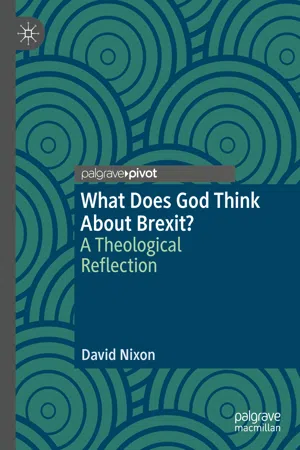
This book is a theological reflection about the process and event of Brexit: Britain's departure from the European Union. Within a framework of liberation and postmodern theology, it examines Brexit against a history of the EU, with themes of community, identity, marriage, and divorce. It considers the emotional reactions which have been generated, and places Brexit in the context of contemporary populism and the politics of the United States. The book concludes with a call for reconciliation via new imaginaries of solidarity and inclusion.
- English
- ePUB (mobile friendly)
- Available on iOS & Android
eBook - ePub
About this book
Information
Topic
Theology & ReligionSubtopic
European Politics© The Author(s) 2019
D. NixonWhat Does God Think About Brexit?https://doi.org/10.1007/978-3-030-33942-5_11. Introduction: Personal Overview
Abstract
This chapter is an Introduction and Personal Overview, with an outline of the methodology framing the whole book. It contains a summary of each subsequent chapter, a brief note about theological reflection and details of the sources employed, including from different media.
Keywords
BrexitEuropean UnionLiberation theologyQueer theologyPopulismReconciliationOn the morning of 24 June 2016, I walked to work somewhat shell-shocked by the result of the EU referendum confirmed in the early hours. As I passed local people whom I did not know, I looked into their faces and wondered: were you one of the people who voted to leave, or did you vote to stay? Chatting to others afterwards, I realised that this had been quite a common activity. Early the following week, my car was vandalised in the street. I had thought initially this might have been linked to an altercation I had had with another driver, but walking round the immediate area, I realised that a number of cars had been damaged. As I read and heard in the media of an increase in violence against minorities, I pondered if this little outbreak of petty crime in my neighbourhood might also be connected to the pent-up feelings unlocked by the vote.
Several weeks later, as I was driving, the radio was playing the last part of Beethoven’s Ninth Symphony, and his rendering of Schiller’s Ode to Joy began. It dawned on me very suddenly, and in way which nearly made me stop the car, that very soon those stirring notes of the EU anthem would no longer hold any traction in this land, and a real sense of bereavement descended. You will tell immediately now where my sympathies lay and lie, and strongly felt too, but before you are tempted to put this writing aside as a crude attempt to inveigle God onto my side, like a latter day wartime recruiting officer, I ask you to hear a final personal anecdote.
Returning from holiday in the Spring of 2017, I was waiting in an airport lounge to catch the flight home from Gran Canaria, a destination popular with UK tourists. There were families and couples, and bustling and shouting and queuing. There were final meals consumed, and coffees and Pepsis drunk, and children being boisterous—there were few if any people with tattoos drinking lager in the morning. And in my observation, it struck me forcibly that I knew really nothing about how these people lived, what really made them tick. I was embarrassed for myself, as I had always considered I was in touch with others and understood them. It was not therefore a tremendous leap to confess how little I knew about the lives of those who voted to leave the EU, when it seemed to myself, family and friends self-evidently obvious that we should stay. Living in Exeter (a university city in South West England), which voted clearly to remain, I had had little contact with those who might disagree with me—a contented silo now bust open.
One immediate public reflection was that the vote revealed stark divisions and discontents that were already there. It had crystallised rather than caused feelings of disenfranchisement or entitlement. That working hypothesis was at least a good enough starting point for me as a theologian to ask what was happening here theologically. Or to put it more directly: what does God think about Brexit?
The theological approach adopted here is to take a number of over-arching themes which emerge from reflection on the EU and the referendum, and to ask how theology helps better understand the events and processes with which we are engaged. Reciprocally, and metaphorically looking through the other end of the telescope, I ask whether these same events have anything to amplify, shift or challenge the theology we already have in place. This method of ‘interillumination’ (Thompson et al. 2008: 27) is a reply to the sharp question posed by Loughlin (1996: 83): ‘do we start from the Word or the world?’ He contends that these are not like two ends of the same journey, but that where we begin determines to a large extent where we finish. He feels that the ‘world’ is far too uncertain a starting point, and therefore prefers the Word.
Similarly, Barth (1936: 7) whose unequivocal emphasis on the Word allows almost no other point of departure; so for example in his consideration of the incarnation in Church Dogmatics IV.1, he writes:
If the fact that God is with us is a report about the being and life and act of God, then from the very outset it stands in a relationship to our own being and life and acts. A report about ourselves is included in that report about God …. It tells us that we ourselves are in the sphere of God. … He does not allow His history to be His and ours to be ours, but causes them to take place as a common history. That is the special truth which the Christian message has to proclaim at its very heart.
David Ford (1981: 182) sums up this interpretation of the narrative of Scripture as ‘like a finger which, for all its shaking and its warts, points to Christ; and it is the only witness we have, so that it must be the authority on God and on the new state of the world since the resurrection, and the criterion against which world-views are measured’. And yet to separate God from those whom God has created and loved is also too limiting, too abstract for a God who chooses to live among us. The emphasis Barth puts on this one aspect of the story, minimising the impact of human understandings, may cause it to buckle under the weight. John Webster (1998: 90) suggests that while God’s freedom is axiomatic, it should be seen in relation to the human freedoms which derive from it. So he writes: ‘the narration of God’s mighty deeds cannot proceed without the narration of the corresponding deeds of God’s fellow-workers [sic]’. In this sense, Word and world can be held together.
An exploration of a ‘theology of Brexit’ proceeds therefore initially from the human situation in its specific socio-cultural and geographic context. It evokes themes mainly from a contemporary cultural lexicon and draws on insights from human sciences. At the same time, however, it will always and inevitably be framed by the major Christian tropes of creation, incarnation, crucifixion, resurrection, repentance and so on, and the text to which it refers most frequently is that of Scripture. It would be impossible for me to disentangle those concepts from my imagination and wrong to claim I could do so. This process is more complex than a simple binary choice, either this starting point or that; rather it is more like the spinning of yarn and the weaving of cloth. But this homely imagery also has an uncomfortable edge; Mother Mary Clare (1988), a contemplative nun of the Sisters of the Love of God in Oxford, encourages an adventure into new territory:
We must try to understand the meaning of the age in which we are called to bear witness; we must first accept that this is an age in which the cloth is being unwoven; it is therefore no good trying to patch. We must rather set up the loom on which coming generations may weave a new cloth according to the pattern God provides.
The context of Brexit also allies this theology with other contextual theologies and their developments. The movements of liberation in the 1960s, 1970s and 1980s based in South Africa, South America, Western Europe and North America concerned rights and equalities for a range of people: black and minority ethnic, those economically and politically marginalised, women, LGBT, disabled people and so on. Liberation theologies responded to the question posed by the Peruvian Gutiérrez (1988): how can we tell poor people that God loves them given the conditions in which they live? Postmodern thinking and queer theory led to further theological expansion, not least in critiquing liberation theology in three ways: the need to examine more closely the concept of justice and for whom; a tendency to homogenise marginal groups to produce ‘the homeless’, ‘the disabled’ and so on; and therefore thirdly to recognise more fully ‘constellations’ (Youdell 2005) of identity—the concept that people may be discriminated against along different axes of being in different ways. Nevertheless, the spirit of liberation theology remains strong, allowing Goss (1998: 194) to comment: ‘queering imaginatively reconstructs theology, spirituality and church practices in new, inclusive configurations’.
A theology of Brexit situates itself heuristically within these boundaries and seeks a creative response to both an event and a process, and also to something which touches people at their emotional and spiritual core. It will not be a complete theology not just because Brexit is still unfolding (and will continue to do so into the future) but also because this sort of theology does not wish to claim a doubtful universality. Rather, I attempt to analyse an evolving situation, to create a bricolage of provisional interpretation, to assemble an array of theological fragments as Duncan Forre...
Table of contents
- Cover
- Front Matter
- 1. Introduction: Personal Overview
- 2. Thinking Theologically: A Framework for Brexit
- 3. Community and Identity
- 4. Marriage and Divorce
- 5. Anxiety and Uncertainty
- 6. Nation and World
- 7. Reconciliation, Healing and Forgiveness
- 8. Conclusions: How Theology Can Reframe the Imagination
- Back Matter
Trusted by 375,005 students
Access to over 1.5 million titles for a fair monthly price.
Study more efficiently using our study tools.
Frequently asked questions
Yes, you can cancel anytime from the Subscription tab in your account settings on the Perlego website. Your subscription will stay active until the end of your current billing period. Learn how to cancel your subscription
No, books cannot be downloaded as external files, such as PDFs, for use outside of Perlego. However, you can download books within the Perlego app for offline reading on mobile or tablet. Learn how to download books offline
Perlego offers two plans: Essential and Complete
- Essential is ideal for learners and professionals who enjoy exploring a wide range of subjects. Access the Essential Library with 800,000+ trusted titles and best-sellers across business, personal growth, and the humanities. Includes unlimited reading time and Standard Read Aloud voice.
- Complete: Perfect for advanced learners and researchers needing full, unrestricted access. Unlock 1.5M+ books across hundreds of subjects, including academic and specialized titles. The Complete Plan also includes advanced features like Premium Read Aloud and Research Assistant.
We are an online textbook subscription service, where you can get access to an entire online library for less than the price of a single book per month. With over 1.5 million books across 990+ topics, we’ve got you covered! Learn about our mission
Look out for the read-aloud symbol on your next book to see if you can listen to it. The read-aloud tool reads text aloud for you, highlighting the text as it is being read. You can pause it, speed it up and slow it down. Learn more about Read Aloud
Yes! You can use the Perlego app on both iOS and Android devices to read anytime, anywhere — even offline. Perfect for commutes or when you’re on the go.
Please note we cannot support devices running on iOS 13 and Android 7 or earlier. Learn more about using the app
Please note we cannot support devices running on iOS 13 and Android 7 or earlier. Learn more about using the app
Yes, you can access What Does God Think About Brexit? by David Nixon in PDF and/or ePUB format, as well as other popular books in Theology & Religion & European Politics. We have over 1.5 million books available in our catalogue for you to explore.