Guided by and complimenting the writings of Robert K. Greenleaf, this book aims to deepen, expand and extend the philosophy of servant-leadership. Proposing a grounding framework for the studies of leadership, training and development, the author suggests that servant-leadership is primarily based on the structures of human development. Emphasizing the notion of a developing servant-consciousness and explaining the composition of a servant-leader disposition, this book analyzes the way that leadership has evolved. The characteristics of a servant-leader are categorized into five primary capacities, each with a focus on holistic listening and path-finding foresight. Servant-leaders in Training is essential reading for scholars of organizational leadership and management, and those wishing to gain a deeper understanding of servant-leader philosophy more generally.
eBook - ePub
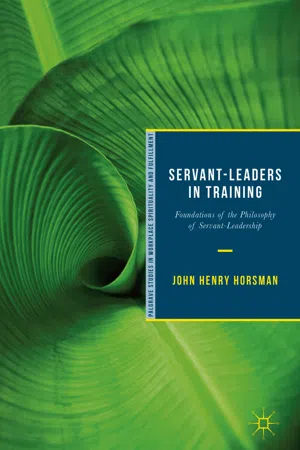
Servant-Leaders in Training
Foundations of the Philosophy of Servant-Leadership
- English
- ePUB (mobile friendly)
- Available on iOS & Android
eBook - ePub
About this book
Information
© The Author(s) 2018
John Henry HorsmanServant-Leaders in TrainingPalgrave Studies in Workplace Spirituality and Fulfillmenthttps://doi.org/10.1007/978-3-319-92961-3_11. Profoundly Relational, Creative, Holistic, and Integrative
John Henry Horsman1
(1)
Gonzaga University, Spokane, WA, USA
John Henry Horsman
For a very long time humans have been peering into the universe, as if trying to find or recognize our home, or our way home. Since the time of the last renaissance, we have located our place in our solar system, and in our galaxy, and we have begun searching and probing deeper into the cosmos. As we explore and discover more about our exterior space, we are simultaneously exploring and discovering (bringing into consciousness) more of the infinite interior depths within ourselves. As with any exploration of new territory, we humans find it helpful in the early part of the exploration to first map what we know. The more we map the universe, the more intriguing it becomes, and we always find there is much more to discover. As we have learned to map the structure of space, our perspective and our consciousness of our place in space and our relationship with space evolve.
Somewhat similarly to our experience of probing interior and exterior space, the study of Servant-leading also reveals an expanding perspective that includes much about our interior relationship with ourselves as well as our exterior relationships with others, groups, organizations, communities, and the entire human and ecological global system. Similar to our efforts to map the structures of space to discover and locate where we are—and where we are not—it is helpful to use the structures of human development to map and evolve a leadership philosophy. Fortunately, multiple models of human development have already been developed, well tested, and found to be quite structurally consistent. The models show the potential for individual development, as well as the historical evolution and development of groups, culture, organizations, and systems. The value of using these human development maps is that we find it quite easy to find where we are currently located on the development journey, and it is also quite easy to locate the people we work with, our group, our organization, and our society. In addition to showing us where we are presently located, the developmental models show us where we have been, and potentially where we might go from here—if we should choose to do so. Models of human development are pertinent frameworks with which to begin explaining the philosophy of Servant-leadership because we can trace the development of leader typologies within the models.
Like peering into the universe, coming to understand Servant-leadership also expands our perspective and, in so doing, serves to nurture the development of an emerging servant-consciousness. A seemingly appropriate iconic symbol for a servant-consciousness is a galaxy spiral. Our Milky Way galaxy, for example, provides us with an expansive view of our place in the universe; it locates our solar system, and our earth home within it. A galaxy spiral is symbolic of a cosmic worldview, a relatively stable worldview that is connected to everything we know even though it is continuously transforming. A cosmic worldview is more expansive than any previous worldviews held in common by humans. A cosmic worldview is an open evolving system, as is a servant-consciousness. A servant-consciousness and a spiraling galaxy can be described as a relatively stable open system in perpetual transformation. Likewise Servant-leadership as perceived and presented herein is a relatively stable open philosophy in perpetual transformation.
Although we may prefer it otherwise, we humans are not evolving toward a more simplified view of the world, or to the way it used to be, we are evolving toward a more complex integrative cosmic worldview—a new worldview that calls for Servant-leaders, who in turn will aide our efforts to better perceive ourselves and our purpose on earth and in the universe. As we enter into the next renaissance, our call is no longer to greater independence, our call now is to independence–interdependence , a dynamic that awakens a more integrated relational awareness within ourselves, with others, with the collective, and with all of creation.
Those who probe the meaning and relevance of Servant-leadership tend to enhance their depth of perception, expand their views, and to some extent become prophetic. Robert K. Greenleaf linked seeking and prophetic vision to the task of becoming a Servant-leader. To that end I have also become a seeker, and this work is some of what I have perceived and discovered in my listening and foreseeing. Perhaps some of it will resonate with your own seeking, and we might journey together for a while.
The objective is to further develop Greenleaf’s key insights, affirm Servant-leader development within the human development models, and introduce some new conceptual structures to prepare the way for a more comprehensive Servant-leader philosophy. For this purpose, I use the terms Servant-leader and Servant-leadership interchangeably, as in being and doing, with the former reflecting the individual leader and the latter reflecting an individual’s interaction with the collective. Servant-leadership is presented herein as an expanding philosophical framework for individual and organizational development. Servant-leadership is offered as a philosophy we can aspire to in our era, and it is a philosophy that will serve us in the age we are entering into. Our purpose entails clarifying the framework of the philosophy and then expanding the philosophy by increasing the breadth and depth of our understandings of Servant-leading. The framework is based on values and skills that nurture the development of the person and the organization for the purpose of creating a more caring serving society. As a profoundly relational and moral approach , serving-first potentially nurtures greater meaning and fulfillment, greater relational engagement, and overall greater personal and collective human flourishing.The primary focus of this writing is to take Greenleaf’s thinking a little further, not to complete it; rather, in a similar theme to Greenleaf’s original approach, to creatively attempt to make the vision a little more whole and a little more integrative, and in doing so add some clarity and perhaps greater complexity to the philosophy of Servant-leadership.
Expanding the philosophy involves learning and nurturing a more profoundly relational, creative, holistic, and integrated way of being and doing our work in the world. A servant-consciousness arises from serving-first, is inherently transforming, and is inspired by compassion, generosity, gratitude, and joy. A servant-consciousness is harmonious with the associated values and skills that range through the higher stages of human development. The actualization of a servant-consciousness requires a deliberate and creative transforming approach for ourselves and for the people and the collectives within which we interact; it involves nurturing and expanding our capacity for a cosmic worldview. The assumption here is that a servant-consciousness is evolving throughout humankind. Such an approach involves much more than merely coming to understand the philosophy of Servant-leadership; rather, it involves engaging the challenge of becoming a Servant-leader in training through practicing, enriching, and clarifying our notions of who we are, our life purposes, and the meaning we derive from pursuing our life quest.
A primary assumption of the human development models is that humans have the capacity to sequentially develop more complex and integrated worldviews along with the values and skills to enable flourishing within those worldviews. Within the models paradigmatic growth is described and categorized....
Table of contents
- Cover
- Front Matter
- 1. Profoundly Relational, Creative, Holistic, and Integrative
- 2. Human Development
- 3. Leadership Development
- 4. Empathetic and Moral
- 5. Listen-First Seeking Clarity Before Influence
- 6. Pathfinding-Foresight and Systems Thinking
- 7. Nurturing a Servant-Consciousness
- Back Matter
Trusted by 375,005 students
Access to over 1.5 million titles for a fair monthly price.
Study more efficiently using our study tools.
Frequently asked questions
Yes, you can cancel anytime from the Subscription tab in your account settings on the Perlego website. Your subscription will stay active until the end of your current billing period. Learn how to cancel your subscription
No, books cannot be downloaded as external files, such as PDFs, for use outside of Perlego. However, you can download books within the Perlego app for offline reading on mobile or tablet. Learn how to download books offline
Perlego offers two plans: Essential and Complete
- Essential is ideal for learners and professionals who enjoy exploring a wide range of subjects. Access the Essential Library with 800,000+ trusted titles and best-sellers across business, personal growth, and the humanities. Includes unlimited reading time and Standard Read Aloud voice.
- Complete: Perfect for advanced learners and researchers needing full, unrestricted access. Unlock 1.5M+ books across hundreds of subjects, including academic and specialized titles. The Complete Plan also includes advanced features like Premium Read Aloud and Research Assistant.
We are an online textbook subscription service, where you can get access to an entire online library for less than the price of a single book per month. With over 1.5 million books across 990+ topics, we’ve got you covered! Learn about our mission
Look out for the read-aloud symbol on your next book to see if you can listen to it. The read-aloud tool reads text aloud for you, highlighting the text as it is being read. You can pause it, speed it up and slow it down. Learn more about Read Aloud
Yes! You can use the Perlego app on both iOS and Android devices to read anytime, anywhere — even offline. Perfect for commutes or when you’re on the go.
Please note we cannot support devices running on iOS 13 and Android 7 or earlier. Learn more about using the app
Please note we cannot support devices running on iOS 13 and Android 7 or earlier. Learn more about using the app
Yes, you can access Servant-Leaders in Training by John Henry Horsman in PDF and/or ePUB format, as well as other popular books in Business & Business Ethics. We have over 1.5 million books available in our catalogue for you to explore.