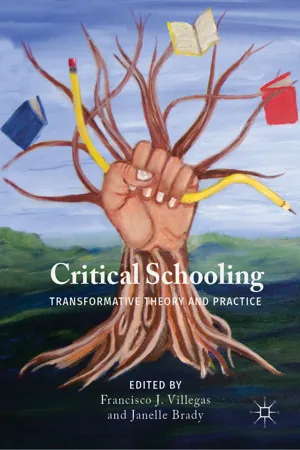
This edited volume brings to the foreground the inequities of contemporary schooling in Canada. The editors and authors perform a critical examination of the Canadian schooling space, highlighting the agency and action of marginalized communities and their efforts to address injustice within contexts of schooling. Grounded in the unique perspective of each author, this book provides a venue for transformative practice to create inclusive and socially just contexts for diverse populations, specifically as experienced by peoples who inhabit the intersections of various modes of oppression.
eBook - ePub
Critical Schooling
Transformative Theory and Practice
- English
- ePUB (mobile friendly)
- Available on iOS & Android
eBook - ePub
Critical Schooling
Transformative Theory and Practice
About this book
Information
Topic
EducationSubtopic
Education General© The Author(s) 2019
Francisco J. Villegas and Janelle Brady (eds.)Critical Schoolinghttps://doi.org/10.1007/978-3-030-00716-4_11. Continuing Important Conversations: An Introduction to This Volume
Francisco J. Villegas1 and Janelle Brady2
(1)
Anthropology and Sociology, Kalamazoo College, Kalamazoo, MI, USA
(2)
University of Toronto, Toronto, ON, Canada
Ghosh & Abdi, (2013) Education and the Politics of Difference (2nd ed.); Ghosh & Galczynski, (2014) Redefining Multicultural Education (3rd ed.); Egbo, Mogadime, etc.
End Abstract1.1 Schooling as a Site of Violence and Resistance
This book continues important conversations surrounding the recognition of inequities within schools and transformative theory and practice. As a collection of essays, this volume stems from a frustration of limited options for critical examination and a desire to centralize and highlight the agency of marginalized communities in their efforts to address injustice within schooling in Canada . To be clear, we are not unattached academics in this process. Thus, rather than proclaiming objectivity or neutrality, each chapter in this book is presented from the authors’ social location . As such, we aim to bring to the fore the systemic violence in schooling and methods to resolve it, rather than recentering the nation or its myths. In the process of developing this book, we as editors are guided by what Aida Hurtado (2003) calls the “politics of urgency ,” that is we recognize the ways that lives, futures, and knowledge, have been, and continue to be, pushed out from institutions that were not designed for our communities. 1 In alignment with Hurtado (2003), the purpose of this project is to “subvert rather than perpetuate debates that sabotage the potential for political action” (p. 224). In this way, we sought contributors that are hopeful, transformative, and cognizant of the value of praxis . Grounding the book in this manner facilitates fuller engagement with the problematics of schooling as experienced by peoples who inhabit the intersections of various modes of oppression .
Schooling as an institution is imagined as the space to develop future citizens as well as a meritocratic site that facilitates access to the goods of the nation , including social mobility. However, the process of schooling is mediated by numerous power relations that define what constitutes valuable knowledge, how learning occurs and is evaluated, who is capable of learning, and who exemplifies excellence. Numerous scholars have analyzed the politics of schooling as well as how it betrays the very values it purports to uphold. This includes calls to redefine the individualized and pathologized dropout to the pushout through an anti-racist approach which takes structural barriers into account (Dei, Mazzuca, McIsaac, & Zine, 1997), analyzing the production of “at risk” youth in normalizing discourses of color-blindness and meritocracy through a critical race perspective (James, 2011; James & Taylor, 2010), interrogating the histories of residential schooling and its links to the present (Haig-Brown, 2002; Susan Dion, 2009), proposing alternate pedagogies and curricular designs (Alexander, 2006; Dei, 1996, 2003, 2010) and the need for schooling to have a liberatory intention (Giroux, 2007; Leonardo, 2004). Scholars like Shujaa (1994) articulate the difference between schooling and education by defining schooling as “a societal imperative necessary for the maintenance of existing relations of power and privilege” (p. 11). Shujaa goes on to define education “… as a process that locates the members of a culture within their cultural history, facilitates the transmission of knowledge, and affirms the cultural identity ” (p. 11). By engaging this operation of schooling and extending it to the scholarship presented earlier, this book aims to continue these conversations as well as link them to contemporary shifts in the ways schooling is conducted today. In this way, the central questions guiding this volume include: What are current inequities facing youth in schooling and how do community members exercise and enact their agency to organize resistance ? What does it mean when we say communities through critical perspectives which seek mutuality, shared responsibility, and solidarity rather than fragmentation and divisions? What are alternate methods of imagining the process of schooling that transform the confines of schooling to education ? And how do we maintain accountability to ensure schools’ promises to our communities ? How can we re-envision the schooling process of preparing citizens that critically departs from anti-difference discourses that often center whiteness and heteropatriarchy to a more complete futurity ? While contributors to this book aim to address these questions, the responses presented are not definitive and instead should be considered ongoing through which we reimagine the definition of the learner and teacher , the overseeing of learning, the problematics of school disciplining, the connections between schools and processes of displacement and profiteering, and the histories of resistance emanating from the communities experiencing violence.
Schools are filled with violent processes that produce physical, psychological, and spiritual harm . These processes are couched in colonialism , white supremacy , and patriarchy . In fact, the historical trajectories of criminalization, demands to assimilation, disavowal of diverse knowledge, illegalization, and constructs of deficient bodies and cultures remain prevalent today, sometimes in subtler forms. As George Dei (1996) reminds us, “current discussions and explications about ‘culture,’ ‘nation ’ and ‘heritage’ can, and do become new tropes for producing racialized doctrines and reproducing overtly racist discourses” (p. 47). That is, language has shifted to facilitate speaking in codes that allow for racist, sexist, homophobic, and colonialist discourse, while masquerading as egalitarian, multicultural, or as recently seen in the Western landscape, through a practice of “freedom of speech .”
Too often, frameworks explicating the differential outcomes experience by people according to race, class, and gender —including racialized poor women—operate under assumptions of deficiency and pathology (Carranza, 2009; Collins, 2000; Dei et al., 1997; hooks, 2015; Hurtado, 1995). Supplementary interventions are often proposed as solutions that will result in the oppressed achieving a similar subjectivity as the dominant . This position assumes a lack, or deficiency rather than acknowledging the historical, and resulting structural, systemic, and institutionalized contexts that result in these differential outcomes. Deficiency theories commonly used range from ideas that individuals must assimilate in myriad ways to find a place within dominant society, to beliefs of inferiority due to biology, familial composition, class, culture, or a combination of all of these factors (Balibar, 1991; Goldberg, 1993; Pon, 2009; Romero, 2008; Thobani, 2007). Assimilatory demands normalize white supremacy and blame those who are deemed non-compliant or refusing to admit their or their culture’s presumed inferiority. These frameworks, often imagined solely as speech acts, have material consequences, particularly as they not only shape discourse but also practices, policies , and laws. We can see this in the deployment of respectability politics, claims that marginalized bodies are divisive when they address, protest or challenge inequity, criminalization of dissent and legalized state violence in the form of police brutality , environmental racism , austerity measures, among others.
The employment of the multitude of deficiency theories available (such as and not limited to: culture of poverty, the bell curve, broken windows theories) can become hegemonic and within the context of schooling produce teachers , staff members, and administrators that reproduce violence. For instance, educators mobilize racist discourses regarding racialized communities placing little value on schooling and as such, follow a theory of deficiency that flows from the parent down to the children (Ladson-Billings, 2007). Although these theories have been proven wrong time and time again, they continue to gain currency (James, 2009).
In Canada , the “push out ” process of racialized students has been documented (Bernhard, 2009; Carranza, 2009; Dei et al., 1997; Rivas & Duarte, 2009; Schugurensky, 2009). In this process, it is often the racialized student, and by extension their family, who is believed to be deficient, lacking, and neglectful of their schooling . There are myriad ways students, t...
Table of contents
- Cover
- Front Matter
- 1. Continuing Important Conversations: An Introduction to This Volume
- 2. “I’m Just a Friend Now”: Community Policing in Toronto Schools
- 3. Restorative Justice: Moving from Punitive Sanctions to Proactive Interactions
- 4. Canada’s Legacy of Colonialism: Implications in Education
- 5. Resistance Is Our Ancestral Knowledge: Incorporating Roots of Resistance into the Education of Adolescent Afro-Caribbean Girls in the Greater Toronto Area (GTA)
- 6. Disrupting Princesses: A Pedagogical Moment in Dismantling Colonial Norms and Representations of Beauty Through an Anti-colonial Framework
- 7. The First Three Years of LAEN: From Unity-Seeking to Equity-Seeking
- 8. Active Communities and Practices of Resistance: Brief History of the Use of Schools as Border Zones in Toronto
- 9. Be a Good Citizen or Else! Neoliberal Citizenship and the Grade Six 2013 Revised Ontario Social Studies Curriculum
- 10. “What Can I Do?”: A Guide for Academics Who (Want to) Support Palestine
- 11. Bridging Borders: Teaching a Bridging Course with Precarious Status Students Transitioning to the University
- 12. Self-Study of an Indigenous Settler in Ontario Schooling: An Exploration of Living Theory
- 13. Living Biocultures: A Framework for Building Sustainable Community Well-Being, Resilience and Innovation
- 14. Community, Schooling, and the Education of Racialized Students: A Postscript
- Back Matter
Trusted by 375,005 students
Access to over 1.5 million titles for a fair monthly price.
Study more efficiently using our study tools.
Frequently asked questions
Yes, you can cancel anytime from the Subscription tab in your account settings on the Perlego website. Your subscription will stay active until the end of your current billing period. Learn how to cancel your subscription
No, books cannot be downloaded as external files, such as PDFs, for use outside of Perlego. However, you can download books within the Perlego app for offline reading on mobile or tablet. Learn how to download books offline
Perlego offers two plans: Essential and Complete
- Essential is ideal for learners and professionals who enjoy exploring a wide range of subjects. Access the Essential Library with 800,000+ trusted titles and best-sellers across business, personal growth, and the humanities. Includes unlimited reading time and Standard Read Aloud voice.
- Complete: Perfect for advanced learners and researchers needing full, unrestricted access. Unlock 1.5M+ books across hundreds of subjects, including academic and specialized titles. The Complete Plan also includes advanced features like Premium Read Aloud and Research Assistant.
We are an online textbook subscription service, where you can get access to an entire online library for less than the price of a single book per month. With over 1.5 million books across 990+ topics, we’ve got you covered! Learn about our mission
Look out for the read-aloud symbol on your next book to see if you can listen to it. The read-aloud tool reads text aloud for you, highlighting the text as it is being read. You can pause it, speed it up and slow it down. Learn more about Read Aloud
Yes! You can use the Perlego app on both iOS and Android devices to read anytime, anywhere — even offline. Perfect for commutes or when you’re on the go.
Please note we cannot support devices running on iOS 13 and Android 7 or earlier. Learn more about using the app
Please note we cannot support devices running on iOS 13 and Android 7 or earlier. Learn more about using the app
Yes, you can access Critical Schooling by Francisco J. Villegas, Janelle Brady, Francisco J. Villegas,Janelle Brady in PDF and/or ePUB format, as well as other popular books in Education & Education General. We have over 1.5 million books available in our catalogue for you to explore.