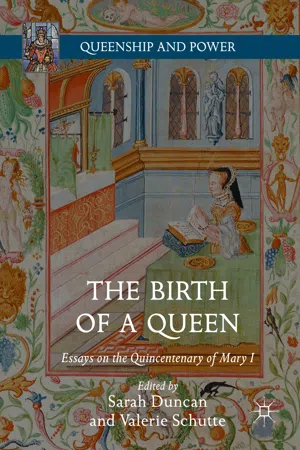
Marking the 500th year anniversary of the birth of Queen Mary I in 1516, this book both commemorates her rule and rehabilitates and redefines her image and reign as England's first queen regnant. In this broad collection of essays, leading historians of queenship (or monarchy) explore aspects of Mary's life from birth to reign to death and cultural afterlife, giving consideration to the struggles she faced both before and after her accession, and celebrating Mary as a queen in her own right.
eBook - ePub
The Birth of a Queen
Essays on the Quincentenary of Mary I
- English
- ePUB (mobile friendly)
- Available on iOS & Android
eBook - ePub
The Birth of a Queen
Essays on the Quincentenary of Mary I
About this book
Information
© The Author(s) 2016
Sarah Duncan and Valerie Schutte (eds.)The Birth of a QueenQueenship and Power10.1057/978-1-137-58728-2_11. Introduction: Princess, Bastard, Queen, Villain
Sarah Duncan1 and Valerie Schutte2
(1)
History Department, Spring Hill College, 4000 Dauphin St., Mobile, AL, 36608, USA
(2)
Independent Scholar, Pittsburgh, PA, USA
Queen Mary I was not born to rule. Although she would later be crowned queen of England on October 1, 1553, her birth on February 18, 1516 to King Henry VIII and his first wife Catherine of Aragon was not greeted with the same lavish celebrations that had been bestowed upon the child, named Henry, who had been born to the royal couple in 1510. Had he lived beyond a few scant months, Henry would not only have been Mary’s older brother but undisputed heir to the throne. The birth of a healthy daughter was an occasion of joy, to be sure, particularly after the death of little Henry, another short-lived son, and multiple miscarriages, but it did nothing to ensure the succession of the English throne upon the Tudor line, as the oft-quoted comment made by Henry VIII—“if it is a girl this time, by God’s grace boys will follow”—bears out. 1 When she was christened on February 21, 1516 there was no guarantee that she would live to adulthood, nor any precedent to indicate that she would one day become the first queen to rule England; her path to the crown was not an easy, or even straightforward, one. Throughout her lifetime, the roles that Mary inhabited would be marked by their unconventional nature and pattern: in her youth, as princess and royal heir, then bastard child of a nonvalid union, finally illegitimate but restored to the line of succession; in her adulthood, as regnant queen, first single, then married; and in her final years and after her death when she was characterized as a bloodthirsty villainess, a role that has continued to define her until very recently. 2
Mary’s life, therefore, is marked by a series of liminal moments—occasions upon which the course of her life turned—and dominated by unforeseen events and fateful occurrences. What if either of her two brothers, born alive, had lived to adulthood? Mary would then have been raised as a typical royal daughter and princess, and in all likelihood, followed the path laid out by Henry VIII’s sisters who were respectively married to the kings of Scotland and France to seal political and dynastic alliances. Instead, Mary’s life from birth to death followed a much more unpredictable trajectory. With the failure of any more children to be born to Henry and Catherine, Mary was her parents’ sole surviving child. She was raised in both traditional and nontraditional ways: during her childhood, as a royal princess, she was betrothed to the son of King Francis I of France and later to the future Holy Roman Emperor, Charles V, although both betrothals were eventually broken off. Yet as the sole legitimate heir to the throne, for the first 17 years of her life Mary was raised as such. 3 Although Henry never formally invested her as Princess of Wales, at the age of nine she was sent to the Welsh Marches with her own household and council based at Ludlow Castle. Mary was also well-educated in the humanist tradition, an education that included Latin and grammar tutors such as Giles Duwes and Thomas Linacre, and was overseen by her mother, Catherine of Aragon, who had been the recipient of an excellent education herself at the hands of her mother, Isabel of Spain, queen in her own right.
Mary’s life took yet another unexpected trajectory when in 1527, unsatisfied with the lack of a son and heir, Henry undertook steps to annul his marriage with Catherine in order to marry a second time, and Mary took her mother’s side in the course of their divorce. Mary’s position as royal princess and sole heir was downgraded after Rome’s failure to grant Henry an annulment resulted in Henry’s willingness to split England from the Roman Catholic Church and his subsequent marriage to Anne Boleyn. As a result, Mary was declared illegitimate and demoted from princess to lady, her household was dissolved, and she was placed in the household of her half-sister, Elizabeth, the only living progeny of Henry and Anne’s marriage. In 1536, Catherine of Aragon’s death and Anne Boleyn’s execution meant that Henry was free to marry a third time, to Jane Seymour, a union that produced one living son and changed Mary’s life and status once again. Having reconciled with Henry and capitulated to his demand that she submit to “his Highness, and to all and singular statutes of this realm,” 4 Mary was thereafter restored to court and to the king’s favor as his “dear and well-beloved daughter”; still illegitimate, and known as Lady Mary rather than princess, she enjoyed an enhanced status and a more traditional role. Once more, from the late 1530s until her father’s death in 1547 she became a desirable marriage candidate, although nothing came of any marriage negotiations. 5
When her brother ascended the throne as Edward VI in 1547, Mary’s position altered again. The 1543 Act of Succession and her father’s last will and testament placed her second in line to the throne after Edward. Now a wealthy landed magnate in her own right, Mary was also putative heir to the throne, and by virtue of her Catholic faith, a beacon of hope for Catholics and a focal point of a Catholic opposition during his reign. Still, any expectation that she might become queen was likely quite small. It was only with Edward’s sudden death at the age of 15 in 1553 that Mary’s fortune changed, leading to another, more momentous, transition. What if events had progressed differently and Edward had lived to marry and sire an heir? What if the attempt by Edward and the Duke of Northumberland to change the succession in favor of Lady Jane Grey had succeeded? Fortune favored Mary in the first instance; in the second, she made her own fortune, by taking on the nontraditional role of military leader to make a preemptive strike against the attempted coup and claim her right to the throne—the first Tudor to take up arms to support that claim since her grandfather, Henry VII, had won the Battle of Bosworth Field. Within weeks of Edward’s death, Mary rode triumphantly into London as queen.
Mary’s accession to the throne thrust her into yet another nontraditional role: regnant queen. Mary was the first woman to claim the English crown since Empress Matilda did so in the twelfth century; unlike Matilda, she was the first woman to successfully hold the throne. In the intervening years a number of strong queen consorts had exerted influence over reigning kings, but not until Mary ascended to the throne did a woman have control over the realm in her own right. 6 She ruled as a single queen, as her sister Elizabeth did after her, and also as a married queen, having decided to marry for the sake of producing an heir to the throne, like her father did before her. She would take on the roles of Virgin Queen, wife, and would-be mother, and she would usher in an unprecedented time period in the history of Great Britain, when a trio of female monarchs, Mary herself, her successor Elizabeth I, and Mary, queen of Scots, would rule England and Scotland for half a century. Yet Mary, as the first of these three remarkable rulers, had no role model (except perhaps her grandmother Isabel), and no precedent to follow in defining her untraditional role as queen regnant of England. 7 She was the first woman to take the political helm of her kingdom at a time when the nature of female rule created ambiguous feelings at best. Yet she successfully established herself as both king and queen of England; negotiated with the Emperor Charles V for her own marriage with his son Philip of Spain, the highest ranking Catholic prince in Europe, in a marriage treaty that gave Mary autonomy; and reintroduced Catholicism to England. In spite of her reputation for failure, it has been said by one historian that her only real failure was in dying too soon and by another that her only failure was in dying without having produced a child of her own to follow in her footsteps. 8 What if Mary’s two false pregnancies had resulted in the birth of a living child? This is another liminal moment in Mary’s life—had she been succeeded by a Catholic Tudor heir, her reputation as “Bloody” might not have had the staying power that it has had.
The Birth of English Queenship
This collection of essays on Queen Mary I coincides with the quincentenary of Mary’s birth in 1516 and seeks both to celebrate the rule of England’s first regnant queen and to contribute to the growing list of works that have begun to rehabilitate and redefine Mary’s image and reign. It has only been a recent development that historians have focused on Mary as queen in her own right, rather than using her as a foil by which to measure later queens regnant, particularly her sister, Elizabeth I. Offering essays on the life, reign, and reputation of Mary, this volume explores her long road to accession, how she established and maintained her authority, the complexities inherent in her role as female monarch, and the development of her image as queen both during her life and after her death. It adds to the growing number of revisionist works that have only just begun to reevaluate Mary and her reign, thus challenging her enduring and one-dimensional reputation as an unsuccessful ruler, and to contribute to the more nuanced picture of the queen that is emerging and ongoing.
In the last ten years a large number of monographs, essay collections, and articles have been published about Mary I, many of them revisionist in nature, reappraising many aspects of Mary’s reign. These publications have included five new biographies, a gender politics study, and works examining Mary’s church and religion. 9 In addition, at least three essay collections have appeared in print. Of these collections, one focuses on religion exclusively, and many of the essays in the other two are comparative in nature and explore the similarities between Mary and her younger sister, Elizabeth, as well as Mary’s influence on Elizabeth. 10 This volume thus complements existing scholarship, and also provides the first collection of essays to examine aspects of Mary’s life from birth to reign to cultural afterlife and reputation, giving due consideration to the struggles that she faced both before her accession and after it, and celebrating Mary as queen in her own right.
The chapters included in this volume, arranged in roughly chronological order, investigate heretofore unexamined issues in many of the transitional moments in Mary’s life: from princess to queen; from single queen to married queen to would-be mother; from triumphant queen to her life after death as a bloody villainess. They bring further understanding to the ways in which Mary negotiated her roles as princess, heir, and queen. The first three chapters examine Mary, her childhood, and her transition to ruler. Charles Beem explores Mary’s role as royal heir in “Princess of Wales? Mary Tudor and the History of English Heirs to the Throne” (Chap. 2) and contextualizes that position within the history of Princes of Wales as first in line to the throne. Mary was the only one of her siblings to ever be regarded as such, indicating that her upbringing had more in common with previous male heirs than either of her half-siblings. Her childhood and education were shaped not only by the traditions for heirs apparent, but also, over time, by the changes in her status; they were also influenced by a number of Henry VIII’s queens. Valerie Schutte’s chapter “Under the Influence: The Impact of Queenly Book Dedications on Princess Mary” (Chap. 3) in her examination of book dedications given to Henry’s wives that mentioned Mary. In these dedications, dedicators expressed their understanding of each queen’s infl uence over Mary. These perceptions may not always have been accurate, but nonetheless, they affected perceptions of Mary before she ascended the throne. Schutte argues that, in spite of her new legal status and downgraded position, Mary continued to be seen as influential in her own right. Hilary Doda takes up the idea of perception in the chapter “Lady Mary to Queen of England: Transformation, Ritual, and the Wardrobe of the Robes” (Chap. 4) to examine how Mary used her image and wardrobe, from the time she was a princess through the first year of her reign, to control her image, her place in the succession, and her gendered role as queen. Mary’s dress became one strategy whereby she justified her right to be queen and took an active role in her transition from princess to ruling queen.
The second section of this collection considers Mary’s queenship as sole queen, both single and married, and scrutinizes various aspects of her reign. In Mary Hill Cole’s chapter “The Half-Blood Princes: Mary I, Elizabeth I, and their Strategies of Legitimation,” (Chap. 5) she examines the Acts of Succession and explores how Mary dealt with her illegitimacy and troubled family in the past as compared to Elizabeth’s later treatment of the same problem. Upon her accession, Mary used parliament to pursue a bold strategy of erasing her parents’ divorce, reclaiming her own legitimacy, and asserting her right to the throne. Elizabeth, unable to take the same direct approach as Mary, still legitimized her right to rule through Parliament, yet, as Cole argues, she never achieved the success of her sister in this regard. Anna Whitelock takes a closer look at one particular Parliamentary statute, the Act for Regal Power, in the chapter “ ‘A queen, and by the same title, a king also’: Mary I: Queen-in-Parliament” (Chap. 6) and examines how Mary used it to establish her authority as queen and define female kingship. Whitelock argues that Mary, displaying the political astuteness normally attributed to Elizabeth, dealt with the debate and fears about female sovereignty by fashioning her own queenship as that of a queen-in-parliament and that “parliamentary queenship was Mary’s most significant and oft-overlooked legacy to her sister Elizabeth.” As well as negotiating her right to power, Mary also had to retain it. Gary Gibbs explores Wyatt’s Revolt, the response of Mary and her government to it, including harsh punishments as well as pardons, and the resulting critiques of Mary’s actions in its aftermath in “The Queen’s Easter Pardons, 1554: Ancient Customs and the Gift of Thucidyde...
Table of contents
- Cover
- Frontmatter
- 1. Introduction: Princess, Bastard, Queen, Villain
- 1. From Princess to Queen
- 2. Mary as Sole Queen
- 3. Mary’s Image, Past and Present
- Backmatter
Trusted by 375,005 students
Access to over 1.5 million titles for a fair monthly price.
Study more efficiently using our study tools.
Frequently asked questions
Yes, you can cancel anytime from the Subscription tab in your account settings on the Perlego website. Your subscription will stay active until the end of your current billing period. Learn how to cancel your subscription
No, books cannot be downloaded as external files, such as PDFs, for use outside of Perlego. However, you can download books within the Perlego app for offline reading on mobile or tablet. Learn how to download books offline
Perlego offers two plans: Essential and Complete
- Essential is ideal for learners and professionals who enjoy exploring a wide range of subjects. Access the Essential Library with 800,000+ trusted titles and best-sellers across business, personal growth, and the humanities. Includes unlimited reading time and Standard Read Aloud voice.
- Complete: Perfect for advanced learners and researchers needing full, unrestricted access. Unlock 1.5M+ books across hundreds of subjects, including academic and specialized titles. The Complete Plan also includes advanced features like Premium Read Aloud and Research Assistant.
We are an online textbook subscription service, where you can get access to an entire online library for less than the price of a single book per month. With over 1.5 million books across 990+ topics, we’ve got you covered! Learn about our mission
Look out for the read-aloud symbol on your next book to see if you can listen to it. The read-aloud tool reads text aloud for you, highlighting the text as it is being read. You can pause it, speed it up and slow it down. Learn more about Read Aloud
Yes! You can use the Perlego app on both iOS and Android devices to read anytime, anywhere — even offline. Perfect for commutes or when you’re on the go.
Please note we cannot support devices running on iOS 13 and Android 7 or earlier. Learn more about using the app
Please note we cannot support devices running on iOS 13 and Android 7 or earlier. Learn more about using the app
Yes, you can access The Birth of a Queen by Sarah Duncan, Valerie Schutte, Sarah Duncan,Valerie Schutte in PDF and/or ePUB format, as well as other popular books in History & British History. We have over 1.5 million books available in our catalogue for you to explore.