This book analyses the nationalist rebellion which emerged in Romania following the Second World War. The first two decades after the end of the war were times of rebellion in imperial peripheries. Armed movements, sometimes communist but nearly always nationalist in orientation, rose in opposition to retreating or advancing imperial powers. One such armed revolt took place in Romania, pitting nationalist partisans against a communist government. This book is an analysis of how the authorities crushed this rebellion, set in the context of parallel campaigns fought in Europe and the Third World. It focuses on population control through censorship, propaganda and deportations. It analyses military operations, particularly patrols, checkpoints, ambushes and informed strikes. Intelligence operations are also discussed, with an emphasis on recruiting informants, on interrogation, torture and infiltration. Bullets, brains and barbwire, not "hearts and minds" approaches, crushed internal rebels in post-1945 campaigns.
- English
- ePUB (mobile friendly)
- Available on iOS & Android
eBook - ePub
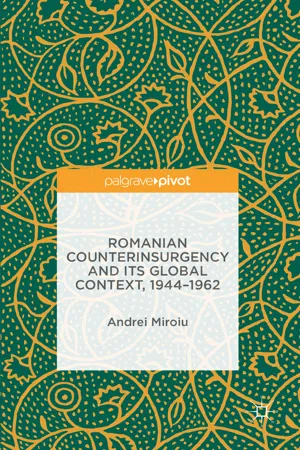
Romanian Counterinsurgency and its Global Context, 1944-1962
About this book
Information
Topic
StoriaSubtopic
Storia dell'Europa orientale© The Editor(s) (if applicable) and The Author(s) 2016
Andrei MiroiuRomanian Counterinsurgency and its Global Context, 1944-196210.1007/978-3-319-32379-4_11. Introduction
Andrei Miroiu1
(1)
Bucharest, Romania
Abstract
The introduction provides the rationale for the book and sets it in the context of the contemporary, post-9/11 debates concerning counterinsurgency. It briefly engages with the two main approaches to the analysis and interpretation of early Cold War anti-guerrilla campaigns and makes the case for both the comparative approach in the study of counterinsurgency and the relevance of non-Western, small state military operations against armed rebels. The theoretical stance embraced is laid out, and the main arguments are presented.
Keywords
Asymmetric warfareCold WarCommunist blocCounterinsurgencyIn the first decade of the twenty-first century, the problems and eventual failures of American-led military campaigns in Iraq and Afghanistan spurred the need for a reappraisal and deeper study of counterinsurgency. One of the main directions followed was historical, with the gaze of military practitioners and scholars focusing especially on the “classical period” of counterinsurgency, the period stretching from the end of the Second World War to the end of the Vietnam War. 1 The bulk of the studies concentrated on two important cases: the British campaign in Malaya, which was seen as a “textbook victory,” and the French war in Algeria, seen as the archetypal defeat. While many were mostly interested in recuperating the perceived wisdom of the time through a re-read of the literature of the period, especially the work of “luminaries” such as Robert Thompson or David Galula, those of a more thorough inclination revisited the counterinsurgencies of the period in depth, making use of new archival documents, testimonies and memoirs.
The results of the two approaches could not have been more different. The first advocated that much of what they took to be lessons of the past, especially those concerning the winning of the “hearts and minds” of the civilian population, are relevant and useful as guides for contemporary conflicts. 2 Unfortunately, the proponents of this camp, some of them military officers or academics associated with governmental departments or military research structures, found their ideas embraced by military and political leaders and translated into policies in the Middle East and Central Asia. 3 The second camp took a longer time to produce their results, but they were damning; “classical counterinsurgencies” fought by Western powers had been brutal, murderous conflicts fought in disregard of internal and international law. 4
Throughout this period little attention was paid to the counterinsurgency campaigns waged by non-Western powers. Some assumed the cultural differences between the capitalist West and the communist East meant that any work on such campaigns would have no comparative value at all. 5 Nevertheless, little was published, particularly in English, on such topics. Even the campaigns fought on the European continent by the Soviet Union and its communist allies received scant attention, despite the proximity to the physical and cultural Western space. 6
This book is an attempt to rectify this neglect and has two main aims. The first is to present and analyze one such campaign, fought by the Soviet-imposed and -supported government of Romania against a scattered insurgency waged by anti-communist, nationalist groups between 1944 and the early 1960s. The second goal is to integrate this counterinsurgency in its global context, through a comparison not only with the actions of the USSR in its western borderlands but also with the campaigns fought by Western powers in their colonies, especially the British in Malaya and the French in Algeria.
Still seldom mentioned in the English-speaking world, the Romanian anti-communist armed resistance and the governmental responses to it are now, due to local circumstances and efforts, better known than other contemporary rebellions. The opening and thorough research of the archives of the repressive institutions of the country led to the publication of a vast number of volumes of documents, archival funds, secret periodicals and memoirs directly concerned with the events. A solid secondary literature emerged in the last 20 years; based on a careful study of primary and secondary sources, one can attempt a presentation and analysis of Romanian counterinsurgency. Yet to stop here would produce a partial image, perhaps useful for historical purposes but one that would have little relevance in the general framework of war studies, more specifically of strategic studies. A comparative look yields more interesting and relevant results if we are to understand insurgency and counterinsurgency as unitary, coherent phenomena and thus relevant objects of study for social sciences. Moreover, directly comparing communist and Western counterinsurgency has not been attempted so far and would thus contribute both to dispelling the idea that there were significant cultural differences between the camps and to a more comprehensive understanding of what it meant to wage irregular warfare in the immediate post-1945 period.
This study is based on the assumption that counterinsurgencies are fundamentally military affairs. Therefore, the analysis attempted here is predicated upon the idea that there are three essential elements of governmental response to armed rebellions: population control, intelligence and military operations. The main premise behind choosing these dimensions was that contemporary governments faced with insurgencies have three main tasks. The first task is to prevent the transformation of the conflict into a civil war by allowing the insurgents to attract vast sectors of the civilian population to their side; the best avenue for doing so is through population control. The second task is to find the enemy and uncover its cells, structures and modus operandi, which is the task of intelligence agencies. The third task is to eliminate the armed rebels—an objective that is considered in the framework of military operations.
Both in the case of Romania and other, better known campaigns, the findings of this study point to the hollowness of the prevalent narrative concerning “hearts and minds” approaches aimed at the local populations and instead highlight the centrality of massive deportations and physical and psychological intimidation and control of targeted populations. The study of intelligence engages with the relative merits of centralised and decentralised organisation for counterinsurgency campaigns, evaluates the use of interrogation and torture and assesses the role of infiltration and counter-gangs. Military approaches, such as patrols, cordoning, garrisoning, raids, and special forces operations, are analyzed in relation to achieving success in the campaigns.
Perhaps the most important argument raised here is that population control was the strategic-level answer to early post-war counterinsurgencies, whereas intelligence and military operations were mostly relevant on a tactical level. This led to the proposal of a counter-metaphor to the oft-used “hearts and minds” portrayal of successful counterinsurgency. This work argues that one should more accurately see success in these campaigns as a combination of “bullets, brains and barb wire,” where brains stands for the intelligence operations providing the information that brought the enemies in the way of the bullets used in military operations, or behind the barb wire, which is a better symbolic depiction of what population control policies actually were.
This book is divided in six chapters. The second comprises the comparative, global context in which the Romanian campaign was fought, with particular attention to Western colonial campaigns fought in Malaya and Algeria, but also using examples from similar ventures in Greece, Madagascar, Indochina, Kenya, Cyprus, Tunisia and Morocco. It is focused specifically on Western imperial campaigns, as Soviet experience is discussed in an integrated manner with the Romanian one in Chap. 3. While the reader interested only in the Romanian campaign could entirely skip this chapter, I do believe that a more comprehensive understanding is gained by reading it.
The third chapter discusses the historical context of the anti-communist armed resistance in Romania in the first decade and a half of the Cold War. It presents the historical conditions of the establishment of a pro-Moscow government in Romania at the end of the Second World War, the causes of the insurgency and its social base and a typology of armed rebel groups. The fourth chapter contains a discussion of the organisation of communist intelligence and police counter-insurrectionary efforts and the role of Soviet advisors in the conflict. It details specific intelligence operations, such as informant networks, interrogation, betrayal, debriefing, infiltration, surveillance and counter-gangs. The fifth chapter engages with the use of specific military operations, such as patrols, checkpoints, ambushes, sweeps and targeted strikes, and continues with detailed examples of their use in the destruction of specific armed groups. It also focuses on the forms of population control used by the government to prevent the rebellion from spreading and eventually cut the insurgents from any popular support. It discusses complete territorial control and censorship but is dedicated in depth to the crushing of peasant riots and the use of massive internal deportation of restive populations or groups deemed suspect by the government.
Notes
- 1.For the term encompassing the period from 1948 to 1973, see James D. Kiras, "Irregular Warfare" in David Jordan, James D. Kiras, David J. Lonsdale, Ian Speller, Christopher Tuck and C. Dale Walton, Understanding Modern Warfare, Cambridge: Cambridge University Press, 2008, 260.
- 2.See, for instance, Richard Stubbs, Hearts and Minds in Guerilla Warfare. The Malayan Emergency 1948–1960, Oxford: Oxford University Press, 1989; John A. Nagl, Learning to Eat Soup with a Knife. Counterinsurgency Lessons from Malaya and Vietnam, Chicago: The University of Chicago Press, 2005; Nigel Alwyn-Foster, “Changing the Army for Counterinsurgency Operations” in Military Review, Vol. 85, No. 4 (2005); John Mackinlay, The Insurgent Archipelago. From Mao to bin Laden, New York: Columbia University Press, 2009; David Kilcullen, Counterinsurgency, Oxford: Oxford University Press, 2010; David H. Ucko, “The Malayan Emergency: The Legacy and Relevance of a Counter-Insurgency Success Story” in Defence Studies, Vol. 10, No. 1–2 (2010). For the consensus see Beatrice Heuser, The Evolution of Strategy. Thinking War from Antiquity to the Present, Cambridge: Cambridge University Press, 2010, 436–437.
- 3.The main document that codified the policies inspired by this school of thought is US Army, Counterinsurgency FM 3-24, December 2006. For critical analysis of its effects see, among many, John D. Kelly, Beatrice Jaregui, Sean T. Mitchell, Jeremy Walton (eds.), Anthropology and Global Counterinsurgency, Chicago: University of Chicago Press, 2010; Michael Hastings. The Operators: the Wild and Terrifying Inside Story of America’s War in Afghanistan, New York: Blue Rider Press, 2012; Fred M. Kaplan, The Insurgents: David Petraeus and the Plot to Change the American Way of War, New York: Simon & Schuster, 2013; Gian Gentile, Wrong Turn. America’s Deadly Embrace of Counterinsurgency, New York: The New Press, 2013.
- 4.Some of the most relevant examples are Caroline Elkins, Imperial Reckoning. The Untold Story of Britain’s Gulag in Kenya, New York: Henry Holt and Co., 2005; William Polk Violent Politics. A History of Insurgency, Terrorism and Guerrilla War from the American Revolution to Iraq, New York: Harper, 2007; Karl Hack, “The Malayan Emergency as Counter-Insurgency Paradigm”, Journal of Strategic Studies, Vol. 32, No. 3 (2009), 383–414; Daniel Branch, Defeating Mau Mau, Creating Kenya. Counterinsurgency, Civil War and Decolonization, Cambridge, Cambridge University Press, 2009; Douglas Porch, Counterinsurgency: Exposing the Myths of the New Way of War, Cambridge: Cambridge University Press, 2013; Celeste Ward Gventer, David Martin Jones, and Michael Lawrence Rowan Smith, (eds.) The New Counter-Insurgency Era in Critical Perspective, London: Palgrave Macmillan, 2014.
- 5.Rod Paschall, “Soviet Counterinsurgency: Past, Present and Future” in Richard H. Shultz (ed.), Guerrilla Warfare and Counterinsurgency. U.S. – Soviet Policy in the Third World, Lexington: Lexington Books, 1989.
- 6.Notable exceptions to this neglect are Yuri Zhukov, “Examining the Authoritarian Model of Counter-insurgency: The Soviet Campaign Against the Ukrainian Insurgent Army” in Small Wars and Insurgencies, Vol. 18, No. 3 (2007), 439–466; Dorin Dobrincu, “Historicizing a Disputed Theme: Anti-communist Armed Resistance in Romania” in Vladimir Tismăneanu (ed.), Stalinism Revisited: The Establishment of Communist Regimes in East-Central Europe, Budapest: Central European University Press...
Table of contents
- Cover
- Frontmatter
- 1. Introduction
- 2. Western Imperial Counterinsurgency, 1945–1962
- 3. A Small Rebellion
- 4. Intelligence and Intelligence Operations
- 5. Military Operations and Population Control
- 6. Conclusion
- Backmatter
Trusted by 375,005 students
Access to over 1.5 million titles for a fair monthly price.
Study more efficiently using our study tools.
Frequently asked questions
Yes, you can cancel anytime from the Subscription tab in your account settings on the Perlego website. Your subscription will stay active until the end of your current billing period. Learn how to cancel your subscription
No, books cannot be downloaded as external files, such as PDFs, for use outside of Perlego. However, you can download books within the Perlego app for offline reading on mobile or tablet. Learn how to download books offline
Perlego offers two plans: Essential and Complete
- Essential is ideal for learners and professionals who enjoy exploring a wide range of subjects. Access the Essential Library with 800,000+ trusted titles and best-sellers across business, personal growth, and the humanities. Includes unlimited reading time and Standard Read Aloud voice.
- Complete: Perfect for advanced learners and researchers needing full, unrestricted access. Unlock 1.5M+ books across hundreds of subjects, including academic and specialized titles. The Complete Plan also includes advanced features like Premium Read Aloud and Research Assistant.
We are an online textbook subscription service, where you can get access to an entire online library for less than the price of a single book per month. With over 1.5 million books across 990+ topics, we’ve got you covered! Learn about our mission
Look out for the read-aloud symbol on your next book to see if you can listen to it. The read-aloud tool reads text aloud for you, highlighting the text as it is being read. You can pause it, speed it up and slow it down. Learn more about Read Aloud
Yes! You can use the Perlego app on both iOS and Android devices to read anytime, anywhere — even offline. Perfect for commutes or when you’re on the go.
Please note we cannot support devices running on iOS 13 and Android 7 or earlier. Learn more about using the app
Please note we cannot support devices running on iOS 13 and Android 7 or earlier. Learn more about using the app
Yes, you can access Romanian Counterinsurgency and its Global Context, 1944-1962 by Andrei Miroiu in PDF and/or ePUB format, as well as other popular books in Storia & Storia dell'Europa orientale. We have over 1.5 million books available in our catalogue for you to explore.