In an era when many young people feel marginalized and excluded, this is the first comprehensive, critical account to shed new light on the trouble of 'belonging' and how young people in schools understand, enact and experience 'belonging' (and non-belonging). It traverses diverse dimensions of identity, including gender and sexuality; race, class, nation and citizenship; and place and space. Each section includes a provocative discussion by an eminent and international youth scholar of youth, and is essential reading for anyone involved with young people and schools. This book is a crucial resource and reference for sociology of education courses at all levels as well as courses in student inclusion, equity and student well-being.
- English
- ePUB (mobile friendly)
- Available on iOS & Android
eBook - ePub
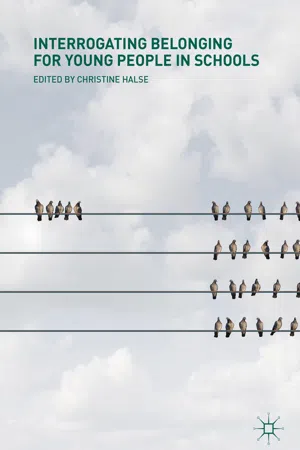
Interrogating Belonging for Young People in Schools
About this book
Information
Topic
EducationSubtopic
Education General© The Author(s) 2018
Christine Halse (ed.)Interrogating Belonging for Young People in Schoolshttps://doi.org/10.1007/978-3-319-75217-4_11. Theories and Theorising of Belonging
Christine Halse1
(1)
The Education University of Hong Kong, Hong Kong, China
Keywords
BelongingLiteratureTheoryYuval-DavisAhmedAminColhounIntroduction
This collection of essays and commentaries appears at a critical moment in history. It is an era marked by increasing transnational mobility and interconnectedness and the largest flow of refugees and migrants fleeing war, persecution and poverty in search of a safer, better life in recorded history. Around the globe, it is also an era of resurgent conservatism, nationalism and nativism, increasing physical, social and political attacks on racial, ethnic, cultural and religious minorities, and growing social and economic disparities within and between societies.
Deeply entangled in these historical conditions are profound questions about what belonging—and not belonging—means, how it is enacted and experienced, and its effects on and implications for individuals, groups and societies. Some of these questions are: what criteria are deployed to mark particular individuals and groups as belonging or not belonging? Who has the authority and power to decide who is entitled and not entitled to ‘belong’? What technologies, strategies, processes and social institutions are mobilised to enforce inclusion and exclusion? What privileges does belonging confer? How do the material, bodily and affective consequences of belonging/not belonging manifest themselves? What is lost or gained when individuals or groups are positioned as belonging/not belonging to the social majority? What are the personal, educational, social, political, economic and ethical implications for individuals and societies?
The contributors to this collection address such questions. They do so by bringing theories about belonging from disciplines beyond the field of education into dialogue with empirical data about the tangible, material and desired ways that young people experience, enact and understand belonging through their interactions with peers, teachers, schools and schooling practices. While attending to broader social and educational themes, each chapter offers a nuanced, micro-level analysis of the operation and experience of belonging and the haunting alternative of not belonging for young people, schools and schooling. These detailed analyses reveal the complexity of belonging as a theory, practice and mode of being, and its contemporary salience for young people and education.
The Concept of Belonging
Belonging has been described as ‘still a rather new theoretical term’ (Youkhana 2015, p. 12). Yet ‘ questions of belonging and the politics of belonging constitute some of the most difficult issues that are confronting all of us these days’ as a new arena of political and cultural contestation (Yuval-Davis 2011, p. 1). For these reasons, the processes, practices and theories of belonging have become a subject of interest and interrogation across multiple disciplines. These include but are not limited to political science and social policy (e.g., Börner 2013; Yuval-Davis 2011; Yuval-Davis et al. 2006), gender studies (e.g., Cervantes-Carson and Rumens 2007), studies of religion (e.g., Day 2011), race relations (e.g., Garbutt 2011), sociology (e.g., Savage et al. 2005), migration studies (e.g., Singh and Babacan 2010; Steiner et al. 2013), social geography (e.g., Antonsich 2010; Taylor 2009; Wright 2015); psychology and adolescent health (Bernat and Resnick 2009; Resnick et al. 1997; Walton and Carr 2012); philosophy and cultural studies (e.g., Probyn 1996), and youth studies (e.g., Bauer et al. 2012; White and Wyn 2013).
In contrast, significantly less attention has been paid to how belonging operates and might be theorised in the field of education. Of course, there are important exceptions. A sizable body of research in educational psychology and learning theory demonstrates that young people both need and benefit from a sense of belonging in schools (e.g., Osterman 2000). The concept of belonging is also central to citizenship education (e.g., Carson 2006; Gill and Howard 2009), refugees in schools (e.g., Arnot et al. 2009; Arnot and Swartz 2012; Pinson et al. 2010), teaching minority populations (e.g., Maher 2014; Matthews 2008), international education (e.g., Fail et al. 2004) and social justice in education (Hayes and Skattebol 2015). Debra Hayes and Jen Skattebol (2015) show, for example, how the emotional attachments of disadvantaged youth to family and friends constructs a politics of belonging that is manifest in resistance to conventional schooling. However, the social justice practices of an alternative school that attends to these specific ways of belonging gives students a second chance at education that can address their social disadvantage.
Nevertheless, belonging is a broad concept that has been described as vaguely defined (see Crowley 1999) and under-theorised ( see Anthias 2006; Antonsich 2010; Mee and Wright 2009). In scholarly convention, the term is used as encompassing all its grammatical variations, operating as a noun and a verb depending on its context. Thus, belonging can mean ‘to belong’ (v) or to possess or own something; it can also mean ‘belongingness’ (n), denoting that one belongs to and is a member of a particular social group, solidarity, collectivity or organisation.
What belonging involves, however, is not straightforward in a world of increasing racial, religious, ethnic, cultural and language diversity in schools, cities, societies and nations; growing digital connectedness that distributes values, ideas, practices and cultures across diverse local, national and transnational groups; and accelerating global interconnectedness of economies, businesses, education policy and systems. Each of these conditions constructs new social solidarities and fields of social interaction that find expression in the lives of individuals and their connectedness and belonging to specific social groups, collectivities and solidarities and particular places , spaces and times.
In his critique of liberal cosmopolitanism, Craig Calhoun (2003) argues that belonging or connectedness to particular social solidarities is intrinsic to the social world and central to the constitution of daily human life:
…it is impossible not to belong to social groups, relations, or culture … real people … are necessarily situated in particular webs of belonging [and] people are implicated in social actions which they are not entirely free to choose…. Moreover, when the limits of belonging to specific webs of relationships are transcended, this is not into a freedom from relationships but into a different organization of relationships [that creates] a patchwork of new connections . (Calhoun 2003, pp. 536–537)
Because the belonging that arises through connectedness is an active social process of everyday life, it is necessarily always relational. This means it is produced through the co-constitutive interaction of individuals with other people, things, institutions and specific socio-cultural contexts. It is this intersection between the self and the social—how individuals belong—that works to ‘define and configure what it means to belong ( and not belong)’ (Wright 2015, p. 393)...
Table of contents
- Cover
- Front Matter
- 1. Theories and Theorising of Belonging
- Part I. Gender, Sexuality and Belonging
- Part II. Race, Class, Citizenship and Nation
- Part III. Places and Spaces of Belonging
- Part IV. Pedagogies of Belonging and Non-belonging
- Part V. Afterword
- Back Matter
Trusted by 375,005 students
Access to over 1.5 million titles for a fair monthly price.
Study more efficiently using our study tools.
Frequently asked questions
Yes, you can cancel anytime from the Subscription tab in your account settings on the Perlego website. Your subscription will stay active until the end of your current billing period. Learn how to cancel your subscription
No, books cannot be downloaded as external files, such as PDFs, for use outside of Perlego. However, you can download books within the Perlego app for offline reading on mobile or tablet. Learn how to download books offline
Perlego offers two plans: Essential and Complete
- Essential is ideal for learners and professionals who enjoy exploring a wide range of subjects. Access the Essential Library with 800,000+ trusted titles and best-sellers across business, personal growth, and the humanities. Includes unlimited reading time and Standard Read Aloud voice.
- Complete: Perfect for advanced learners and researchers needing full, unrestricted access. Unlock 1.5M+ books across hundreds of subjects, including academic and specialized titles. The Complete Plan also includes advanced features like Premium Read Aloud and Research Assistant.
We are an online textbook subscription service, where you can get access to an entire online library for less than the price of a single book per month. With over 1.5 million books across 990+ topics, we’ve got you covered! Learn about our mission
Look out for the read-aloud symbol on your next book to see if you can listen to it. The read-aloud tool reads text aloud for you, highlighting the text as it is being read. You can pause it, speed it up and slow it down. Learn more about Read Aloud
Yes! You can use the Perlego app on both iOS and Android devices to read anytime, anywhere — even offline. Perfect for commutes or when you’re on the go.
Please note we cannot support devices running on iOS 13 and Android 7 or earlier. Learn more about using the app
Please note we cannot support devices running on iOS 13 and Android 7 or earlier. Learn more about using the app
Yes, you can access Interrogating Belonging for Young People in Schools by Christine Halse in PDF and/or ePUB format, as well as other popular books in Education & Education General. We have over 1.5 million books available in our catalogue for you to explore.