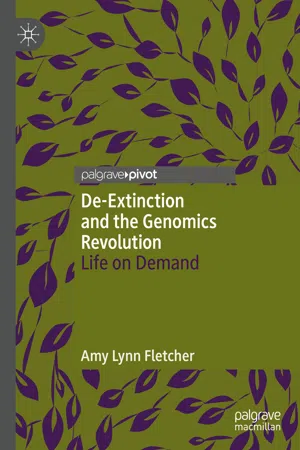
This book considers the cultural history and politics of de-extinction, an approach to wildlife conservation that seeks to use advanced biotechnologies for genetic rescue, crisis interventions, and even species resurrections. It demonstrates how the genomic revolution creates new possibilities for human transformation of nature and accelerates the arrival of the era of life-on demand. Fletcher combines a summative overview of the modern progress in biology and biotechnology that has brought us to this moment and evaluates the relationship between de-extinction and provocative contemporary ideas such as rewilding, eco-modernism, and the Anthropocene. Overall, the book contends that de-extinction, as reported in the public sphere, shifts between the demands of science and spectacle and draws upon our ongoing fascination with lost worlds, Frankenstein's monster, woolly mammoths, and dinosaurs.
- English
- ePUB (mobile friendly)
- Available on iOS & Android
eBook - ePub
About this book
Information
© The Author(s) 2020
A. L. FletcherDe-Extinction and the Genomics Revolutionhttps://doi.org/10.1007/978-3-030-25789-7_11. Preface and Acknowledgments
Abstract
This short book considers the implications of “life-on-demand,” that is, our ability to manipulate life via biotechnology. The enquiry centers on the idea of de-extinction, which gained global visibility in 2013 due to a TEDx De-Extinction event sponsored by several deep-pocketed stakeholders, but has its genesis in the scientific and social fascination with life, death, and immortality that dates to the nineteenth century and has persisted in various guises ever since. Against the backdrop of the contemporary extinction crisis, leveraging the power of biotechnology is arguably crucial to sustainability and even to human survival. Yet the dream of herds of mammoths trundling across the tundra or flocks of passenger pigeons darkening the skies again pulls on the imagination in ways that go far beyond science. This book thus scrutinizes the porous boundaries between the possible and the probable, fact and fantasy, inevitability and hype, that constitute science in society in the twenty-first century.
Keywords
BiotechnologyDe-extinctionImmortalitySilicon ValleyScience in societySocio-technical ImaginariesThis book considers the implications of nature made to order or what I call life-on-demand. As digital and biotechnologies extend the frontiers of what is possible with respect to human manipulation of the natural environment and species, including our own, it is important to pause and consider both how we reached this moment and what it signifies about how human beings relate to both the contemporary extinction crisis and the environmental imaginary of nature yet to come. The enquiry centers on the idea of de-extinction, which gained global visibility in 2013 due to a major TEDx De-Extinction event sponsored by several deep-pocketed stakeholders, but has its genesis in the scientific and social fascination with life, death, and immortality that gripped the nineteenth century in Europe and the United States and which has persisted in various forms ever since.
De-extinction, and its more established conceptual cousin, genetic rescue, are two ideas that deserve to be taken seriously as innovative responses to the catastrophic extinction crisis that surrounds us. Genetic rescue seeks to maximize genetic diversity and minimize inbreeding through either natural or facilitated reproduction in small and isolated populations. Genetic rescue “is a tool that can stem biodiversity loss more than has been appreciated, provides population resilience, and will become increasingly useful if integrated with molecular advances in population genomics.”1 Against the stark reality of the contemporary extinction crisis, wherein approximately 27 percent of the world’s species are threatened,2 genetic rescue could improve conservation interventions, fortify population resilience, and stem biodiversity loss.3 In the mid-1980s, Michael Soulé described conservation biology as a crisis discipline, arguing that conservation biology’s relationship to biology is analogous to “that of surgery to physiology and war to political science.”4 In the decades since, the extinction crisis has only worsened and is now reaching potentially catastrophic tipping points. Leveraging the power of genetic rescue and population genomics is crucial to averting this ecological disaster.
Yet as genetic rescue integrates within mainstream conservation work, a complementary idea, de-extinction, generates a steady stream of controversy, mass media attention, and public fascination since, at the farthest end of their scientific and entrepreneurial ambition, de-extinction proponents raise the possibility that advanced biotechnological tools such as reproductive cloning, gene editing, and ancient DNA analysis provide a means not only to revitalize extant populations but to bring back extinct species such as the woolly mammoth, Tasmanian tiger, or passenger pigeon. Critics of de-extinction worry about the diversion of scarce resources to such speculative “resurrection” projects and argue that the preservation of endangered species should be prioritized over fanciful projects to bring back charismatic lost species that departed the Earth quite some time ago. Proponents counter that de-extinction will actually contribute to deep ecological enrichment of the planet by restoring keystone species that humans carelessly decimated in earlier eras and that the long-term research will yield insights that may also save critically endangered species from passing over the threshold into extinction. As the field of de-extinction takes shape, other issues that have been well canvassed over the last decade include moral hazard, wherein the notion that species can be readily “brought back” reduces the incentive to protect them in the first place, the question of species authenticity, given that any “resurrected” species would technically be a hybrid (due to the use of surrogate species as either a genome template or for gestation), and the bioethical implications of bringing back a few remnants of species (such as woolly mammoths) that in their own time traveled in large herds and had fine-tuned social behaviors.
This book shifts focus from the arguments for and against de-extinction to consider its broader promissory and cultural dimensions. First, as will be seen, the idea of de-extinction is not quite as new as some of its contemporary proponents profess it to be, having a pedigree that tracks back to the emergence of the science fiction novel in the nineteenth century and to several influential scientific figures in the history of modern biology. Intimations of creating life-on-demand can be found in the nineteenth-century musings of physicist Ernst Mach (1838–1916) and biologist Jacques Loeb (1859–1924), for example, and, in 1951, the German scientist Heinz Heck (1894–1982) published accounts of his attempts to breed back the auroch—the progenitor of most contemporary cattle that, as a distinct species, had died out by 1667. This book places the contemporary subject of de-extinction and the media discourse scaffolding it into this broader historical context. It demonstrates how the twenty-first-century environmental imaginary, in which life is made to order through mastery of technology and seemingly fixed borders such as the line between extant and extinct become much more porous and open to human intervention, is firmly rooted in aspirations to exert control over nature that characterize the modern biotechnological project.
In doing this, I draw upon summative historical evidence as well as the vast scientific and popular literature on de-extinction that has emerged since the mid-1980s, when Russ Higuchi and his research team at the University of California released the first evidence that so-called ancient DNA could persist, in fragmented form, for at least 150 years.5 Analyzing the voluminous amount of documents, interviews, articles, and presentations that underwrite de-extinction discourse allows one to evaluate how the prospect of “resurrection biology” emerged, how it has been critiqued and negotiated in the mass media, and what visions of the future of wilderness and our technological relationship to nature are in play. As Alan Petersen argues, “because the media operate at the interface between genetic researchers and the public, they are likely to play an important role in shaping public perceptions of genetics and its value and applications, by selectively presenting some subthemes and not others.”6
The idea of de-extinction emerges from serious science but it also captures the imagination of the mass media, the general public, novelists, and film-makers in multiple ways that ensure that the boundary between science fact and science fiction remains permeable. Ergo, I also consider how disputants in this debate negotiate the limits of de-extinction in the public domain (inclusive of digital and print media, TED conferences, the published scientific literature, and other outlets for scientific research and debate) and navigate the tension between the desire to normalize de-extinction within conservation science and the deployment of resurrected woolly mammoths to attract support, attention, and funding within a crowded scientific and media landscape. The organizing premise of this book is that de-extinction is a rich case study of the tension between regimes of hope, in which new and better scientific interventions and products are always on the horizon, and regimes of truth, in which science must recalibrate the timeline for success and invoke expertise to demarcate the line between science and hype.7 Just as stem cell research gained widespread public attention and funding traction in the early 2000s, when put in the promissory context of curing degenerative diseases, the image of herds of mammoths trundling across the tundra or flocks of passenger pigeons darkening the skies again pulls on the human imagination and bridges the knowledge gaps between scientists, investors, and the mass public. This fact does not imply deliberate manipulation by any stakeholder in this debate. Instead, an essential starting point in this analysis is that the contemporary ecosystem of big science, inclusive of multiple and interlocking actors and agendas and sustained by the public’s attention and support, inevitably blurs the line between science and science fiction. We therefore have to parse continuously the shifting boundaries between the possible and the probable, fact and fantasy, inevitability and hype.
Multiple players engage daily in constructing the field of de-extinction—entrepreneurs, scientists, ethicists, journalists, artists, academics, and investors—and collectively the interaction between these stakeholders advances a new discourse of life and conservation that renders old edicts such as “when a species is gone, it is gone forever” less absolute. Moreover, in an era of exponential technological change, wherein the power to shape politics, culture, and markets shifts to prominent technology centers such as Silicon Valley, certain corporate players can push the frontiers of the conceivable more consequentially than others. The debate about the benefits, risks, and ethics of de-extinction thus intersects with the imperative to extract applied and commercial value from research in order to keep the biotechnological innovation ecosystem alive and functioning. As the story is told, a few enterprising and well-connected individuals had a disruptive idea: what if extinction need not remain the final stop on the evolutionary journey? Through a combination of grit, enthusiasm, talent, and research, stakeholders invested in this idea decided to find out if we could eventually replenish the Earth with vanished species. As with all such stories, this account is partially true, but it obscures the more tangled pathway via which certain elite ideas and agendas gain traction in science and society and others do not. Ergo, tracing the idea of de-extinction as it shifts between the modes of normal science and spectacular science, disruptive innovation and incremental innovation, and aspirations and retrenchment is to elucidate a paradigmatic case of life-in-the-making.
This analysis attends to the discursive politics of de-extinction, the way in which texts, documents, speeches, and scientific talks combine to produce a new framework both for wilderness restoration and for thinking about our relationship to the natural world. Per John Dryzek, “a discourse is a shared way of apprehending the world. Embedded in language…each discourse rests on assumptions, judgements, and contentions that provide the basic terms for analysis, debates, agreements, and disagreements, in the environmental area.”8 A focus on how language is used to create new scientific possibilities, and on the friction between public language and expert language, demonstrates how de-extinction is one key territory in a much larger biotechnological frontier being explored in this century. In applying the tools of...
Table of contents
- Cover
- Front Matter
- 1. Preface and Acknowledgments
- 2. Matters of Life and Death in the Anthropocene
- 3. The Secrets of All Inheritance: A Cultural History of DNA
- 4. Mammoths, Museums, and Molecules: A De-Extinction Icon Emerges
- 5. Conclusion: Life-on-Demand
- Back Matter
Trusted by 375,005 students
Access to over 1.5 million titles for a fair monthly price.
Study more efficiently using our study tools.
Frequently asked questions
Yes, you can cancel anytime from the Subscription tab in your account settings on the Perlego website. Your subscription will stay active until the end of your current billing period. Learn how to cancel your subscription
No, books cannot be downloaded as external files, such as PDFs, for use outside of Perlego. However, you can download books within the Perlego app for offline reading on mobile or tablet. Learn how to download books offline
Perlego offers two plans: Essential and Complete
- Essential is ideal for learners and professionals who enjoy exploring a wide range of subjects. Access the Essential Library with 800,000+ trusted titles and best-sellers across business, personal growth, and the humanities. Includes unlimited reading time and Standard Read Aloud voice.
- Complete: Perfect for advanced learners and researchers needing full, unrestricted access. Unlock 1.5M+ books across hundreds of subjects, including academic and specialized titles. The Complete Plan also includes advanced features like Premium Read Aloud and Research Assistant.
We are an online textbook subscription service, where you can get access to an entire online library for less than the price of a single book per month. With over 1.5 million books across 990+ topics, we’ve got you covered! Learn about our mission
Look out for the read-aloud symbol on your next book to see if you can listen to it. The read-aloud tool reads text aloud for you, highlighting the text as it is being read. You can pause it, speed it up and slow it down. Learn more about Read Aloud
Yes! You can use the Perlego app on both iOS and Android devices to read anytime, anywhere — even offline. Perfect for commutes or when you’re on the go.
Please note we cannot support devices running on iOS 13 and Android 7 or earlier. Learn more about using the app
Please note we cannot support devices running on iOS 13 and Android 7 or earlier. Learn more about using the app
Yes, you can access De-Extinction and the Genomics Revolution by Amy Lynn Fletcher in PDF and/or ePUB format, as well as other popular books in Social Sciences & Sociology. We have over 1.5 million books available in our catalogue for you to explore.