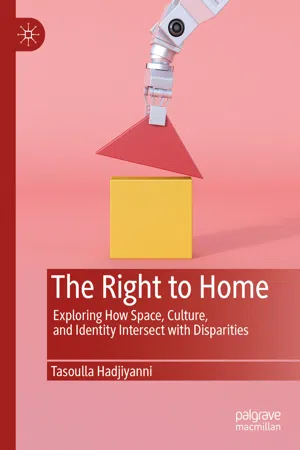
This book explores how the design characteristics of homes can support or suppress individuals' attempts to create meaning in their lives, which in turn, impacts well-being and delineates the production of health, income, and educational disparities within homes and communities. According to the author, the physical realities of living space—such as how kitchen layouts restrict cooking and the size of social areas limits gatherings with friends, or how dining tables can shape aspirations—have a salient connection to the beliefs, culture, and happiness of the individuals in the space. The book's purpose is to examine the human capacity to create meaning and to rally home mediators (scholars, educators, design practitioners, policy makes, and advocates) to work toward Culturally Enriched Communities in which everyone can thrive. The volume includes stories from Hmong, Somali, Mexican, Ojibwe, and African American individuals living in Minnesota to show how space intersects withrace, gender, citizenship, ability, religion, and ethnicity, positing that social inequalities are partially spatially constructed and are, therefore, malleable.
“Home is more than housing.” This is typically the simple answer to the question, “What is home?” Decades of research on what home means to people have unearthed the multiple dimensions that are tied to home-making processes, conflating home-making with meaning-making. Houses are among the settings where people create order, shape intentions, form dreams, face adversity, rethink obligations, and relish in their rights. In a house, life attains significance through gatherings with friends and family to share stories around the living roomfireplace; cooking favored foods in the kitchen and generating familiar smells and tastes; praying to express gratitude and ask the divine for re-assurance; decorating using colors, textures, and objects that create a preferred aesthetic, and in the case of Blanca Morales, studying to make her dream of becoming a doctor come true.
As a poster child for the Deferred Action for Childhood Arrivals program (DACA), Blanca cannot help but reminisce about the kitchentable in the tiny studio apartment in Santa Ana, California, where she grew up. Strolling through Harvard Medical School, she can still hear her mother’s voice. Tired from picking strawberries all day, she would find the energy to call on her youngest children to be quiet so Blanca could study at the kitchentable, the place where her dream began and where her future as an American success story was crafted (Flores & Conlon, 2018). Although the high school drop-out rate among Hispanics has fallen to a new low in 2016, it remained at 10 percent, the highest of all racial and ethnic groups in the U.S.—the overall drop-out rate in the U.S. stood at 6 percent (Gramlich, 2017). And yet, the kitchentable has received little attention in efforts to eliminate educational disparities and create communities in which everyone can thrive. Where was the table located? How big was it? What kind of lighting was there? Which rooms were adjacent to the kitchentable? Where did Blanca store her homeworkmaterials? And how did the family manage to have a meal when the table was occupied (Image 1.1)?
Image 1.1
Table where Blanca’s future as an American success story was crafted. Image courtesy of Blanca Morales
The urgency behind these questions is tied to expected demographic changes that for the state of Minnesota point to 40 percent of the population being people of color by 2040, compared to present numbers of 15 percent. Close to half of the growth in the state’s population is expected to come from international immigrants (Metropolitan Council, 2012). Health, income, and educational disparities abound in the U.S. between Whites and people of color. The statistics are sobering and in the chapters that follow, we will delve deeper into them. Take, for example, life expectancy. Between 1980 and 2014, life expectancy at birth in the U.S. has increased by 5.3 years for both men and women. This promising statistic is overshadowed however, by a gap of 20.1 years between U.S. counties with the lowest and highest life expectancies. Many of the counties with very low life expectancies are found in North and South Dakota and overlap with large Native American reservations (Dwyer-Lindgren et al., 2017).
Much of the variation in life expectancy can be explained by differences in socioeconomic level (poverty, income, education, unemployment), race/ethnicity, behaviors (smoking and physical activity), metabolic risk factors (obesity, diabetes, hypertension, cardiovascular disease), and access to and quality of health care (Dwyer-Lindgren et al., 2017). Higher-income Americans, for instance, are twice as likely to report being in good health than their lower-income counterparts, and they are less likely to have high stress levels. Income can protect individuals from chronic stressors such as food insecurity, violence, and substandard housing, while at the same time it can provide better access to high-quality health care (Schanzenbach, Mumford, Nunn, & Bauer, 2016). It is not surprising then that in Minnesota, one’s zip code was found to relate to life expectancy, strongly correlating socioeconomic status and health with place. In the Minneapolis/St. Paul region, residents of the highest-income areas have been found to have an average life expectancy of 82 years, while residents of the lowest-income areas have an average life expectancy of 74 years, and these areas typically have high concentrations of people of color (Helmstetter, Brower, & Egbert, 2010).
Place and location have also been noted for shaping economic and social outcomes. A groundbreaking study by some of the country’s top economists that used millions of earnings records to better understand upward mobility demonstrated that where you grow up matters, particularly for middle-class and poor children. Upward mobility tended to be higher in metropolitan areas where poor families were more dispersed among mixed-income neighborhoods and in areas with more two-parent households, better elementary schools and high schools, and more civic engagement, including membership in religious and community groups. The findings lend weight to the characteristics of different regions, versus the characteristics of local residents, as being responsible for the varying mobility rates (Chetty, Friedman, Hendren, Jones, & Porter, 2018).
Part of the challenge in tying home-based practices to disparities is first, the limited cross-over among different forms of scholarship: scholarship around health, income, and educational disparities draws from fields such as public health and public policy while scholarship around home draws on ethnographic and phenomenological studies that stem from fields such as geography, anthropology, and environmental psychology. Second, in an era defined by displacement, globalization, migration (both within and across national borders), transnationalism, and questions around what (and how) constitutes culture and identity, understandings of home as a static and permanent place and one that is linked to a specific location and physical structure have shifted. Home is now understood as “that which takes place in terms of relations” (Latimer & Munro, 2009, p. 328), extending to things, people, rituals, traditions, and other forms of creating connections that expose home’s ambiguous, elusive, political, and contextual character (Duyvendak, 2011; Kusenbach & Paulsen, 2013). The focus is on the dweller and the dweller’s agency, leaving home interiors undertheorized and treated as monolithic entities, ones examined from a bird’s eye view, with little understanding of how design characteristics impact diverse lifeways. Unresolved are three questions: how are relationships produced through domestic environments? What aspects of residential design support or suppress people’s attempts to construct meaning? And, what are the implications of the various ways of meaning-making for the production of inequality and marginalization?
Housing is already embedded in global, n...
Table of contents
Cover
Front Matter
1. Introduction: Oikophilia
2. The “and”
3. Hmong Stories: “Only in the house do your dead ancestors live”
4. Somali Stories: “I hope God will not isolate me from my community”
5. Mexican Stories: “I can talk to her and she listens”
6. Ojibwe Stories: “When the traditions are lost, it is like a person who has no identity”
7. African American Stories: “To be self-sufficient and responsible in society”
8. Moving Forward
Back Matter
Trusted by 375,005 students
Access to over 1.5 million titles for a fair monthly price.
Study more efficiently using our study tools.
Frequently asked questions
Yes, you can cancel anytime from the Subscription tab in your account settings on the Perlego website. Your subscription will stay active until the end of your current billing period. Learn how to cancel your subscription
No, books cannot be downloaded as external files, such as PDFs, for use outside of Perlego. However, you can download books within the Perlego app for offline reading on mobile or tablet. Learn how to download books offline
Perlego offers two plans: Essential and Complete
Essential is ideal for learners and professionals who enjoy exploring a wide range of subjects. Access the Essential Library with 800,000+ trusted titles and best-sellers across business, personal growth, and the humanities. Includes unlimited reading time and Standard Read Aloud voice.
Complete: Perfect for advanced learners and researchers needing full, unrestricted access. Unlock 1.5M+ books across hundreds of subjects, including academic and specialized titles. The Complete Plan also includes advanced features like Premium Read Aloud and Research Assistant.
Both plans are available with monthly, semester, or annual billing cycles.
We are an online textbook subscription service, where you can get access to an entire online library for less than the price of a single book per month. With over 1.5 million books across 990+ topics, we’ve got you covered! Learn about our mission
Look out for the read-aloud symbol on your next book to see if you can listen to it. The read-aloud tool reads text aloud for you, highlighting the text as it is being read. You can pause it, speed it up and slow it down. Learn more about Read Aloud
Yes! You can use the Perlego app on both iOS and Android devices to read anytime, anywhere — even offline. Perfect for commutes or when you’re on the go. Please note we cannot support devices running on iOS 13 and Android 7 or earlier. Learn more about using the app
Yes, you can access The Right to Home by Tasoulla Hadjiyanni in PDF and/or ePUB format, as well as other popular books in Scienze sociali & Design d'interni. We have over 1.5 million books available in our catalogue for you to explore.