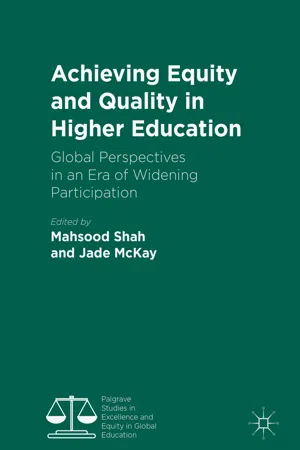
Across the world, higher education is witnessing exponential growth in both student participation and types of educational providers. One key phenomenon of this growth is an increase in student diversity: governments are widening access to higher education for students from traditionally underrepresented groups. However, this raises questions about whether this rapid growth may in face compromise academic quality. This book presents case studies of how higher education institutions in diverse countries are maintaining academic excellence while increasing the access and participation of students from historically underrepresented backgrounds. Including case studies spanning four continents, the authors and editors examine whether increasing widening participation positively impacts upon academic quality. This volume will be of interest and value to students and scholars of global higher education, representation and participation in education, and quality in higher education.
eBook - ePub
Achieving Equity and Quality in Higher Education
Global Perspectives in an Era of Widening Participation
- English
- ePUB (mobile friendly)
- Available on iOS & Android
eBook - ePub
Achieving Equity and Quality in Higher Education
Global Perspectives in an Era of Widening Participation
About this book
Information
Topic
EducationSubtopic
Comparative Education© The Author(s) 2018
Mahsood Shah and Jade McKay (eds.)Achieving Equity and Quality in Higher EducationPalgrave Studies in Excellence and Equity in Global Educationhttps://doi.org/10.1007/978-3-319-78316-1_11. Leadership for Institutional Change to Promote Diversity and Success
Introduction
This chapter explores the contribution of leadership to a whole institution approach (WIA) to WP and student success using empirical evidence from two research studies involving 21 HEPs in the UK. This chapter is based on two key principles. First, increasing student diversity and ensuring that these students are successful in HE and beyond, which equates to a high quality learning experience; and second, ensuring the success of all students, including those from diverse and under-served groups, which requires a WIA. This chapter is structured as follows: an overview of the UK HE context and the relationship between widening access, student success and academic quality; summary details about the two empirical studies; consideration of a WIA and why it is necessary; the introduction of the theoretical framework; a discussion of the evidence about the role of leadership drawing on the framework and the empirical evidence; and concluding points about the practice of leadership for institutional change to promote diversity and success.
The UK Context
The UK has had a longstanding and comparatively successful approach to expanding participation in HE by students from groups who have been traditionally underrepresented. Each of the four nations—England, Scotland, Wales and Northern Ireland—has over the past 20 years used policies and institutional funding as levers to encourage, incentivise and require HEPs to ‘widen access’. This focus on entry quickly extended to embrace the retention, completion and longer-term success of these students, with a strong current emphasis on employment outcomes, all of which can be viewed as indicators of the quality of a higher education system. For example, in England the National Strategy makes explicit the lifecycle approach to WP, and all institutions that charge fees above a minimum threshold are required to allocate a proportion of additional fee income to widening access, student retention and success and progression into employment or further study. Annual Access Agreements set out each institution’s commitments (including spending) and outcome targets, and these must be approved by the Director of Fair Access and subsequently published; progress is monitored annually.
The UK HE System
Higher education in the UK is a responsibility controlled at the level of each of the four nations: England, Scotland, Wales and Northern Ireland.
In England alone there are more than 100 universities, and approximately 350 HEPs in receipt of public sector funding. This is in addition to more than 600 private providers, most of which are comparatively small. In 2012–13 there were 2,340,275 HE students at HE institutions, plus 186,455 HE students at further education colleges in England. The majority of students in the UK are registered for full-time study (79%); and 67% are under 21 when they commence HE study. The young participation rate in England is 38% and in Scotland it is 45%. Participation rates however vary between groups, and in England 51% of young people in the most advantaged quintile participate in HE, while only 20% participate from the most disadvantaged quintile. 43% of students are male, but there are significant differences between subjects. 71% of students identify themselves as ‘white’ (compared to other ethnic categories) and 82% have no known disability. The student population has been increasing since the system expanded in the early 1990s, and while this has slowed it has not stopped, despite the introduction of student tuition fees (2006) and significantly increased fees (2012/13). The population of part-time students declined significantly in 2012/13 however, and has not yet recovered, but overall student numbers remain intact at the system level. From 2015/16 the recruitment caps were lifted in England, enabling institutions to recruit as many students as they choose, thus reducing some of the challenges for widening participation; while in Scotland student numbers are fixed, with additional places allocated for widening access students from specific areas of disadvantage based on their home postcode (address). In England the non-continuation rate from first to second year of study for young students is around 7% and around 13% for mature students, and the overall completion rate for the sector is 82%.
Diversity and Quality: The Teaching Excellence Framework
Over the past two decades the UK HE system has not only expanded its student numbers and diversity, it has also maintained many of its indicators of quality, including selective admission to HE and high rates of completion. In 2017 the Teaching Excellence Framework (TEF) was introduced as a method of assessing the quality of learning and teaching, making both the outcomes and the evidence publicly available; although this was not its primary purpose, the TEF demonstrates the UK’s commitment to diversity and quality.
The TEF assesses HEPs in three broad areas: teaching quality, learning environment plus student outcomes and learning gain. Teaching quality takes into account: contact, stimulation, challenge, student engagement; course design, assessment and feedback; developing students’ knowledge, skills and understanding; and recognition and reward of excellent teaching. Learning environment includes: libraries, laboratories and studios; work experience, peer interaction and extra-curricular activities; support for learning and independent study; a personalised academic experience to maximise retention, progression and attainment; and links between teaching and learning, and scholarship , research or professional practice. Student outcomes and learning gain looks for positive outcomes such as lifelong learning skills and contribution to society, economy and the environment; progression to further study; and knowledge, skills and attributes to compete for graduate level jobs.
The TEF utilises common metrics available for all providers and combines this with a narrative prepared by each HEP; the first three standardised metrics are derived from the National Student Survey (an annual survey of final year undergraduate students’ satisfaction that all HEPs participate in), and relate to teaching on the course, assessment and feedback and academic support. The other metrics are non-continuation data provided by the Higher Education Statistics Agency (HESA) based on institutions’ annual returns, and two employment outcomes—in employment or further study and in highly skilled (graduate) employment or further study—from the Destination of Leavers of HE, a survey conducted with graduates six months after completion. The TEF is concerned with these metrics overall, but also in relation to students from non-traditional and disadvantaged groups, and data are provided in relation to specific groups (socio-economically) disadvantaged, disabled, BME and mature students. Contextual data are also supplied about each provider, such as entry tariffs (the proportion of students entering with low, medium and high entry qualifications), numbers and proportions of students from each of the specific groups named above and additional information, such as the number of local students (based on travel to work areas). The holistic assessment takes into account the differential outcomes as well as the overall outcomes, and indeed the TEF panel includes WP and diversity experts. This all implies that an excellent experience and outcome for all students—including those from diverse and non-traditional backgrounds—contributes to overall assessment of excellence within HE in the UK. This is reflected in the comment from the Director of Fair Access to Higher Education:
I welcome the publication of these results. I have always argued that, designed well, the TEF had the potential to improve outcomes for all students. So I am pleased that the metrics have taken students’ backgrounds into account, as this will help universities and colleges see where progress is being made for students from disadvantaged backgrounds, and where there are still unexplained gaps in attainment between the most and least advantaged. I look forward to continuing to work with those across the sector to ensure that teaching excellence means excellence for students from all backgrounds. (OFFA 2017)
Empirical Evidence
This chapter is informed by two studies (each led by author): one focusing on improving student retention and success in HE which concluded that a WIA is required, and the second which was commissioned to better understand a WIA to WP (including student success). These are briefly described now.
Study 1: What Works? Student Retention and Success
In 2008 the What Works? Student Retention and Success Programme (WW?1) was launched by the Higher Education Funding Council for Eng...
Table of contents
- Cover
- Front Matter
- 1. Leadership for Institutional Change to Promote Diversity and Success
- 2. Vertically Segregated Higher Education and the Life Course: Comparing Patterns Over 28 Years
- 3. Supporting Students’ Learning: The Power of the Student–Teacher Relationship
- 4. Facilitating the Success of Students from Low SES Backgrounds at Regional Universities Through Course Design, Teaching, and Staff Attributes
- 5. A Case Study Using Developmental Education to Raise Equity and Maintain Standards
- 6. Vision 20:20 and Indigenous Health Workforce Development: Institutional Strategies and Initiatives to Attract Underrepresented Students into Elite Courses
- 7. Social Inclusion or Social Engineering? The Politics and Reality of Widening Access to Medicine in the UK
- 8. University Strategies to Improve the Academic Success of Disadvantaged Students: Three Experiences in Chile
- 9. Widening Participation in Medicine in the UK
- 10. Affirmative Actions as an Instrument to Balance Access to Superior Education in Brazil: The Quotas Policy
- 11. The Conundrum of Achieving Quality Higher Education in South Africa
- 12. Fees Regimes and Widening Access in the Four UK Nations: Are No-Fees Regimes Necessarily More Socially Inclusive?
- 13. High Status Professions, Their Related Degrees and the Social Construction of ‘Quality’
- 14. How Can Contextualised Admissions Widen Participation?
- 15. Governmental Supports for Students in Turkey: Beneficiary Perspective on the Use of Financial and Social Support in Higher Education
- Back Matter
Trusted by 375,005 students
Access to over 1.5 million titles for a fair monthly price.
Study more efficiently using our study tools.
Frequently asked questions
Yes, you can cancel anytime from the Subscription tab in your account settings on the Perlego website. Your subscription will stay active until the end of your current billing period. Learn how to cancel your subscription
No, books cannot be downloaded as external files, such as PDFs, for use outside of Perlego. However, you can download books within the Perlego app for offline reading on mobile or tablet. Learn how to download books offline
Perlego offers two plans: Essential and Complete
- Essential is ideal for learners and professionals who enjoy exploring a wide range of subjects. Access the Essential Library with 800,000+ trusted titles and best-sellers across business, personal growth, and the humanities. Includes unlimited reading time and Standard Read Aloud voice.
- Complete: Perfect for advanced learners and researchers needing full, unrestricted access. Unlock 1.5M+ books across hundreds of subjects, including academic and specialized titles. The Complete Plan also includes advanced features like Premium Read Aloud and Research Assistant.
We are an online textbook subscription service, where you can get access to an entire online library for less than the price of a single book per month. With over 1.5 million books across 990+ topics, we’ve got you covered! Learn about our mission
Look out for the read-aloud symbol on your next book to see if you can listen to it. The read-aloud tool reads text aloud for you, highlighting the text as it is being read. You can pause it, speed it up and slow it down. Learn more about Read Aloud
Yes! You can use the Perlego app on both iOS and Android devices to read anytime, anywhere — even offline. Perfect for commutes or when you’re on the go.
Please note we cannot support devices running on iOS 13 and Android 7 or earlier. Learn more about using the app
Please note we cannot support devices running on iOS 13 and Android 7 or earlier. Learn more about using the app
Yes, you can access Achieving Equity and Quality in Higher Education by Mahsood Shah, Jade McKay, Mahsood Shah,Jade McKay in PDF and/or ePUB format, as well as other popular books in Education & Comparative Education. We have over 1.5 million books available in our catalogue for you to explore.