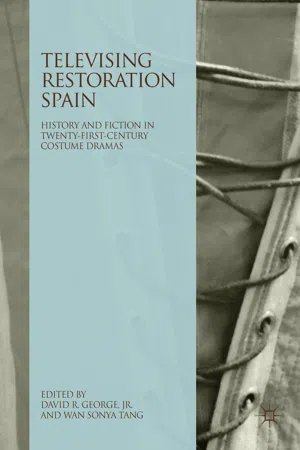
This edited volume examines the historical, political, cultural, and aesthetic implications of re-visiting Restoration Spain (1874-1931) in television costume dramas produced since 2000. Contributors analyze, from different theoretical approaches and disciplinary perspectives, the appeal that the late nineteenth and early twentieth centuries hold for twenty-first-century Spanish audiences, as well as for international viewers who consume these programs through new media platforms. Themes and issues explored include: the production of televisual heritage, representations of period technologies, evolving constructions of gender, hybridization of television genres, and television as historian. Expanding the scope of inquiry in Spanish media studies, this collection seeks to bring Spain into wider discussions of media and historical representation and visual and material culture in Europe, the Americas, and beyond.
eBook - ePub
Televising Restoration Spain
History and Fiction in Twenty-First-Century Costume Dramas
- English
- ePUB (mobile friendly)
- Available on iOS & Android
eBook - ePub
Televising Restoration Spain
History and Fiction in Twenty-First-Century Costume Dramas
About this book
Information
Subtopic
Film & Video© The Author(s) 2018
David R. George, Jr. and Wan Sonya Tang (eds.)Televising Restoration Spainhttps://doi.org/10.1007/978-3-319-96196-5_11. Introduction
David R. GeorgeJr.1 and Wan Sonya Tang2
(1)
Bates College, Lewiston, ME, USA
(2)
Boston College, Chestnut Hill, MA, USA
Keywords
Restoration SpainTelevision seriesLiterary adaptationsTelevision fictionsHeritageQuality televisionCommemorationTransition to democracyManuel PalacioJerome de GrootSpanish modernityPoliticsRegional identityClass relationsGender dynamicsTechnological innovationArtistic innovationGenre El ministerio del tiempo Victorian EnglandIn episode 32 “Tiempo de Verbena” of Televisión Española ’s sci-fi history series El Ministerio del Tiempo (TVE , 2015–2017), the character Angustias (Francesca Piñon) takes a break from her post as secretary in the Ministry of Time to travel back to 1894 in hopes of landing tickets for the premiere of her favorite zarzuela, La verbena de la Paloma. Having missed the show because of her mother’s illness, she is profoundly dismayed to discover upon arriving at the defunct Teatro Apolo in Madrid that the performance has been canceled. Angustias returns to the present and persuades the ministry to send her back in the company of special agents Lola (Macarena García) and “Pacino” (Hugo Silva) to ensure that the show goes on to make history . Within the structure of the series, this particular mission serves as a comic digression from the main plotline, but nonetheless falls within the purview of the government ministry charged with safeguarding the course of Spanish history against the meddling of rival secret societies. The agents initially question the importance of saving a zarzuela for posterity, yet, following the established pattern of the series that gives equal weight to political and cultural artifacts, figures and events in the preservation of national heritage, the trio is assigned the task. Through the depiction of the moment of gestation of what remains one of the most popular pieces of the Spanish género chico (light-opera) repertoire, the trope of time-travel consecrates the work, and more important still, the period of the Restoration (1874–1931) in which it was produced, as fundamental in the trajectory of Spain’s past as represented in the series.
El Ministerio del Tiempo traffics in historical tableaux vivants that entertain and instruct by recreating recognizable episodes of Spanish history for twenty-first-century audiences (Rueda Laffond et al. 2016, 98). The opening sequence of “Tiempo de verbena” exemplifies the modus operandi of the series: Angustias finds herself on stage on the night of the opera’s debut improvising the role of Tia Antonia, backed by Lola and “Pacino,” dressed in traditional Madrid garb. The comic sequence recreates a plausible yet irrecoverable moment of cultural history through a medley of the zarzuela’s most familiar scenes and tunes—“Por ser la Virgen de la Paloma,” “Coplas de Don Hilarión,” and “Donde vas con mantón de Manila”—in uncanny fashion that interpolates the audience’s memories of performances preserved and replayed on film and video. As a result, the historical context becomes available for fabulation: History and fiction playfully mix when fictional agents track down the librettist Ricardo de la Vega (Manuel Brun) and composer Tomás Bretón (Bruno Oro) in a café conversing with novelists Benito Pérez Galdós (Jorge Basanta) and José Echegaray (Pedro Garcia de las Heras). While the musical figures are less known, the time-travelers, and viewers of a certain age, recognize the writers as cultural icons whose faces once adorned 1000 pesetas notes issued in the 1970s and 1980s.
Within the scope of the series, this comic episode is loaded with self-referential winks to avid fans, since this is not the only instance in which ministry agents intervene in the period spanning the turn-of-the-twentieth century over the course of three seasons. By and large, more than as history, the Restoration functions as story in El Ministerio del Tiempo , either as a plot point of origin, or as a convenient retreat into the past, as in the case of Angustias’s “vacation” to 1894. Consequently, the epoch appears prominently, and so not insignificantly, in agent biographies developed both on-screen and in the web of transmedia stories spun on the Internet and social media . Together with Angustias, who was born in the 1870s, all four of the series’ female characters hail from the years of the Restoration : Amelia Folch (Aura Garrido) was born in 1857; Lola, around 1920; and Irene Larra (Cayetana Guillén), in 1930. This gendered treatment of the Restoration is fitting, as it was during this period that the modern Spanish feminist movement was consolidated. Of the four female characters, the popular agent Amelia best embodies the period: Born to an upper-class family in Barcelona , she was supposedly among the first women to graduate university and became active in the anti-slavery movement of the 1880s before her recruitment to the ministry. Her departure from El Ministerio del Tiempo in episode 27 (“Tiempo de esclavos”) occurs significantly after ministry agents foil a wholly fictional plot to assassinate King Alfonso XII in 1881, which would have fundamentally altered the history of the period by leaving the throne without a male heir (Alfonso XIII) . Notably, the ministry’s recruitment officer Irene brushes with death when she travels back to 1918 in episode 13 (“Un virus de otro tiempo”) to assist the birth of historic flamenco dancer Carmen Amaya “La Capitana” and becomes a victim of the Spanish flu pandemic; she is rescued by colleagues and returned to the present to be cured. Perhaps the most emblematic historical events of the Restoration figure in the biography of Amelia’s male cohort Julián Martínez (Rodolfo Sancho ): Halfway through season two, he abandons his post and is eventually tracked down in 1898 serving as volunteer field doctor during the Spanish–American War, first in Cuba (episode 15 “Tiempo de Valientes I”), and finally in the Philippines (episode 16, “Tiempo de Valientes II”). True biography also works as an indirect mode of representing the era in the form of references to mostly cultural figures whose works are emblematic of Restoration Spain as the hatching ground for successive movements of artistic innovation. In addition to the historical characters in “Tiempo de Verbena,” who represent the Realist Generation of 1868, the Generation of 1898, Modernism and the Avant-Garde are evoked in cameo appearances by the likes of Pablo Picasso , Federico García Lorca , Luis Buñuel , and Ramón del Valle-Inclán , among others.
The recurrence of the Restoration in El Ministerio del Tiempo puts the show in dialogue with various recent costume dramas set in the era, as well as with the longer tradition of literary adaptations that have brought to the small screen numerous works of literature from the time. Whereas the vignettes of the sci-fi series transport the agents of the ministry back to the period and engage audiences as voyeuristic spectators who derive pleasure from the characters’ game of dress up, recent series that recreate the age promise to transport viewers themselves through original fictions that directly involve them in stories that are historically plausible and visually pleasurable. These full-fledged recreations of the Restoration are not incompatible with the brief encounters offered by El Ministerio del Tiempo ; on the contrary, both formats complement each other in the production of a more complete rendering of an age that, for all its televisual presence, still remains a largely misunderstood chapter in contemporary Spanish history .
The Restoration Is History
Following the airing of episode 27 “Tiempo de esclavos” on July 7, 2017, Aurelio Pimental posted a feature on TVE ’s El Ministerio del Tiempo webpage titled “Las diez cosas que España no tendría si Alfonso XII hubiera muerto en el atentado de El Ministerio del Tiempo ” (Pimental 2017). In the introduction to the list, the writer assures fans that, had the mission failed, the course of Spanish history would have been fundamentally altered. The enumeration is little more than a hodgepodge of trivia that at best undermines the historical plausibility of the episode set in 1881; most of the events and outcomes listed predate the supposed setting and so would have happened anyway. This aside, the register of things that would be missed today includes the playground song “¿Dónde vas, Alfonso XII?,” the popular boating pond in Madrid’s Retiro Park and the king’s torrid affair with opera diva Elena Sanz, alongside the 1876 Constitution , the end of the Carlist Wars and the institution of the Bourbon monarchy itself. By referring to random events and outcomes of Alfonso XII’s reign, and more generally, of the Restoration of the monarchy he symbolized, the page and viewers’ commentary and rankings of the items provide insight into the place both the period and the monarch occupy in popular historical imaginary.
For television viewers, part of the appeal of the Restoration as a historical setting is that it constitutes an aesthetically attractive period that is recognizable yet about which audiences retain relatively little real knowledge. In 2014, the online version of conservative newspaper ABC published a short quiz titled “¿Aprobarías un examen de la Restauración borbónica?” (Would you pass an exam on the Bourbon Restoration?). In it, author Manuel Villatoro challenges ABC’s online readers to outperform high school students, for whom the Restoration comprises a unit of the state-mandated history curriculum, on a ten-question, largely multiple-choice quiz (2014). Villatoro prefaces the questions by stating that “Su extensión, su cercanía en el tiempo a nuestra época (menos de dos siglos) y sus grandes repercusiones políticas han hecho de este periodo uno de los más ...
Table of contents
- Cover
- Front Matter
- 1. Introduction
- Part I. Producing Heritage
- Part II. Imagining Technologies
- Part III. Constructing Genders
- Part IV. Restoring the Telenovela
- Part V. Sensing the Ending
- Back Matter
Trusted by 375,005 students
Access to over 1.5 million titles for a fair monthly price.
Study more efficiently using our study tools.
Frequently asked questions
Yes, you can cancel anytime from the Subscription tab in your account settings on the Perlego website. Your subscription will stay active until the end of your current billing period. Learn how to cancel your subscription
No, books cannot be downloaded as external files, such as PDFs, for use outside of Perlego. However, you can download books within the Perlego app for offline reading on mobile or tablet. Learn how to download books offline
Perlego offers two plans: Essential and Complete
- Essential is ideal for learners and professionals who enjoy exploring a wide range of subjects. Access the Essential Library with 800,000+ trusted titles and best-sellers across business, personal growth, and the humanities. Includes unlimited reading time and Standard Read Aloud voice.
- Complete: Perfect for advanced learners and researchers needing full, unrestricted access. Unlock 1.5M+ books across hundreds of subjects, including academic and specialized titles. The Complete Plan also includes advanced features like Premium Read Aloud and Research Assistant.
We are an online textbook subscription service, where you can get access to an entire online library for less than the price of a single book per month. With over 1.5 million books across 990+ topics, we’ve got you covered! Learn about our mission
Look out for the read-aloud symbol on your next book to see if you can listen to it. The read-aloud tool reads text aloud for you, highlighting the text as it is being read. You can pause it, speed it up and slow it down. Learn more about Read Aloud
Yes! You can use the Perlego app on both iOS and Android devices to read anytime, anywhere — even offline. Perfect for commutes or when you’re on the go.
Please note we cannot support devices running on iOS 13 and Android 7 or earlier. Learn more about using the app
Please note we cannot support devices running on iOS 13 and Android 7 or earlier. Learn more about using the app
Yes, you can access Televising Restoration Spain by David R. George, Jr., Wan Sonya Tang, David R. George, Jr.,Wan Sonya Tang,David R. George Jr. in PDF and/or ePUB format, as well as other popular books in Media & Performing Arts & Film & Video. We have over 1.5 million books available in our catalogue for you to explore.