The European experience suggests that the efforts made to achieve an efficient trade-off between monetary policy and prudential supervision ultimately failed. The severity of the global crisis have pushed central banks to explore innovative tools—within or beyond their statutory constraints—capable of restoring the smooth functioning of the financial cycle, including setting macroprudential policy instruments in the regulatory toolkit. But macroprudential and monetary policies, by sharing multiple transmission channels, may interact—and conflict—with each other. Such conflicts may represent not only an economic challenge in the pursuit of price and financial stability, but also a legal uncertainty characterizing the regulatory developments of the EU macroprudential and monetary frameworks. In analyzing the "legal interaction" between the two frameworks in the EU, this book seeks to provide evidence of the inconsistencies associated with the structural separation of macroprudential and monetary frameworks, shedding light upon the legal instruments that could reconcile any potential policy inconsistency.
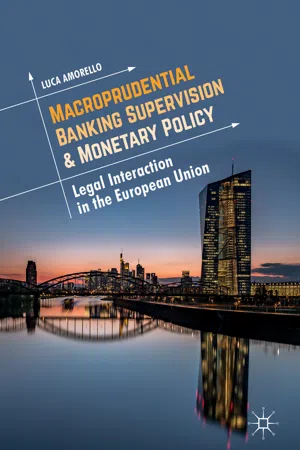
eBook - ePub
Macroprudential Banking Supervision & Monetary Policy
Legal Interaction in the European Union
- English
- ePUB (mobile friendly)
- Available on iOS & Android
eBook - ePub
Macroprudential Banking Supervision & Monetary Policy
Legal Interaction in the European Union
About this book
Information
© The Author(s) 2018
Luca AmorelloMacroprudential Banking Supervision & Monetary Policyhttps://doi.org/10.1007/978-3-319-94156-1_11. Introduction
Luca Amorello1
(1)
Cleary Gottlieb Steen & Hamilton LLP, London, UK
Luca Amorello
Keywords
Macroprudential banking supervisionMonetary policyStatutory targetFinancial stabilityEurozone1.1 Reasons for a Research
It is not a revelation that the 2008 global financial crash considerably distressed the European Union and its members leading to the worst recession in Europe since World War II. A fundamental lack of understanding of system-wide risk and the failure to appreciate the threat posed by aggressive risk-taking behaviors of financial institutions led to underestimate the consequence of excessive accumulation of growing debt and leverage which resulted from booming credit and asset prices.1
Defaulting loans secured by mortgages2 and securities mispricing3 in a deregulated environment played a key role in catalyzing the eruption of the banking system’s failure that ultimately resulted in an impairment of the real and financial transmission channels.4 Further, the soft touch supervision helped amplifying the externalities related to financial shocks.5 Attempts made by some European governments to bail out the banking system eventually triggered a dramatic increase of public debt across many EU countries, leading to the outbreak of the Eurozone Debt Crisis.6
Among different views upon the reasons behind the European financial turmoil, the law & economics literature acknowledges that a prominent fraction of responsibilities lies on the institutional features and competences of the European Monetary Union and, more broadly, of the European Union as a whole.7 As a result, the European debt crisis brought about not only a change in the EU statutory framework8 but also a shift in the institutional competences of the European institutions with the establishment of new supervisory authorities and institutional powers.9
One of the key attributes of the institutional response against the financial turmoil lies in the unconventional reaction of both monetary and prudential authorities seeking to restore the sustainability of the financial markets. For decades mainstream central banking has been dominated by the target of price stability, and conventional operating instruments have been implemented rather straightforward.10
The struggle for price stability (and/or full employment) through the influence of the short-term interest rate represented the ultimate objective of monetary policy, while open market operations were the artillery used to meet the desired interest rate target. Simultaneously, separate prudential agencies have relied mainly on microprudential regulatory instruments aimed at protecting the soundness and prudent management of private market participants by influencing their risk-taking decisions11 and reducing the overall agency costs surrounding the investors-managers relationship.12
Against this backdrop, the European experience seems to suggest that the efforts made to achieve an efficient trade-off between monetary policy and prudential supervision for financial markets ultimately failed. The severity and scope of the global crisis have pushed central banks to explore innovative tools and discover new functions—within or beyond their statutory constraints—capable of restoring the smooth functioning of the financial cycle. The ideal of price stability as unique mandate of central banking has been increasingly under scrutiny, and at least one further macro-objective seems to take root in the worldwide current discussions among central bankers,13 that is, financial stability. Such central bank’s policy enlargement proposal has found the support of a number of academics and practitioners whose main concern is to prevent further systemic disruptions of the lending transmission channels by limiting excessive credit growth and borrowing.14
Under this perspective, the outbreak of the crisis has suggested the inclusion of some macroprudential policy instruments in the overall regulatory toolkit employed by financial supervisors to be deployed worldwide in order to safeguard certain structural features of the financial systems as a whole.15 Consisting in a combination of old practices and new perspectives,16 these macroprudential proposals have mainly involved ad hoc regulatory interventions through a litany of tools and strategies unable to provide any concrete guidance for an overall macroprudential assessment of financial stability.17
Albeit this weakness in the macroprudential dimension seems well recognized, further concerns arise when dealing with its implementation. In particular, some questions become pivotal: ‘which are the legal boundaries of the macroprudential instruments?’; ‘where are located powers and competences of the macroprudential supervision?’; ‘according to the findings obtained, is there any inconsistency in the architecture of the current macroprudential framework?’
Besides, our concern becomes deeper when seeking to investigate the relationship between macroprudential supervision and the scope of central bank’s monetary policy. As a matter of fact, a legal analysis of this relationship requires the development of a new analytical framework aimed at reconciling the macroeconomic outcomes of these policies within their legal boundaries. By doing so, this law and economics analysis will disclose an economic interdependence and a legal interaction that calls for rethinking the institutional arrangements of EU competences and supervisory powers.
1.2 The Problem at Issue
Financial stability plays a major role in ensuring an efficient monetary environment, while the smooth functioning of the monetary policy transmission channel is a crucial requirement for effective prudential policies.18 The economic literature is unanimous in affirming this cross dependence, while a number of studies have provided empirical evidences for most of these interactions.19
However, these interactions are not necessarily consistent. It is not irrational to find scenarios where macroprudential and monetary policies go after different directions: one might be restrictive while the other is expansive. This is the case when a country experiences low nominal growth that requires the intervention of the central bank to lower interest rates.
Although this monetary intervention is deemed as necessary, it is also capable to foster banks towards additional risk-taking and search for yield.20 One can also envisage a different scenario where low interest rates are consistent with low inflation: under these circumstances, low rates may contribute to excessive credit growth and the build-up of asset bubbles,21 thereby sowing the seeds of systemic risk and financial instability. In brief, central bank’s monetary policy, in the pursuit of price stability, may contribute to systemic risk via its risk-taking channel.22 From a supervisory perspective, the emergence of this externality claims for the need of restrictive macroprudential measures to counter the materialization of possible shocks.
The contrary also holds true. Restrictive macroprudential policies are capable to influence credit conditions, thereby affecting the overall economy and the outlook for price stability.23 As argued in the next chapters, the macroprudential instruments may provide a constraint on borrowings and expenditure in one or more sectors of the economy24 that may burden the overall output and inflation rate.25
To put it briefly, macroprudential and monetary policies, by sharing multiple transmission channels, may interact—and conflict—with each other although pursuing different objectives. This statement would entail that when a national authority (or bo...
Table of contents
- Cover
- Front Matter
- 1. Introduction
- 2. Law and Economics of Macroprudential Banking Supervision
- 3. A Legal Approach to Monetary Policy
- 4. Policy Interactions and Conflicts
- 5. The Legal Interaction in the EU Institutional Framework
- 6. Some Concluding Remarks
- Back Matter
Trusted by 375,005 students
Access to over 1.5 million titles for a fair monthly price.
Study more efficiently using our study tools.
Frequently asked questions
Yes, you can cancel anytime from the Subscription tab in your account settings on the Perlego website. Your subscription will stay active until the end of your current billing period. Learn how to cancel your subscription
No, books cannot be downloaded as external files, such as PDFs, for use outside of Perlego. However, you can download books within the Perlego app for offline reading on mobile or tablet. Learn how to download books offline
Perlego offers two plans: Essential and Complete
- Essential is ideal for learners and professionals who enjoy exploring a wide range of subjects. Access the Essential Library with 800,000+ trusted titles and best-sellers across business, personal growth, and the humanities. Includes unlimited reading time and Standard Read Aloud voice.
- Complete: Perfect for advanced learners and researchers needing full, unrestricted access. Unlock 1.5M+ books across hundreds of subjects, including academic and specialized titles. The Complete Plan also includes advanced features like Premium Read Aloud and Research Assistant.
We are an online textbook subscription service, where you can get access to an entire online library for less than the price of a single book per month. With over 1.5 million books across 990+ topics, we’ve got you covered! Learn about our mission
Look out for the read-aloud symbol on your next book to see if you can listen to it. The read-aloud tool reads text aloud for you, highlighting the text as it is being read. You can pause it, speed it up and slow it down. Learn more about Read Aloud
Yes! You can use the Perlego app on both iOS and Android devices to read anytime, anywhere — even offline. Perfect for commutes or when you’re on the go.
Please note we cannot support devices running on iOS 13 and Android 7 or earlier. Learn more about using the app
Please note we cannot support devices running on iOS 13 and Android 7 or earlier. Learn more about using the app
Yes, you can access Macroprudential Banking Supervision & Monetary Policy by Luca Amorello in PDF and/or ePUB format, as well as other popular books in Business & Financial Services. We have over 1.5 million books available in our catalogue for you to explore.