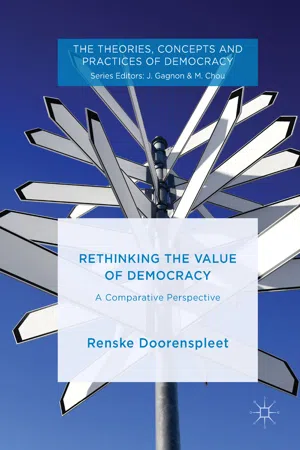
This book is the first comprehensive analysis of the instrumental value of democracy in a comparative perspective. Based on extensive analyses of quantitative studies from different disciplines, it explores both the expected beneficial and harmful impact of democracy. Democracy's reputation as delivering peace and development while controlling corruption is an important source of its own legitimacy. Yet, as this book acutely demonstrates, the arguments tend to be normatively driven interventions in ideologically charged policy debates. The book argues that we need neither a utopian framing of democracy as delivering all 'good things' in politics nor a cynical one that emphasizes only the 'dangerous underbelly' of this form of government. The author also raises critical questions about the value of the study of democracy: the choice for particular concepts and measures, the unknown mechanisms, and the narrow focus on specific instrumental values. This volume will be necessary reading for anyone interested in debates on democracy in the contemporary global context.
- English
- ePUB (mobile friendly)
- Available on iOS & Android
eBook - ePub
About this book
Information
© The Author(s) 2019
Renske DoorenspleetRethinking the Value of DemocracyThe Theories, Concepts and Practices of Democracyhttps://doi.org/10.1007/978-3-319-91656-9_11. Why Democracy?
Renske Doorenspleet1
(1)
Department of Politics and International Studies, University of Warwick, Coventry, UK
The value of democracy has been taken for granted. Overall, democracy is seen as superior and has emerged in the global arena as the gold standard for legitimate government. 1 This type of political system is not just seen as valuable for ‘its own sake’, but also because it brings all kind of ‘good things’. If a dictatorship collapses, then the choice for a democratic system will eventually lead to many positive outcomes. The final destinations will be diverse, though all wonderful. They will go everywhere, but sooner or later the clouds will disappear, the sun will shine, and the skies will be bright and blue. The list is long: democracy will give the country economic development and growth, control of corruption , political stability, national security, international peace, domestic peace and order, victory in war, international legitimacy , respect for human rights, gender equality, more social welfare and less inequality, protection of the environment, social capital, and—not irrelevant—it makes people happier (see Carbone 2009). 2
Democratic systems are considered the best. So far, there has been no real alternative, no serious opponent, and it seems none of the other types of political systems have been working better than the democracies. As Winston Churchill eloquently put it during a parliamentary debate more than seven decades ago: ‘Indeed, it has been said that democracy is the worst form of Government except all those other forms that have been tried from time to time ’ (Churchill 1947). This is a commonplace thesis, not only based on Churchill’s famous quote but also firmly rooted in academic work. Scholars tend to support this idea—often implicitly, sometimes explicitly like the political scientist Larry Diamond: ‘Few people in the world today celebrate authoritarianism as a superior system, the ultimate destination, the best form of government. Democracy remains the only broadly legitimate form of government in the world’ (Diamond 2014). But is it true? Better for whom, in what way and according to which criteria? What is the empirical support for this persistent idea that ‘democracy is best’?
The overarching goal of the book is to investigate the value of democracy in comparative perspective. This is not an easy task, as—again—the declared destinations as mentioned in the literature are all over the place, 3 leaving a quite chaotic picture. 4 This is caused not just by the dozens of different alleged claims of what democracy would, could and should bring, but also by the fact that scholars seem to be determined to show that the democratic system is simply the best. The empirical studies focusing on the value of democracy are more normative and ideological than they make us believe, and I will come back to this issue in the concluding Chapter 7. A final challenge of the theme which is at the core of this book is that the analyses and findings are spread out over different disciplines. Those disciplines have hardly interacted with each other reflecting on this theme, let alone that they have come to some overall conclusions.
The investigation in this book is based on systematic analyses of hundreds of empirical, statistical studies as published in dozens of international journals (covering different disciplines like not only political science , especially comparative politics and international relations , but also within sociology , economics and law). Invariably, one of the key explanatory variables across these studies is the extent of democracy or the type of political system. The sheer quantity of studies across disciplines is striking, and the evidence tends to be contradictory and confusing. This book will break new ground by presenting the findings in one single study and find out what democracy can—and cannot—bring.
Until recently, most scholars and policy makers have assumed the value of democracy , emphasizing, for example, the positive effects of democracy . This optimistic majority also likes to draw attention to the fact that democracy has triumphed worldwide, presenting these global waves as evidence that democracy is universally seen as a ‘good thing’. Undeniably, studies have shown that the democratic type of political system has become increasingly widespread (see also Chapter 2). Particularly, since 1989, waves of democratization have swept the world (Huntington 1991; Doorenspleet 2000; Schmitter and Treschel 2004; Merkel 2010). 5 In addition, scholars who defend democracy keep repeating that—despite recent economic uncertainties and political changes—most people still strongly support the idea of democracy , all around the world. To be sure, studies have shown this worldwide support is still overwhelming and strong (Norris 1999a, b, 2011; Stoker 2006; Merkel 2010; Doorenspleet 2012; Wessels 2015; Inglehart 2016), 6 which reinforces this idea that democracy must have value as it is valued by most people.
Up till now, this rosy picture around the value of democracy has been quite mainstream and has not been challenged too much. Still, this overly optimistic story has been questioned indirectly by scholars who started to study the actual quality of democracy . This approach acknowledges that the future of democracy looks less hopeful and certain than before, due to—for example—decreasing levels of popular satisfaction with democracy (see, e.g., Norris 2011; Doorenspleet 2012). Gradually, more people are dissatisfied with the established political parties, representative institutions and minority rights; they are also more open to authoritarian interpretations of democracy (Foa and Mounk 2017). 7
These scholars have noticed that there are problems around the functioning of democracy in practice (Zakaria 2003; Diamond and Morlino 2005; Stoker 2006; Hay 2007; Flinders 2012) and try to understand and explain these problems in depth. Moreover, the prevailing way of looking at democracy itself, with the ongoing focus on elections, has recently been rigorously questioned. Although the words ‘democracy ’ and ‘election’ have almost become synonymous (see also Chapter 2), a growing group of scholars started to defend the notion that democracy is not just a system with free and fair elections (see also Chapter 7). Studies which convincingly reject the idea to reduce ‘democracy ’ to a set of procedures have received quite some attention in the popular media, leading to debates far beyond the academic world (see, i.e., Van Reybrouck 2016). 8
Although these critical voices challenge the bright side of (the study of) democracy , eventually thei...
Table of contents
- Cover
- Front Matter
- 1. Why Democracy?
- 2. The Numerical Value of Democracy: League Tables, Scores and Trends
- 3. Democracy and Interstate War
- 4. Democracy and Civil War
- 5. Democracy and Corruption
- 6. Democracy and Development
- 7. Conclusion: Rethinking the Value of Democracy
- Back Matter
Trusted by 375,005 students
Access to over 1.5 million titles for a fair monthly price.
Study more efficiently using our study tools.
Frequently asked questions
Yes, you can cancel anytime from the Subscription tab in your account settings on the Perlego website. Your subscription will stay active until the end of your current billing period. Learn how to cancel your subscription
No, books cannot be downloaded as external files, such as PDFs, for use outside of Perlego. However, you can download books within the Perlego app for offline reading on mobile or tablet. Learn how to download books offline
Perlego offers two plans: Essential and Complete
- Essential is ideal for learners and professionals who enjoy exploring a wide range of subjects. Access the Essential Library with 800,000+ trusted titles and best-sellers across business, personal growth, and the humanities. Includes unlimited reading time and Standard Read Aloud voice.
- Complete: Perfect for advanced learners and researchers needing full, unrestricted access. Unlock 1.5M+ books across hundreds of subjects, including academic and specialized titles. The Complete Plan also includes advanced features like Premium Read Aloud and Research Assistant.
We are an online textbook subscription service, where you can get access to an entire online library for less than the price of a single book per month. With over 1.5 million books across 990+ topics, we’ve got you covered! Learn about our mission
Look out for the read-aloud symbol on your next book to see if you can listen to it. The read-aloud tool reads text aloud for you, highlighting the text as it is being read. You can pause it, speed it up and slow it down. Learn more about Read Aloud
Yes! You can use the Perlego app on both iOS and Android devices to read anytime, anywhere — even offline. Perfect for commutes or when you’re on the go.
Please note we cannot support devices running on iOS 13 and Android 7 or earlier. Learn more about using the app
Please note we cannot support devices running on iOS 13 and Android 7 or earlier. Learn more about using the app
Yes, you can access Rethinking the Value of Democracy by Renske Doorenspleet in PDF and/or ePUB format, as well as other popular books in Politique et relations internationales & Politique comparée. We have over 1.5 million books available in our catalogue for you to explore.