This volume explores the selfie not only as a specific photographic practice that is deeply rooted in digital culture, but also how it is understood in relation to other media of self-portrayal. Unlike the public debate about the dangers of 'selfie-narcissism', this anthology discusses what the practice of taking and sharing selfies can tell us about media culture today: can the selfie be critiqued as an image or rather as a social practice? What are the technological conditions of this form of vernacular photography? By gathering articles from the fields of media studies; art history; cultural studies; visual studies; philosophy; sociology and ethnography, this book provides a media archaeological perspective that highlights the relevance of the selfie as a stereotypical as well as creative practice of dealing with ourselves in relation to technology.
Julia Eckel, Jens Ruchatz and Sabine Wirth (eds.)Exploring the Selfiehttps://doi.org/10.1007/978-3-319-57949-8_1
Begin Abstract
1. The Selfie as Image (and) Practice: Approaching Digital Self-Photography
Julia Eckel1, 2, Jens Ruchatz1 and Sabine Wirth1
(1)
Philipps-University Marburg, Marburg, Germany
(2)
Ruhr-University Bochum, Bochum, Germany
Julia Eckel (Corresponding author)
Jens Ruchatz
Sabine Wirth
End Abstract
Selfies are ubiquitous in online culture: Every frequent user of photo-sharing platforms, social network sites, or smartphone apps such as Facebook , Twitter , Flickr , Photobucket, Instagram , Snapfish, WhatsApp , or Snapchat is familiar with these particular photographic images and most likely has already produced a selfie (or many selfies) herself/himself. Since the term “selfie” was chosen Word of the Year by the Oxford Dictionaries in 2013, it has become evident that taking and sharing selfies is not just some temporary hype of web culture. Selfie pictures are apparently here to stay and have taken their place among established photographic practices. The prevalence of self-images among the pictures taken with mobile phonecameras and subsequently uploaded on social media platforms had been accounted for before the popularization of the term “selfie”, at least occasionally (Lasén 2005, 66; Walker 2005; Prøitz 2007; Lasén and Gómez-Cruz 2009; Schwarz 2010; Rocamora 2011).1 In this context those pictures were generally referred to as “self-portraits,” even though the term “selfie” had already been coined. The first documented use of the word goes back to 2002 (Oxford Dictionaries2013; Zimmer 2013). The rapid implementation of the new term took place in media critical discourse,2 taking off in 2012 and culminating in it becoming 2013’s Word of the Year. This discoursive event is not just an arbitrary exchange of one word for another (selfie instead of self-portrait) but indicates the public awareness of an image practice that had long gone mostly unnoticed. In addition, it seems to indicate that selfie images taken with mobile phones differ so much from traditional self-portrait s as to merit a proper name. It can be argued that with the success of the new nomenclature, the picture practice has turned from an emerging genre (Lüders et al. 2010) into a full-fledged genre that is recognized as particular to online culture. The general adoption of the term “selfie” has been instrumental in the popularization of digital self-images—as a photographic practice taken up by a majority of mobile phone users and as a topic of discourses about photography and online media.
In Search for a Selfie Definition
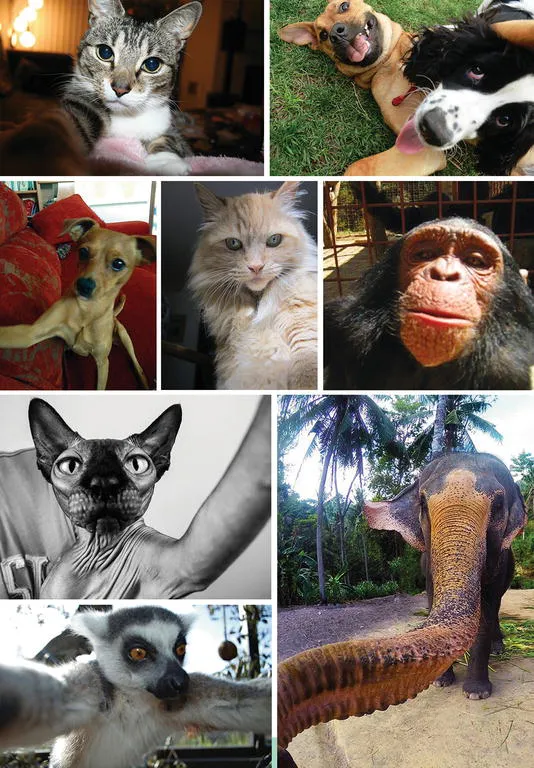
Despite the prevalence of the word and the ubiquitous presence of selfie pictures, it is not so easy to pinpoint what a selfie actually is and what the practice of taking and sharing selfies tells us about today’s media use and media culture. Therefore, it may be helpful to start by focusing on a phenomenon that calls attention to some of the specifics of the selfie by challenging them at the same time: animal selfies. At the peak of the selfie hype around 2012,3 so-called cat selfies and dog selfies started to appear. A number of books and calendars containing such photos even were published (Ellis 2014a, b, 2016; Trompka 2014). These pictures usually show the animal extending its paw toward the lens of the camera, but just a bit off as if it is pressing the release button of a camera phone (see Fig. 1.1). Some animal owners claim that their cats or dogs are indeed capable of taking veritable selfies themselves (Phillips Badal 2016).4 What qualifies these pictures as selfies is, however, that they show the gesture that is familiar from “human” selfies, a gesture that indicates that the subject controlling the shutter release button of the camera is also the object of the picture. Animal selfies can be considered as a self-reflexive pictorial form insofar as they lay bare what visibly defines the typical selfie photograph. They take recourse to the clearest generic marker that is needed to render a photograph recognizable, even readable, as a selfie. Animal selfies highlight the status of the selfie as a “gestural picture,” to use Paul Frosh’s words: The gesture “is simultaneously mediating (the outstretched arm executes the taking of the selfie) and mediated (the outstretched arm becomes a legible sign within selfies of, among other things, the selfieness of the image)” (Frosh 2015, 1611, emphasis in original).
Fig. 1.1
Collection of animal selfies
Thus, the question of what constitutes a selfie is a crucial one and, at the same time, is not easy to answer. While images like animal selfies contribute to the phenomenon on a practical and pictorial level, there seems to be an urge to define the selfie on a terminological/discoursive level as well. The most common and most frequently cited definition found in the selfie discourse is the one quoted in the press release of the Oxford Dictionaries (2013): “a photograph that one has taken of oneself, typically one taken with a smartphone or webcam and uploaded to a social media website.”5 Since this definition repeatedly serves as a reference point within this volume and therefore offers a starting point to analyze the basic ambiguity that troubles selfie research, we will have a closer look at its different components in the next subsections.6
“A photograph that one has taken of oneself”
The definition leaves no doubt: Only photographs can count as selfies; drawings or paintings as well as moving pictures are ruled out.7 Among the plethora of photographs, selfies are those where the photographed subject controls the photograph: Subject/author and object of the image coincide.8 I myself have taken this photo of me, this is exactly what the gesture of the extended arm in the selfie designates: “If both your hands are in the picture and it’s not a mirror shot, technically, it’s not a selfie” (Saltz 2014). The definition is vague and very extensive in another respect, however: Any photographic picture that someone has taken of herself/himself may be named a selfie, which includes analog as well as digital photographs. It further encompasses photographs that do not show the face9 of the photographer but, for instance, their backside (a bum selfie, or belfie) or feet (a foot selfie, felfie or footfie).10 Likewise, a selfie may—and often does—stage more people than just the photograp...
Table of contents
Cover
Front Matter
1. The Selfie as Image (and) Practice: Approaching Digital Self-Photography
Part I. The Selfie in Media Theory and History
Part II. The Displayed Self: The Selfie as Aesthetic Object and Networked Image
Part III. The Self on Display: Technology and Dispositif of the Selfie
Part IV. Displaying the Self: Social, Political, and Creative Interventions
Back Matter
Trusted by 375,005 students
Access to over 1.5 million titles for a fair monthly price.
Study more efficiently using our study tools.
Frequently asked questions
Yes, you can cancel anytime from the Subscription tab in your account settings on the Perlego website. Your subscription will stay active until the end of your current billing period. Learn how to cancel your subscription
No, books cannot be downloaded as external files, such as PDFs, for use outside of Perlego. However, you can download books within the Perlego app for offline reading on mobile or tablet. Learn how to download books offline
We are an online textbook subscription service, where you can get access to an entire online library for less than the price of a single book per month. With over 1.5 million books across 990+ topics, we’ve got you covered! Learn about our mission
Look out for the read-aloud symbol on your next book to see if you can listen to it. The read-aloud tool reads text aloud for you, highlighting the text as it is being read. You can pause it, speed it up and slow it down. Learn more about Read Aloud
Yes! You can use the Perlego app on both iOS and Android devices to read anytime, anywhere — even offline. Perfect for commutes or when you’re on the go. Please note we cannot support devices running on iOS 13 and Android 7 or earlier. Learn more about using the app
Yes, you can access Exploring the Selfie by Julia Eckel, Jens Ruchatz, Sabine Wirth, Julia Eckel,Jens Ruchatz,Sabine Wirth in PDF and/or ePUB format, as well as other popular books in Social Sciences & Photography. We have over 1.5 million books available in our catalogue for you to explore.