eBook - ePub
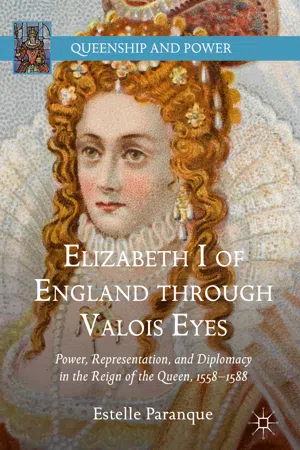
Elizabeth I of England through Valois Eyes
Power, Representation, and Diplomacy in the Reign of the Queen, 1558–1588
- English
- ePUB (mobile friendly)
- Available on iOS & Android
eBook - ePub
Elizabeth I of England through Valois Eyes
Power, Representation, and Diplomacy in the Reign of the Queen, 1558–1588
About this book
This book examines the first thirty years of Elizabeth I's reign from the perspective of the Valois kings, Charles IX and Henri III of France. Estelle Paranque sifts through hundreds of French letters and ambassadorial reports to construct a fuller picture of early modern Anglo-French relations, highlighting key events such as the St. Bartholomew's Day Massacre, the imprisonment and execution of Mary, Queen of Scots, and the victory of England over the Spanish Armada in 1588. By drawing on a wealth of French sources, she illuminates the French royal family's shifting perceptions of Elizabeth I and suggests new conclusions about her reign.
Information
© The Author(s) 2019
Estelle ParanqueElizabeth I of England through Valois EyesQueenship and Powerhttps://doi.org/10.1007/978-3-030-01529-9_11. Introduction: In Valois Eyes
Estelle Paranque1
(1)
New College of the Humanities, London, UK
Estelle Paranque
On September 7, 1533, Elizabeth Tudor was born. Her parents had married just months before, generating shock and disapproval all around Europe. In his dispatch to Francis I of France, Jean de Dinteville, the French ambassador to the English court, reported the June 1 coronation of “Anne de Boulen” and Henry VIII’s displeasure on learning that many courtiers were gossiping about it.1 The relationship between Elizabeth’s parents swiftly deteriorated, and in 1536 Anne Boleyn was accused of high treason for incestuous and promiscuous relationships with several men, including her brother George. On May 19, she was beheaded. Soon after, Elizabeth was declared bastard and illegitimate, precipitating more than a decade of tumult for the young princess. She was third in line to the throne, after her half-brother Edward and her half-sister Mary. During their respective reigns, Elizabeth survived countless false accusations and even imprisonment in the Tower of London.
Events in England , France, and Spain were usually locked together. The Italian wars that ravaged Europe from 1494 to 1559 had a profound impact on diplomatic relations between the three countries.2 Francis I of France (and before him Charles VIII and Louis XII) and Charles V of Spain had been fighting over the duchy of Milan and the kingdom of Naples in an atmosphere of seemingly irreconcilable tension between the two royal houses.3 In 1522, Henry VIII of England had chosen to join the league formed by the Pope Leo X and Charles V of Spain against France. Following a military catastrophe at Pavia in 1525, in January of the following year Francis was forced to sign the Treaty of Madrid, by which he renounced his claims to Italy, Flanders , and Burgundy.4 However, Clement VII, who had succeeded to the papacy in 1523, did not wish to see Charles V’s empire grow any further. Another alliance was formed, this time with France and England ranged against Spain, but it collapsed and Charles V surrounded the papal states.5
Francis I died on March 31, 1547. Four years later, his son, Henry II, declared war on Spain in a bid to regain some glory and the Italian territories. In 1556, Charles V abdicated, leaving his imperial title to his brother Ferdinand and his Spanish crown to his son Philip II. The latter was married to Mary I of England , which paved the way for a political and military alliance. Two years later, the French invaded and regained control of Calais , which had been under English jurisdiction since 1347. In 1559, the Peace of Cateau-Cambrésis brought the Italian wars to an end by forcing Henry II to renounce his Italian claims. But Calais remained French.
Mary I had died on November 17, 1558, whereupon, to many people’s surprise, Elizabeth had become Queen of England . The loss of Calais during her sister’s reign was a profound national disgrace, and Elizabeth was determined to reclaim it.6 In 1562, ostensibly to help the Huguenots in their struggles against French Catholics, she sent 6000 troops to Newhaven (Le Havre ), and expressed the hope that “the English occupation of Le Havre could be treated for the return of Calais.”7 However, the English expedition ended in failure as the French forces united against Elizabeth’s troops and Calais was lost forever.8 Despite the 1572 Treaty of Blois, which stated that England and France would form an alliance against Spain, relations between the two courts continued to be characterized by mistrust.9
Representations of Elizabeth: Power, Persuasion, and Perpetual Youth
This book focuses on how Elizabeth was perceived by the French royal family and their ambassadors from 1558 to 1588. It also examines the dynamics of Anglo-French relations at that time and argues that, contrary to assumptions based on the fact that France was a Catholic country while England was officially Protestant, the representations of Elizabeth in French diplomatic correspondence were not entirely negative. Indeed, the general traffic of diplomatic correspondence offers a wide range of perspectives on the English queen.
These representations of the English queen have fascinated scholars for centuries. Interestingly, her contemporaries in France—Charles IX and Henry III—have not attracted nearly as much attention, and the French historiography covering their reigns does not engage so intensively with their representations.10 From the portrayals of Elizabeth as the Virgin Queen and Deborah the Israelite judge who freed her people from oppression, the image of a Protestant heroine who managed to rule effectively amid a horde of Catholic enemies has been extensively studied and developed, notably by Sir John Neale and Roy Strong.11 But this image is a complex one,12 not least because her depiction as Protestant heroine was as much imposed upon Elizabeth as it was generated by the actions and proclamations of the queen herself.13 Indeed, in many ways, she was a reluctant heroine of the Reformation, because, while she could not ignore the struggles of continental Protestants, she had no desire to go to war against her neighbors in order to defend her coreligionists.14
Another image of Elizabeth that has been explored in depth is “mother of her country.”15 Her gender has been studied as a significant part of her queenship , and a number of scholars, such as Maria Petty and Ilona Bell, have attempted to problematize the gendered representations of the queen.16 In The Heart and Stomach of a King: Elizabeth I and the Politics of Sex and Power, Carole Levin evolves a more complex image of Elizabeth.17 Though Levin does not dismiss the importance of Elizabeth’s sex, she rightly explains that, as she remained single, she was both Queen and King of England , which played an important role in her self-representation.18 This duality—a male and female representation of the Tudor queen—is also examined by Kevin Sharpe, for example in his analysis of the famous 1588 Tilbury speech.19 Many other historians have similarly explored Elizabeth’s image in the context of her warlike rhetoric.20 This dual representation of Elizabeth as both King and Queen of England was echoed in French writings, too—demonstrating that her reign was perceived as unusual both inside and outside the borders of her realm.
Elizabeth’s portraits have also drawn the attention of numerous scholars.21 For instance, Anna Riehl Bertolet focuses on the English queen’s face and its importance in both written accounts and portraiture.22 Meanwhile, Frances Yates explores Elizabeth’s representation as Astraea, the Greek goddess of innocence, in literary works and links this depiction to the queen’s faith.23 More recently, Mary Villeponteaux and others have examined how the English viewed their queen and shaped some of her images.24 These works have established that Elizabeth’s reputation and representation were multi-layered in England , and I argue that this was also the case within the French court.
In this study, I suggest a series of fresh and complementary approaches on these issues by looking at the French royal family and their ambassadors’ letters and official reports. Close examination of these royal and diplomatic sources has revealed that some familiar images, such as Elizabeth as Protestant champion, were not reported by the Valois, while other, often rather different, images and perceptions of Elizabeth did emerge in their correspondence.
Monarchs tended to use familial tropes when engaging with one another and to maintain alliances. While this is hardly surprising, the way in which they shaped fictional familial relationships is intriguing.25 The following chapters investigate the important categorization of Elizabeth as a member of the French royal family and trace the significant changes in the terms that were chosen to accompany this image. Furthermore, the French rulers and their ambassadors developed many other representations of the Tudor monarch—from pirate queen to benevolent ruler—largely in response to the state of diplomatic relations between the two countries.
In some respects, this book’s approach is similar to those of two significant works that have touched on foreign perceptions of the Tudor queen. In his essay ...
Table of contents
- Cover
- Front Matter
- 1. Introduction: In Valois Eyes
- 2. “her so evil and dangerous will”: Long Live the Queen and Diplomatic Games 1558–1565
- 3. “a rock”: Between Peace and Conflict—An Intriguing Queen, 1568–1570
- 4. “a germayne sister”: The Impact of the St. Bartholomew’s Day Massacre’s on Representations of Queen Elizabeth—August 1572–June 1574
- 5. “he will have the honor to marry her this time”: Last Chance to Marry the “Frog,” 1579–1581
- 6. “declared herself as our enemy”: Crisis, Confrontation, and Secret Correspondence, 1584–1588
- Back Matter
Trusted by 375,005 students
Access to over 1.5 million titles for a fair monthly price.
Study more efficiently using our study tools.
Frequently asked questions
Yes, you can cancel anytime from the Subscription tab in your account settings on the Perlego website. Your subscription will stay active until the end of your current billing period. Learn how to cancel your subscription
No, books cannot be downloaded as external files, such as PDFs, for use outside of Perlego. However, you can download books within the Perlego app for offline reading on mobile or tablet. Learn how to download books offline
We are an online textbook subscription service, where you can get access to an entire online library for less than the price of a single book per month. With over 1.5 million books across 990+ topics, we’ve got you covered! Learn about our mission
Look out for the read-aloud symbol on your next book to see if you can listen to it. The read-aloud tool reads text aloud for you, highlighting the text as it is being read. You can pause it, speed it up and slow it down. Learn more about Read Aloud
Yes! You can use the Perlego app on both iOS and Android devices to read anytime, anywhere — even offline. Perfect for commutes or when you’re on the go.
Please note we cannot support devices running on iOS 13 and Android 7 or earlier. Learn more about using the app
Please note we cannot support devices running on iOS 13 and Android 7 or earlier. Learn more about using the app
Yes, you can access Elizabeth I of England through Valois Eyes by Estelle Paranque in PDF and/or ePUB format, as well as other popular books in History & British History. We have over 1.5 million books available in our catalogue for you to explore.