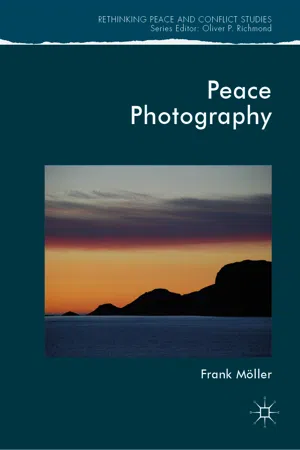
This study thinks with photography about peace. It asks how photography can represent peace, and how such representation can contribute to peace. The book offers an original critique of the almost exclusive focus on violence in recent work on visual culture and presents a completely new research agenda within the overall framework of visual peace research. Critically engaging with both photojournalism and art photography in light of peace theories, it looks for visual representations or anticipations of peace – peace or peace as a potentiality – in the work of selected photographers including Robert Capa and Richard Mosse, thus reinterpreting photography from the Spanish Civil War to current anti-migration politics in Europe. The book argues that peace photography is episodic, culturally specific, process-oriented and considerate of both the past and the future.
Those who transmitted the image of the world always sided with those who determined the rules of the world.1 In order to change the rules of the world, the image of the world had to be changed as well. This could be done by re-interpreting and appropriating the existing body of images to one’s own purposes—always asking what a given work of art does to serve the interests of one’s own class—and making own images, both visual and non-visual ones. Both strategies were forms of resistance —aesthetics of resistance, resistance (limited as it may have been) through aesthetics, aesthetics as resistance. While resistance was more than aesthetics , it could not be thought of without aesthetics. This is one of the core lessons to be learned from Peter Weiss’s monumental novel, Die Ästhetik des Widerstands, navigating, on almost 1200 pages, the labyrinth of workers’ resistance to, and emancipation from, forms of institutionalised violence over time and across space. One ingredient of this violence was exclusion from artistic work, künstlerische Entmündigung in many forms.2 One ingredient of emancipation was claiming the right to the arts , both as consumers and as producers, insisting, among other things, that workers are perfectly capable of interpreting works of art and that these interpretations, inspired by their own experience, education and socialisation, are valid and true. Such interpretations are political; they are attempts to escape from speechlessness and, thus, ingredients of the political struggle.3 Doubts remained, though. What, the book’s protagonist ponders, is the value of reading a book or discussing a painting when simultaneously the political representatives of the working class and ordinary workers had to face systematic expropriation, oppression, incarceration, even physical liquidation? Did such practices offer any kind of protection in an age characterised by the concentration of the means of both production and violence in the hands of the enemies who not only threatened to use violence so as to intimidate the workers and prevent them from acting against oppression but also regularly did resort to violence to defend their privileges? What is the value of looking at images when such looking results in a feeling of hopelessness4 and mistrust against an art world that tried to conquer travail and disgust5 by means of form and colour?6
Fig. 1.1
Frank Möller, untitled (Riga, April 2017)
Roland Bleiker , in Aesthetics and World Politics, echoes such doubts when asking whether it is ‘trivial, or perhaps even irresponsible, to explore aesthetic themes’ in an age of ‘war, genocide , terrorism, poverty, climate change and financial turmoil’.7 His reply is an emphatic argument for such an exploration, capitalising on ‘creativity and imagination ’ and ‘cultivating a more open-ended level of sensibility about the political’.8 It is also an emphatic argument for the use of aestheticapproaches . Mimetic approaches , while relying on the myth of the neutral, value-free, disinterested observer, ignore individual researchers’ inevitable acts of interpretation. Aesthetic approaches , on the other hand, necessitate interpretation, imagination and creativity on the part of the researcher. They acknowledge that analysis equals interpretation, that representation is necessarily non-identical with that which it represents, and that ‘the difference between the represented and its representation is the very location of politics’.9
The protagonists in the first part of Weiss’s book, situated in post-1918 Germany and in Spain during the Civil War, would agree with this assessment. When discussing works of art by painters such as Delacroix, Gericault and Picasso, for example, they acknowledge that painters, even if they try to be as precise as possible, can never communicate real events. Rather than representing the pain of others, they can only reproduce their own experience. However, they create the highest level of emotional intensity if they succeed, by means of imagination , in creating the impression of congruence between their own experience and others’.10 The protagonists—and we, the readers, with them—spend hours in the company of paintings and books, searching for that which, regardless of both the artists’ intentions and the established, conventional, bourgeois ways of meaning making, can be connected to their own social, political and cultural conditions, helping to make sense of these conditions but also giving hope for change.
Indeed, the principles referred to in the quotation that opened this chapter only seemed to be unchangeable. While traditionally, those who transmitted the image of the world had sided with those who determined the rules of the world, things were about to change. During the Spanish Civil War , for example, pro-Republican photographers understood that, in order to tell a compelling human story, they ‘had to be engaged, had to have judged the political stakes in that story, and had to have taken sides’.11 Having judged the political stakes in the story led them to take, and visualise, a pro-Republican stance. Even those artists who had sided with those in power often incorporated into their work liberating, emancipatory elements. Surrealism , according to Weiss’s protagonists, broke with conventional logics and revealed the manipulations from which the masses suffered. Dada caricatured and destroyed the pathetic self-idolisation of the petit bourgeoisie. Painters such as Kandinsky and Dali and Magritte decomposed visual prejudice. Photomontage and Soviet film deconstructed bourgeois society by revealing its internal contradictions, often ridiculing its protagonists.12 These aesthetic reflections served the purpose of strengthening the sense of community among those hitherto cut off from aesthetics and the arts .13 They also served the purpose of creating something that had to be new in its entirety rather than consisting of bits and pieces granted to them by others.14 These reflections were essentially political, filling the gap between the represented and its representation with own experience; and they were critical if by ‘critical’ we mean that which ‘opposes … the mere recognition of established opinion or the extrapolation from established versions of facticity’.15
Politics and art , art and politics; the politics of art and the art of politics. Elsewhere, I suggest that
[k]nowledge on politics and art , modestly, supplements knowledge generated elsewhere in the social sciences and helps explain what other forms of inquiry cannot explain. More ambitiously (and controversially), it explains the world differently and renders visible what other forms of social inquiry hide (for a variety of reasons). Work on politics and art expands the discursive frames within which politics unfold thus paving the way to new forms of political activity, and reveals the limitations and biases of established forms of social research. By so doing, it challenges both the knowledge produced elsewhere and the power positions derived from this knowledge.16
And while it is certainly true that the ‘aesthetic does not need to legitimate itself in relation to any presumed to be “more real” realm of political science or international relations’17 (or in relation to anything else, for that matter), I will link the aesthetic to the realm of peace and conflict research as a specific form of social inquiry. However, I am neither interested in legitimating the aesthetic nor in claiming that peace and conflict research is more real than the aesthetic. Rather, I will engage the aesthetic—and in particular one specific form of visual culture : photography —in its relation to peace , inspired by a twin question: how can photography represent peace and how can such representation contribute to peace? To exaggerate, I am interested in a new image of the world, one that breaks with habitual...
Table of contents
Cover
Front Matter
Part I
Part II
Part III
Back Matter
Trusted by 375,005 students
Access to over 1.5 million titles for a fair monthly price.
Study more efficiently using our study tools.
Frequently asked questions
Yes, you can cancel anytime from the Subscription tab in your account settings on the Perlego website. Your subscription will stay active until the end of your current billing period. Learn how to cancel your subscription
No, books cannot be downloaded as external files, such as PDFs, for use outside of Perlego. However, you can download books within the Perlego app for offline reading on mobile or tablet. Learn how to download books offline
Perlego offers two plans: Essential and Complete
Essential is ideal for learners and professionals who enjoy exploring a wide range of subjects. Access the Essential Library with 800,000+ trusted titles and best-sellers across business, personal growth, and the humanities. Includes unlimited reading time and Standard Read Aloud voice.
Complete: Perfect for advanced learners and researchers needing full, unrestricted access. Unlock 1.5M+ books across hundreds of subjects, including academic and specialized titles. The Complete Plan also includes advanced features like Premium Read Aloud and Research Assistant.
Both plans are available with monthly, semester, or annual billing cycles.
We are an online textbook subscription service, where you can get access to an entire online library for less than the price of a single book per month. With over 1.5 million books across 990+ topics, we’ve got you covered! Learn about our mission
Look out for the read-aloud symbol on your next book to see if you can listen to it. The read-aloud tool reads text aloud for you, highlighting the text as it is being read. You can pause it, speed it up and slow it down. Learn more about Read Aloud
Yes! You can use the Perlego app on both iOS and Android devices to read anytime, anywhere — even offline. Perfect for commutes or when you’re on the go. Please note we cannot support devices running on iOS 13 and Android 7 or earlier. Learn more about using the app
Yes, you can access Peace Photography by Frank Möller in PDF and/or ePUB format, as well as other popular books in Politics & International Relations & Journalism. We have over 1.5 million books available in our catalogue for you to explore.