This edited collection examines the multi-faceted phenomenon of transparency, especially in its relation to social movements, from a range of multi-disciplinary viewpoints. Over the past few decades, transparency has become an omnipresent catch phrase in public and scientific debates. The volume tracks developments of ideas and practices of transparency from the eighteenth century to the current day, as well as their semantic, cultural and social preconditions. It connects analyses of the ideological implications of transparency concepts and transparency claims with their impact on the public sphere in general and on social movements in particular. In doing so, the book contributes to a better understanding of social conflicts and power relations in modern societies. The chapters are organized into four parts, covering the concept and ideology of transparency, historical and recent developments of the public sphere and media, the role of the state as an agent of surveillance, and conflicts over transparency and participation connected to social movements.
eBook - ePub
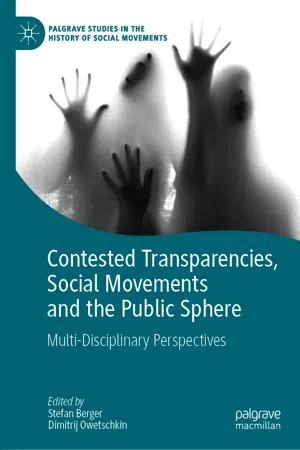
Contested Transparencies, Social Movements and the Public Sphere
Multi-Disciplinary Perspectives
- English
- ePUB (mobile friendly)
- Available on iOS & Android
eBook - ePub
Contested Transparencies, Social Movements and the Public Sphere
Multi-Disciplinary Perspectives
About this book
Information
Topic
HistoireSubtopic
Histoire moderne© The Author(s) 2019
S. Berger, D. Owetschkin (eds.)Contested Transparencies, Social Movements and the Public SpherePalgrave Studies in the History of Social Movementshttps://doi.org/10.1007/978-3-030-23949-7_11. Contested Transparencies: An Introduction
Dimitrij Owetschkin1 and Stefan Berger1
(1)
Institute for Social Movements, Ruhr University Bochum, Bochum, Germany
The Many Uses of the Concept of Transparency
Transparency belongs to those terms, concepts and ideas that have been all-present and powerful in contemporary public debates. In scientific discourse, across many disciplines, it appears to be a “key concept of the present”, 1 that often acquires a “quasi-religious significance” and that is “mystic in essence”. 2 Transparency appears alternatively as “one of the fundamentally distinctive traits of contemporary Western culture”, 3 or “defining principle of contemporary society”, or as “a taken-for-granted ideal and explanation of how society and its organizations must function”. 4
This ubiquitous term that seems to have been referenced exponentially in recent years is in danger of being “overused” and “sometimes misused”. 5 Demands for greater transparency can be found in politics, administration, economy, the finance sector, in education, in the health service, in the sciences, in the churches and in sports. A range of social movements and their media have been in the forefront of such demands, although they have also been mainstreamed for many years now. Transparency International is arguably the most well-known NGO that has been founded with the explicit aim of pushing for more transparency at all levels of society. By now transparency is widely regarded as solution to a whole range of political, social, economic and cultural problems. In particular it is often seen as a cure-all against the abuse of political and economic power, including corruption, finance scandals, and company crises. It is quite generally perceived as “the vanguard of the open society”. 6 At the same time, however, those worried about increasing social control and surveillance, power concentration in the hand of the few, and an erosion of democracy, trust, social cohesion, freedom and individuality have warned against the dangers of an all-transparent society, in which the individual would have no privacy left. 7 While organizations and institutions, including the state, have to be made transparent in order to be democratically accountable, the individual has to be protected against being made transparent as a means of social control.
Overall then, the concept of transparency is characterized by much ambiguity and complexity. Its contours are often opaque—it can be used in different contexts with diverse, even contradictory political intentions and meanings. And it can be applied to entirely different subjects and institutions. As “travelling keyword” 8 and “magic concept” 9 transparency is, at one and the same time, an expectation, a demand, a prescription, a value, a norm, an attitude, a perception and a principle. It can be applied to structures, functional procedures, achievements and the impact of organizations, actions and their consequences, but it can also be related to the inner self of the individual, relationships between human beings and the process of human cognition. It can also be directed towards the past: being transparent vis-à-vis the past can be a means of coming to terms with that past, of working through a problematic past, especially where it involves dictatorships, authoritarian regimes, wars and genocides. 10
The term transparency tends to be used in strongly normative ways and is associated most frequently with information access, openness, disclosure and accountability, but also with clarity, predictability, fairness, public scrutiny or participation. Its opposites are most frequently “secrecy” and “concealment”. 11 Moreover, the term has many other connotations, 12 some of them—related to literary studies—are discussed by Jens Gurr in this volume (Chapter 4). The semantic contexts of its usage play an important role for the diverse meanings it can take. Relational concepts that are either complementary or contrasting determine its normative direction. Such diverse conceptual fields have given transparency very different meanings in diverse contextual debates, for example regarding openness and freedom, trust and acceptance, control and security or secrecy and privacy. In each of these contexts it is understood and interpreted differently.
Hence, as a concept transparency appears to be a kind of Wittgensteinian “family resemblance concept”, where the manifold individual usages cannot be brought together under one umbrella concept, so that it can only be explored in its relations and overlaps with a whole bundle of other concepts with which it interacts. 13 In a similar way transparency becomes a “floating signifier”, forever contested, bound to specific historical contexts and associated with a range of distinct political projects. 14 Yet aside from its discursive opaqueness and its tendency to be part and parcel of “language games”, 15 the concept of transparency is also related to practices that develop over time and are related to different societal contexts and actors. The subsequent contributions to this volume deal with both—discourses and practices surrounding transparency, and they do so by taking into account diverse disciplinary perspectives and historical contexts.
The Ambivalences of Transparency in the Literature on Transparency
Research on transparency has been booming and expanding in line with the increasingly omnipresent discourses on transparency in the public sphere. Specific disciplinary perspectives often prevail, although a range of interdisciplinary handbooks, anthologies and edited collections have also become available in recent years. 16 Yet, overall, each discipline has developed its own disciplinary understanding of transparency and each has put special emphasis on specific aspects and problems of transparency. Each has also developed its own methodological and theoretical arsenal with which to investigate transparency.
The historical sciences have so far focussed on transparency as access to information and knowledge sharing, primarily discussing transparency in the context of semantic fields such as openness, public sphere, publicity, secrecy and privacy. 17 What has been revealed and what has been hidden are key aspects investigated by historians in relation to transparency. Research has examined the tensions between the state’s need for secrecy and the normative demands of democratic control and a democratic public sphere. What border has been drawn between what is public and what is private. Especially within the sub-field of media history, the history of the public sphere has played a major role in recent decades. 18 Within the fields of intellectual and cultural history, the emergence and development of concepts of the public sphere 19 and of ideas of transparency itself have also been investigated. 20
The social sciences and economics have been more interested in the meaning of transparency for governance. This includes the relevance of transparency for the functioning of political systems, institutions and organizations. Transparency is here often closely related to ideas about the access to information. It becomes synonymous with the ability of an actor to access information about other actors or processes, institutions and organizations. In other words, transparency is seen as a mirror opposite of secrecy. 21 Transparency is about the accessibility of information for citizens who are being helped through transparency to better understand and comprehend decision-making processes. Transparency helps their opinion formation regarding a wide diversity of political issues. 22 It is also widely seen as a value that has become a human right—“the right to know”. 23
Especially in the field of economics the “principal–agent model” has played an influential role in transparency studies. 24 Here transparency is regarded as absence or reduction of information asymmetries between interacting subjects—defined as “sender” and “receiver”. 25 Hence much research in economics, as well as in political sciences, focusses on functional aspects of transparency, such as how much transparency is necessary in order either to ensure the optimal performance, efficiency and acceptance of institutions or the mastering of communication between institutional and non-institutional actors. Any diversion from the right measure of transparency is interpreted as being dysfunctional with regard to the overall aim of performance optimization. 26 How useful transparency is, depends vitally on the values and normative orders that are posited as desirable. It becomes an instrument with which it is possible to achieve a desirable norm, for example efficiency, prosperity, participation, trust or acceptance. 27 Transparency itself then has no intrinsic value of its own. However, it may be more correct to perceive transparency as a value interrelated with a range of other values that have to be defined vis-à-vis transparency—in their specific chronological, spatial and social contexts. ...
Table of contents
- Cover
- Front Matter
- 1. Contested Transparencies: An Introduction
- Part I. Transparency and Ideology: Semantic and Historical Aspects
- Part II. Transparency and the Public Sphere
- Part III. Transparency, State and Surveillance
- Part IV. Transparency Conflicts and Social Movements
- Back Matter
Trusted by 375,005 students
Access to over 1.5 million titles for a fair monthly price.
Study more efficiently using our study tools.
Frequently asked questions
Yes, you can cancel anytime from the Subscription tab in your account settings on the Perlego website. Your subscription will stay active until the end of your current billing period. Learn how to cancel your subscription
No, books cannot be downloaded as external files, such as PDFs, for use outside of Perlego. However, you can download books within the Perlego app for offline reading on mobile or tablet. Learn how to download books offline
Perlego offers two plans: Essential and Complete
- Essential is ideal for learners and professionals who enjoy exploring a wide range of subjects. Access the Essential Library with 800,000+ trusted titles and best-sellers across business, personal growth, and the humanities. Includes unlimited reading time and Standard Read Aloud voice.
- Complete: Perfect for advanced learners and researchers needing full, unrestricted access. Unlock 1.5M+ books across hundreds of subjects, including academic and specialized titles. The Complete Plan also includes advanced features like Premium Read Aloud and Research Assistant.
We are an online textbook subscription service, where you can get access to an entire online library for less than the price of a single book per month. With over 1.5 million books across 990+ topics, we’ve got you covered! Learn about our mission
Look out for the read-aloud symbol on your next book to see if you can listen to it. The read-aloud tool reads text aloud for you, highlighting the text as it is being read. You can pause it, speed it up and slow it down. Learn more about Read Aloud
Yes! You can use the Perlego app on both iOS and Android devices to read anytime, anywhere — even offline. Perfect for commutes or when you’re on the go.
Please note we cannot support devices running on iOS 13 and Android 7 or earlier. Learn more about using the app
Please note we cannot support devices running on iOS 13 and Android 7 or earlier. Learn more about using the app
Yes, you can access Contested Transparencies, Social Movements and the Public Sphere by Stefan Berger, Dimitrij Owetschkin, Stefan Berger,Dimitrij Owetschkin in PDF and/or ePUB format, as well as other popular books in Histoire & Histoire moderne. We have over 1.5 million books available in our catalogue for you to explore.