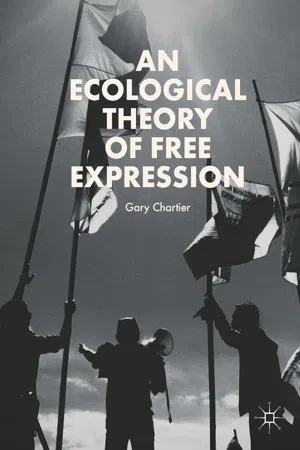
This book advances a comprehensive moral defense of freedom of expression—one with implications for law and policy, but also for the choices of individuals and non-governmental institutions. Gary Chartier seeks to ground expressive freedom in mutually supportive concerns related to themes including property, autonomy, flourishing, and discovery, while seeking to tightly cabin the range of potential injuries that might trigger legal liability for expressive activity. Chartier argues suggestively for an understanding of expressive freedom as rooted and realized in a complex set of social ecosystems that merit protection on multiple grounds and applies it provocatively to a range of contemporary issues.
- English
- ePUB (mobile friendly)
- Available on iOS & Android
eBook - ePub
An Ecological Theory of Free Expression
About this book
Information
Topic
PhilosophySubtopic
Political Philosophy© The Author(s) 2018
Gary ChartierAn Ecological Theory of Free Expressionhttps://doi.org/10.1007/978-3-319-75271-6_11. Protecting Expression
Gary Chartier1
(1)
Tom and Vi Zapara School of Business, La Sierra University, Riverside, CA, USA
Keywords
Freedom of expressionExpressive freedomNatural lawEcologyFlourishingFree speech An ecological theory of free expression —shaped by multiple complementary, mutually reinforcing rationales—focuses on institutional environments that respect and further expressive activity and realize the goods associated with it.
This book elaborates a theory of free expression . It is concerned with why we ought to value and protect expressive freedom and with the sorts of institutional environments likely to safeguard and encourage it. I seek to show why, both ex ante and ex post, expressive activity as such should not be burdened at all with legal sanctions.
I make my case in the idiom provided by a moral theory rooted in the Aristotelian tradition.1 Some aspects of this approach are doubtless controversial,2 but in general it is quite similar to familiar Kantian and Humean approaches and to other Aristotelian positions. I don’t seek to defend the theory here, and much of what I say could readily be recast in one or another theoretical vocabulary. But the theory does, in any case, provide a convenient way of thinking and talking about the moral and legal issues I address.
On this view, the basic aspects of well-being for creatures like ourselves—we might also talk about basic goods or basic dimensions of welfare or flourishing or fulfillment—include life and bodily well-being, knowledge , practical reasonableness , play , skillful performance, friendship and sociability, aesthetic experience , imaginative immersion, meaning and harmony with reality in the widest sense, sensory pleasure,3 and self-integration .4 These dimensions of welfare aren’t reducible to any common, underlying element like happiness (understood subjectively) or desire-satisfaction, nor are they best understood as means to any independently specifiable goal. They are incommensurable, and individual instances of these aspects of well-being are non-fungible.5
One way of flourishing is choosing wisely with respect to one’s own flourishing and the flourishing of others. Doing so means adhering to a set of basic requirements,6 at least four of which are important here: (i) acknowledge the basic goods, and only the basic goods, as non-derivative, non-instrumental reasons for action (the Principle of Recognition); (ii) don’t purposefully or instrumentally injure any aspect of well-being—one’s own or another’s (the Principle of Respect ); (iii) don’t arbitrarily distinguish among those affected by one’s actions—do so only when doing so (a) is a means of effecting or promoting participation in an actual aspect of well-being (say, picking people for a team in an athletic contest on the basis of their ability rather than at random) and (b) is consistent with a general rule one would be willing to see applied to oneself and one’s loved ones as well as others (the Principle of Fairness ); and (iv) set priorities and make possible long-range planning by making some small- and large-scale commitments and adhere to these commitments under ordinary circumstances (the Principle of Commitment).7
In virtue of this cluster of principles, choosing in a vast number of ways, crafting any of a vast array of lives, will qualify as reasonable. By contrast, we will have good reason to use force or substantial social pressure to interfere with a smaller subset of choices—to prevent, end, or remedy unwarranted injuries to people’s bodies or justly acquired possessions effected by those choices.8 But while they allow for the use of force or social pressure in some cases, the principles of practical reasonableness make room for the legal and social toleration of a vast number of unreasonable ways of life. Choices integral to these ways of life are inconsistent with the requirements of practical rationality; but those same requirements give us reason to avoid interfering with such choices forcibly or by means of intense social pressure.
Many discussions of free expression in the United States presuppose or seek to justify a particular understanding of First Amendment jurisprudence. It is certainly the case that American constitutional law has offered relatively robust protections for many varieties of expression. But this book is an exercise in moral, political, and legal theory; I do not seek to take positions regarding contested questions in constitutional exegesis, nor do I assume the authority of the US Constitution (or of the statutes, treaties, and court decisions invoked in connection with the issue of freedom of expression in Europe, Canada, and elsewhere).9 In addition, I am concerned, as I have indicated, not only with reasons for people to avoid favoring or imposing legal and other forcible constraints on expressive acts but also with reasons for individuals and consensual institutions to avoid imposing non-forcible sanctions on such acts.10
“Expression” here is a catchall term. It is easy to point to instances of what the term is intended to cover: the words and pictures in newspapers, books, magazines, blogs, tattoos, and speeches; the moving images in films and television programs; the sounds experienced when listening to live and recorded musical performances and addresses.11 What I have in mind is something like the information-content available by means of any of these media—that is, content that influences or seems likely to influence the thoughts, feelings, imagination, or behavior of one or more recipients apart from its role in announcing the intentions of the communicator.12 The expressive content of an act ordinarily includes at least (i) the thoughts, attitudes, emotions , or the like it is intended to evoke and (ii) the further fact that the communicator intends to evoke these. An act may be expressive even when not deliberate. But an act is often meaningful just to the extent that it is seen as conveying particular contents which the communicator intends to convey and as conveying the further thought that the communicator wishes to convey just these contents.
Freedom of expression c...
Table of contents
- Cover
- Front Matter
- 1. Protecting Expression
- 2. Possession and Expression
- 3. Expression and Injury
- 4. Public Choice, Class, and the Ecology of Free Expression
- 5. Autonomy, Fulfillment, and Expression
- 6. The Instrumental Value of Expression
- 7. Expression on Government Land, by Government Workers, and in Non-Governmental Associations
- 8. Respecting and Promoting Free Expression: Case Studies
- 9. Ecology and Expression
- Back Matter
Trusted by 375,005 students
Access to over 1.5 million titles for a fair monthly price.
Study more efficiently using our study tools.
Frequently asked questions
Yes, you can cancel anytime from the Subscription tab in your account settings on the Perlego website. Your subscription will stay active until the end of your current billing period. Learn how to cancel your subscription
No, books cannot be downloaded as external files, such as PDFs, for use outside of Perlego. However, you can download books within the Perlego app for offline reading on mobile or tablet. Learn how to download books offline
Perlego offers two plans: Essential and Complete
- Essential is ideal for learners and professionals who enjoy exploring a wide range of subjects. Access the Essential Library with 800,000+ trusted titles and best-sellers across business, personal growth, and the humanities. Includes unlimited reading time and Standard Read Aloud voice.
- Complete: Perfect for advanced learners and researchers needing full, unrestricted access. Unlock 1.5M+ books across hundreds of subjects, including academic and specialized titles. The Complete Plan also includes advanced features like Premium Read Aloud and Research Assistant.
We are an online textbook subscription service, where you can get access to an entire online library for less than the price of a single book per month. With over 1.5 million books across 990+ topics, we’ve got you covered! Learn about our mission
Look out for the read-aloud symbol on your next book to see if you can listen to it. The read-aloud tool reads text aloud for you, highlighting the text as it is being read. You can pause it, speed it up and slow it down. Learn more about Read Aloud
Yes! You can use the Perlego app on both iOS and Android devices to read anytime, anywhere — even offline. Perfect for commutes or when you’re on the go.
Please note we cannot support devices running on iOS 13 and Android 7 or earlier. Learn more about using the app
Please note we cannot support devices running on iOS 13 and Android 7 or earlier. Learn more about using the app
Yes, you can access An Ecological Theory of Free Expression by Gary Chartier in PDF and/or ePUB format, as well as other popular books in Philosophy & Political Philosophy. We have over 1.5 million books available in our catalogue for you to explore.