CHAPTER 1
Crew Chief
I can’t tell you exactly what inspired my younger brother Manly and me to want to fly fighter airplanes. I don’t think it was any one specific event. Manly and I watched a newsreel at the movie theater in Ayden that showed airplanes taking off a Navy aircraft carrier. Flying an airplane off an aircraft carrier appeared to be exciting and great fun. That newsreel inspired both of us to conduct an experiment that involved flying. We had a rooster that was mean as hell; it would jump up on Speck, our youngest brother, whenever it had a chance, and try to peck his eyes out. Man, we hated that rooster! Mother had walked to town one day and left me in charge, as usual. Manly and I decided that we would launch the rooster off an aircraft carrier, the roof of our barn, and see how well it could fly. We caught the rooster, climbed on top of the barn, and launched him. Believe it or not, he didn’t fly too good! He crash-landed near the pigsty and was still wobbling around like a drunken sailor when we caught him for another try. They say that practice makes perfect, but after three or four failed launches, that rooster expired.
We lived on the dirt road between Ayden and Scuffleton, so every now and then, an automobile would come by. We told Mother that the poor rooster had wandered into the road and been killed by an automobile. She plucked it, and we had the rooster for dinner. I think Daddy knew we had a role in the demise of the rooster because Manly and I kept giggling during dinner, and Daddy kept giving us dirty looks.
By the 1930s, crop dusters were operating in North Carolina, flying biplanes. Those guys were, and still are, amazing pilots, flying below treetop level and dodging power lines. That looked like so much fun to me! I imagined that flying fighters in the Army Air Corps or Navy would be just as much fun. When I was trucking tobacco as a youngster or priming tobacco later in the hot, hot North Carolina heat and humidity, flying an airplane to make a living seemed like a fanciful dream. After flying fighters in World War II and bombers and trash carriers since then, I still admire those crop duster pilots to this day.
Application for Pilot Training, 1941
I completed three semesters at North Carolina State before I enlisted in the Army National Guard artillery and later in the regular Army. I transferred from the artillery to the Air Corps with one thought in mind: one day I would become a fighter pilot. My first assignment in the Air Corps was at Randolph Field in San Antonio. I began trying to get into pilot training as soon as I was assigned to the 81st school squadron as a crew chief.
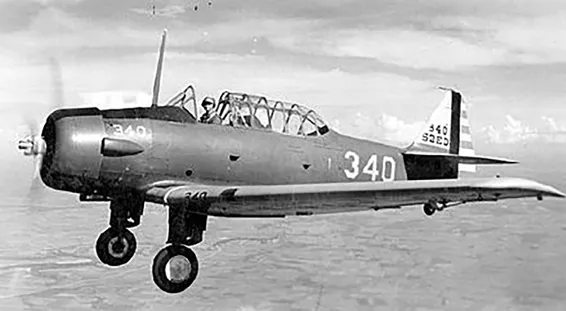
There were two types of aircraft at Randolph, trainers built by North American Aviation: the BT-9 and the BT-14 Yale. The BT-9 was about the same as a BT-14 except that it had a nasty habit of stalling. The BT-9 had to be modified with leading edge slats that increased lift and helped to ease the problem with stalls.
History often repeats itself. Decades later, I would fly the F-4E and F-4G. One of the significant differences between these models of the F-4 and earlier C and D models was that the E and G had leading edge slats to increase lift and ease the problem with stalls.
I was a crew chief on BT-14s, but occasionally I worked on BT-9s. The BT-14 was a forerunner of the AT-6 Texan, the best-known trainer of that period. The BT-14s had gear that were welded down and 450 hp engines, whereas AT-6s had retractable gear and 650 hp engines. I wanted to learn as much as I could about both BT models because I wanted to fly them one day. I read all the tech orders (TOs) and all the information I could find on both airplanes in the maintenance office in Hangar E. My studies helped me to pass on-the-job training and receive an air mechanics second-class rating.
North American BT-14 Yale (Wikiwand)
In those days, Randolph Field didn’t have a paved runway; it had two dirt runways. There were not any lights on either runway, so night flying was almost magical. Both BT models had racks in the fuselage behind the rear cockpits with slots for flares. There were Dzus fasteners that could be taken off when flying at night so that the flares could be put in the racks. There was a pull ring in the cockpit that would release one flare at a time. You often had three or four planes in the landing pattern, and if each airplane dropped a flare, the night sky could get very bright and beautiful, almost eerie. I really wanted to be up there, dropping flares at night, instead of down on the ground wiping off canopies. (Sammy referred to crew chief maintenance duties as wiping canopies.)
I applied to flying school every month, and every month they told me that I was too young. There was a law in those days that you could not be an officer and a gentleman until you were twenty-one years old, and I was only nineteen. I was not all that busy as a crew chief, so I kept annoying them to get into pilot training. I guess I thought that if I bothered them enough that they would send me to flying school just to get rid of me.
The Aviation School of Medicine, where the USAAF trained doctors to become flight surgeons, was located at Randolph Field. The flight surgeon students had to practice giving flight physicals, so the school would ask for volunteers in the enlisted ranks to be guinea pigs. Every time they asked, I volunteered. After going over there three or four times to be a guinea pig, the commanding officer (CO), Colonel White, asked me, “Why don’t you apply to pilot training since you always pass the flight physical?” I told him that the powers-to-be kept telling me that I was not old enough and that if he could help me to get an exception to the rule, I would appreciate it. He laughed and said, “All I can do is give you some advice.” His advice was that I should keep applying because one day I would be old enough!
I kept applying, and about six months later, the first sergeant called me into the orderly room. He said, “We have found a way to send you to flying school. The Army is now sending enlisted people to flying school as long as they can pass the physical and other educational requirements.” He said that the minimum age limit didn’t apply to enlisted pilot candidates. “You can go through flying school in your current rank, and if you make it, you will be promoted to flying sergeant.” He said that the flying sergeant rank would basically be the same rank as staff sergeant.
I asked, “Where do I sign?”
In addition to passing the flight physical, candidates had to be between the ages of eighteen and twenty-two. They had to have a high school diploma and have ranked in the top 50 percent of the class with at least one and one half credits in math.
The first sergeant got the forms out of his desk, and we filled them out. He said the application would go to Army Air Forces Flying Training Command and that it would take a while for them to process it and notify me of the results. He said, “There aren’t very many people in the Army who know anything about this program, so we need to get your application in right away to get you in as quickly as possible. Go back to work, and we’ll do whatever we can to get you in.”
I don’t guess it was a week before the “first shirt” (squadron’s first sergeant) called me back in. I had continued working as a crew chief, and when I was called back, I thought, Here it is, hot dog, I’m going to flying school!
However, the first shirt said, “I have other propositions for you. You have progressed to the point that if there is a vacancy, you could be promoted to tech sergeant. However, we only have a limited number of tech sergeant slots in the squadron, and I don’t see a vacancy coming open any time soon. There is another way for you to make more money. You have passed everything to become an advanced mechanic one. That is a private first-class rank, but with tech sergeant pay. I have a third possible deal for you, one that I think you will like the best. They are getting ready to open a pilot training base at Enid, Oklahoma, and we must provide Enid the initial cadre of aircraft maintenance personnel to get things started. The unit at Enid should have a lot of slots for all ranks. We can send you to Enid as part of the initial cadre, and that should put you into position to get promoted. The best part of the deal is that a transfer to Enid will not affect your going to flying school as soon as that works out.”
I liked the third option best. I didn’t have my feet set in concrete or anything tied down in San Antonio, so off I went to Enid, Oklahoma, to what is now Vance AFB.
When estab...