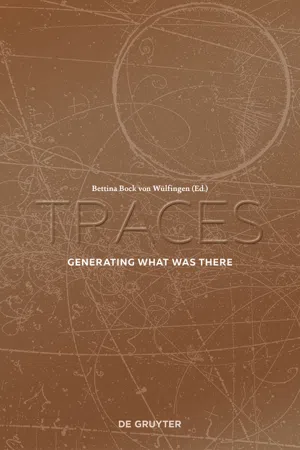
Traces keep time and make the past visible. As such, they continue to be a fundamental resource for scientific knowledge production in modernity. While the art of trace reading is a millennia-old practice, tracings are specifically produced in the photographic archive or in the scientific laboratory. The material traces of the forms represent the objects and causes to which they owe their existence while making them invisible at the moment of their visualization. By looking at different techniques for the production of traces and their changes over two centuries, the contributions show the continuities they have, both in the laboratories and in large colliders of particle physics. This volume, inspired by Carlo Ginzburg's early works, formulates a theory of traces for the 21st century.
- 124 pages
- English
- PDF
- Available on iOS & Android
eBook - PDF
About this book
Information
Topic
ArtSubtopic
Art GeneralTable of contents
- Inhalt
- Editorial
- Image Description
- Layers of Operation. Lars Leksell’s Neurosurgical Planning Image
- Description, Experiment, and Model. Reading Traces in Paleobiological Research Exemplified by a Morpho-functional Analysis
- Image Description
- Visualizing Viruses. Notes on David S. Goodsell’s Scientific Illustrations and Their Use in Molecular Biology between Picture Model and Trace
- Microscopic Imaging. Interference, Intervention, Objectivity
- “It is not enough, in order to understand the Book of Nature, to turn over the pages looking at the pictures. Painful though it may be, it will be necessary to learn to read the text.” Visual Evidence in the Life Sciences, c. 1960
- Giving a Theory a Material Body. Staining Technique and the “Autarchy of the Nucleus” since 1876
- Interview
- Traces and Patterns. Pictures of Interferences and Collisions in the Physics Lab A Dialogue between Dr. Anne Dippel and Dr. Lukas Mairhofer
- Liquid or Globular? On the History of Gestalt-seeing in the Life Sciences of the Early 19th Century
- Traces of Bodies and Operational Portraits. On the Construction of Pictorial Evidence
- Reduced Complexity or Essentialism? Medical Knowledge and “Reading Traces” in the History of Art
- Image Credits
- Authors
Trusted by 375,005 students
Access to over 1.5 million titles for a fair monthly price.
Study more efficiently using our study tools.
Frequently asked questions
Yes, you can cancel anytime from the Subscription tab in your account settings on the Perlego website. Your subscription will stay active until the end of your current billing period. Learn how to cancel your subscription
No, books cannot be downloaded as external files, such as PDFs, for use outside of Perlego. However, you can download books within the Perlego app for offline reading on mobile or tablet. Learn how to download books offline
Perlego offers two plans: Essential and Complete
- Essential is ideal for learners and professionals who enjoy exploring a wide range of subjects. Access the Essential Library with 800,000+ trusted titles and best-sellers across business, personal growth, and the humanities. Includes unlimited reading time and Standard Read Aloud voice.
- Complete: Perfect for advanced learners and researchers needing full, unrestricted access. Unlock 1.5M+ books across hundreds of subjects, including academic and specialized titles. The Complete Plan also includes advanced features like Premium Read Aloud and Research Assistant.
We are an online textbook subscription service, where you can get access to an entire online library for less than the price of a single book per month. With over 1.5 million books across 990+ topics, we’ve got you covered! Learn about our mission
Look out for the read-aloud symbol on your next book to see if you can listen to it. The read-aloud tool reads text aloud for you, highlighting the text as it is being read. You can pause it, speed it up and slow it down. Learn more about Read Aloud
Yes! You can use the Perlego app on both iOS and Android devices to read anytime, anywhere — even offline. Perfect for commutes or when you’re on the go.
Please note we cannot support devices running on iOS 13 and Android 7 or earlier. Learn more about using the app
Please note we cannot support devices running on iOS 13 and Android 7 or earlier. Learn more about using the app
Yes, you can access Traces by Bettina Bock von Wülfingen in PDF and/or ePUB format, as well as other popular books in Art & Art General. We have over 1.5 million books available in our catalogue for you to explore.