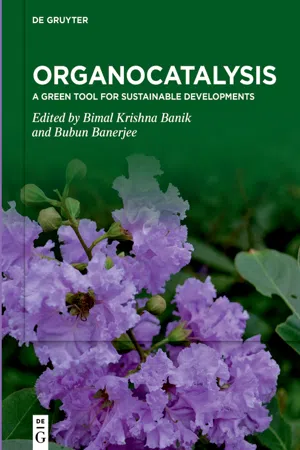
Organocatalysis are an important tool for greener catalytic processes due to the lack of precious metals used. This book explores different organocatalysts and their use in synthesis. Topics covered include zwitterionic imidazolium salt catalysts, asymmetric catalysts in aqueous media, beaker yeast catalysis, organocatalysts for Aldol and Michael reactions, amino acid-based organocatalysts, and Brönsted acidic surfactant organocatalysts.
eBook - ePub
Organocatalysis
A Green Tool for Sustainable Developments
- 396 pages
- English
- ePUB (mobile friendly)
- Available on iOS & Android
eBook - ePub
Organocatalysis
A Green Tool for Sustainable Developments
About this book
Information
Topic
Physical SciencesSubtopic
Environmental Science1 Synthetic drives for useful drug molecules through organocatalytic methods
Bimal Krishna Banik
Department of Mathematics and Natural Sciences, College of Sciences and Human Studies, Prince Mohammad Bin Fahd University, Al Khobar, Kingdom of Saudi Arabia
Biswa Mohan Sahoo
Roland Institute of Pharmaceutical Sciences, Berhampur, India
Abhishek Tiwari
Faculty of Pharmacy, IFTM University, Moradabad, India
Varsha Tiwari
Faculty of Pharmacy, IFTM University, Moradabad, India
Adya Jain
Department of Chemistry, MRK Educational Institutions, IGU, Rewari, India
Preetismita Borah
CSIR-Central Scientific Instruments Organization, Chandigarh, India
Abstract
The treatment of various pathological conditions in human beings involves the use of safe and efficacious drug substances. But there are different complications associated with the treatment of various disease states including drug resistance, adverse drug reactions, toxicity, etc. To minimize these problems, there is an urgent need to develop new therapeutics with suitable pharmacokinetic and pharmacodynamic properties. So, the organocatalytic methods are emerged as a potential synthetic tool to accelerate the design of new drug candidates with improved physicochemical and pharmacological properties, selectivity, and efficiency for the treatment of life-threatening diseases. Organocatalytic reactions refer to the chemical reaction that is accelerated by organic catalysts instead of using organometallic catalysts. Organocatalysts are more advantageous in comparison to metallic catalysts because organocatalysts are cost-effective, stable, efficient, non-toxic, readily available, and easy to handle. In addition to this, the organocatalysis method involves an eco-friendly reaction by minimizing the formation of by-products and reducing the chemical hazards. Organocatalysts are categorized into four classes such as Lewis acids, Lewis bases, Bronsted acids, and Bronsted bases. These catalysts are generally involved in various reactions mechanisms such as Aldol reaction, Diels–Alder reactions, Michael Addition and Knoevenagal reactions, etc. The utility of organocatalyst in synthetic chemistry results in the development of medicinally active compounds with diverse structural features.
Keywords: biological activity, drugs, organocatalyst, reaction, synthesis,
1.1 Introduction
Catalysts refer to the chemical substances that promote the rate of any organic reaction without affecting its equilibrium stage [1]. It acts by decreasing the activation energy of the chemical process [2]. Chemical reactions proceed in the presence of catalysts by interacting with reactants that lead to the generation of the intermediate materials which further undergo reaction to produce final products [3]. Catalysts are commonly classified based on their structure, composition, types of synthesis, and state of aggregation. According to the state of aggregation, catalysts are categorized into two types including homogeneous and heterogeneous catalysts [4]. The function of homogeneous catalysts is carried out in the same phase as the reactants whereas the heterogeneous catalysts exhibit their activities in different phases than the reacting substances. Further, catalysts are categorized into different types such as organic, enzymatic, or metallic [5]. Out of these, organic catalysts or organocatalysts are more advantageous in terms of synthetic range, less toxic, economically viable, mild reaction conditions, absence of metallic substances, less polluting, robust, and stable in air and water, as shown in Table 1.1. Hence, the use of organocatalyst in the synthesis of drug mole...
Table of contents
- Title Page
- Copyright
- Contents
- 1 Synthetic drives for useful drug molecules through organocatalytic methods
- 2 Organocatalytic total synthesis of bioactive compounds based on one-pot methodologies
- 3 Microwave-induced biocatalytic reactions toward medicinally important compounds
- 4 Organocatalysts based on natural and modified amino acids for asymmetric reactions
- 5 Critical trends in synthetic organic chemistry in terms of organocatalysis
- 6 Organo-catalysis as emerging tools in organic synthesis: aldol and Michael reactions
- 7 Enzyme-catalyzed synthesis of bioactive heterocycles
- 8 Sulfonated β-cyclodextrins: efficient supramolecular organocatalysts for diverse organic transformations
- 9 Baker’s yeast (Saccharomyces cerevisiae) catalyzed synthesis of bioactive heterocycles and some stereoselective reactions
- 10 Bronsted acidic surfactants: efficient organocatalysts for diverse organic transformations
- 11 The aryl iodine-catalyzed organic transformation via hypervalent iodine species generated in situ
- 12 Zwitterionic imidazolium salt: an effective green organocatalyst in synthetic chemistry
- Index
Trusted by 375,005 students
Access to over 1.5 million titles for a fair monthly price.
Study more efficiently using our study tools.
Frequently asked questions
Yes, you can cancel anytime from the Subscription tab in your account settings on the Perlego website. Your subscription will stay active until the end of your current billing period. Learn how to cancel your subscription
No, books cannot be downloaded as external files, such as PDFs, for use outside of Perlego. However, you can download books within the Perlego app for offline reading on mobile or tablet. Learn how to download books offline
Perlego offers two plans: Essential and Complete
- Essential is ideal for learners and professionals who enjoy exploring a wide range of subjects. Access the Essential Library with 800,000+ trusted titles and best-sellers across business, personal growth, and the humanities. Includes unlimited reading time and Standard Read Aloud voice.
- Complete: Perfect for advanced learners and researchers needing full, unrestricted access. Unlock 1.5M+ books across hundreds of subjects, including academic and specialized titles. The Complete Plan also includes advanced features like Premium Read Aloud and Research Assistant.
We are an online textbook subscription service, where you can get access to an entire online library for less than the price of a single book per month. With over 1.5 million books across 990+ topics, we’ve got you covered! Learn about our mission
Look out for the read-aloud symbol on your next book to see if you can listen to it. The read-aloud tool reads text aloud for you, highlighting the text as it is being read. You can pause it, speed it up and slow it down. Learn more about Read Aloud
Yes! You can use the Perlego app on both iOS and Android devices to read anytime, anywhere — even offline. Perfect for commutes or when you’re on the go.
Please note we cannot support devices running on iOS 13 and Android 7 or earlier. Learn more about using the app
Please note we cannot support devices running on iOS 13 and Android 7 or earlier. Learn more about using the app
Yes, you can access Organocatalysis by Bimal Krishna Banik, Bubun Banerjee, Bimal Krishna Banik,Bubun Banerjee in PDF and/or ePUB format, as well as other popular books in Physical Sciences & Environmental Science. We have over 1.5 million books available in our catalogue for you to explore.