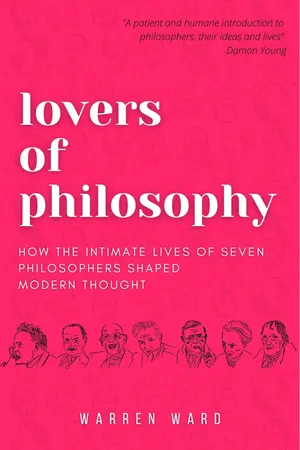
They were Europe's greatest thinkers, but what were they like at love? Lovers of Philosophy explores the love lives of seven philosophers, and how their most intimate experiences came to shape their ideas. In these pages, the reader learns about the significance of Kant's infatuation, Hegel's premarital liaisons, Nietzsche's heartbreak, Heidegger's hypocrisy, Sartre's promiscuous polyamory, Foucault's sexual liberation, and Derrida's dalliances in extramarital desire. The stories of these philosophers' love lives are told against a backdrop of Europe undergoing tumultuous change. Beginning in the eighteenth-century Prussian Enlightenment, the book traverses the French Revolution, Napoleonic wars, Industrial Revolution, two World Wars, and events of May 1968 before arriving at the culture wars of the late twentieth century. For anyone who has struggled to understand continental philosophy's vast array of movements, from German idealism through to phenomenology, existentialism, post-structuralism, and deconstructionism, Lovers of Philosophy also provides the reader with an easy-to-follow overview of the progression of ideas from Kant to Derrida.
eBook - ePub
Lovers of Philosophy
How the Intimate Lives of Seven Philosophers Shaped Modern Thought
- English
- ePUB (mobile friendly)
- Available on iOS & Android
eBook - ePub
About this book
Information
Topic
PhilosophySubtopic
Philosophy History & TheoryChapter 1
Kant and the Countess
The Graduate
On a clear, blue-skied summer’s day in 1753, a twenty-eight-year-old unemployed philosophy graduate called Immanuel Kant arrived by horse and buggy at the grounds of the famous Keyserlingk Palace. He was there to apply for a position as family tutor for the Keyserlingks’ two young children. Kant’s potential new employer had arranged for a driver to collect him at his modest cottage in the centre of Königsberg and bring him to the palace, a few miles outside the city.
This was Kant’s first time outside the city gates; he had not previously met the twenty-five-year-old Countess Caroline von Keyserlingk who was about to interview him. But he had, like others in the town, heard the descriptions of her as ‘beautiful, intellectually agile and artistically creative’.1 He was also aware of rumours that she had a passionate interest in philosophy.
Kant was in desperate need of employment at this time. His beloved father, a harness-maker, had died a few years earlier, leaving the family destitute. As the oldest male, it had been Kant’s duty to bury his father in the Königsberg cemetery, alongside his mother who had died nine years earlier.
Kant’s circumstances had, since then, become increasingly dire as he looked for work to support himself and his siblings. Positions for philosophy graduates were hard to come by, so he sought a job as a Hofmeister, a private family tutor. Such employment did not carry a very high social standing or many prospects for career advancement, but it could at least bring some much-needed income. After a couple of short-lived and unsatisfactory appointments, Kant jumped at this opportunity to work for Königsberg’s leading noble family.
As his buggy pulled into the driveway, Kant was greeted by a large green garden in the French style, backgrounded by a sprawling baroque palace. This son of a humble artisan, only recently graduated from university, felt immediately out of place in this sumptuously decorated setting.
But Kant was not only offered the position, he soon became a close confidante of the Countess. Classically educated, Caroline von Keyserlingk had a good working knowledge of both classical and contemporary philosophy. At the time Kant met her, she was translating a work by the German philosopher Johann Gottsched into French.
Keyserlingk had been married since the age of fifteen to the Count, thirty years her senior. At sixteen, she gave birth to her first son. Her second came a year later. Her two children were now at the age, eight and nine, where they could benefit from a family tutor. But the Countess insisted, on offering the handsome new tutor the position, that he regularly put time aside to engage with her in philosophical debate.
The Countess
The Countess had long-standing interests in not only philosophy, but in literature, music, and the arts. She was a proficient lutenist, and arranged for her sons to have singing lessons from a very young age. She was enamoured of all things French; she spoke the language fluently, and the palace’s furnishings and decorations reflected the latest styles from Paris, as did her wardrobe. Unfortunately for the Countess, her cultural and intellectual interests were not shared by her husband, nor, for that matter, by anyone else in the court. She was delighted, therefore, when the learned young Kant joined her court, and arranged for him to attend the palace as often as possible.
We do not know if the Count had any concerns about the new tutor’s repeated visits upon his wife. Gossip had, however, already begun to circulate in the palace corridors. As one observer of the Countess noted:
The young beauty was passionately interested in philosophy; rumour had it that she was no less interested in the visiting philosopher.2
A Harness-Maker’s Son
The Countess soon learned that her new employee had an upbringing vastly different to hers.
Born in 1724, Kant had spent his whole life in Königsberg, a small, windswept city on Prussia’s Baltic coast. Königsberg was not a centre of political or academic importance like Berlin or Halle, but it was close enough to these cities to keep in touch with the ideas of the day. And its location on the Baltic navigation routes meant its citizens were regularly exposed to the goods and services, but also the ideas, of the English and Dutch.
Kant’s father, Johann, whose descendants had emigrated from Scotland several generations earlier, was a bridle-maker of modest means, but highly respected within his community. He and his wife, Anna Regina, had nine children, with four dying before reaching maturity. Immanuel was the fourth-born child, and the oldest surviving son.
Kant’s early world was one of horses, carriages, and harness-making. He spent his childhood in a part of the city the Countess had never set foot in, where the city’s master craftsmen all lived and worked. His childhood neighbourhood bustled day and night with the sounds and smells of saddlers, harness-makers, tanners, and blacksmiths.
While the Countess’s early years were populated with servants, tutors, music, and manicured gardens, Kant’s were suffused with the smells of hay, manure, and leather. In Königsberg’s wet, cold, and windy winters these ever-present aromas blended with the homely scents of woodfire, ash, and rainwater. Every morning, the young Kant woke to the sounds of neighing horses, cracking whips, and craftsmen hard at work.
On Sundays the Kant family, like everyone else in their community, proceeded to church, the main event of the day. The Kants belonged to the Pietist faith, and their churches, like those of their Lutheran forebears, were spare, stark, and simple, free of the iconography of the Roman Catholic houses of worship they distinguished themselves from. These were the only mornings that Königsberg’s streets were empty, apart from worshipping women in bonnets and long dresses and men in hats, wigs, stockings, and tunics, all making their way to the Sunday service as church bells rang out.
Although Kant’s parents weren’t overly strict in their religious beliefs, they did pass on to their son, mainly through their own example, the Pietist values of humility, thrift, hard work, and self-sacrifice. Such an upbringing instilled in Kant a discipline and dedication that would stand him in good stead when he later embarked on tackling the thorniest philosophical problems of his day.
Kant’s parents had been forward-thinking enough to send their son, who had shown academic promise from a young age, to a Pietist school from the age of eight, where he received a schooling in the classics until his mid-teens.
Kant’s mother, however, would not live to see the results of her foresight. When Kant was only thirteen years old, she died in tragic circumstances.
Having already endured the loss of four children of her own, Anna Kant became very distressed on learning that her dearest friend was at risk of dying from scarlet fever. Taking it upon herself to nurse her friend, she encouraged her to take her medicine by sipping some herself. Immediately afterwards, she realised with horror she had exposed herself to the deadly fever. Her friend died after many tortured hours of painful delirium, followed a few days later by Anna herself.
Despite the trauma of being left alone at age thirteen with his father and siblings, Kant managed, with his father’s generous help, to enrol at the age of sixteen at Königsberg University, where he would graduate with a degree in philosophy six years later.
Magister
After being hired by Countess Keyserlingk, Kant accustomed himself surprisingly quickly to palace life. He worked hard to familiarise himself with the ways of society, an effort that would not only bring him closer to the Countess, but also accelerate his trajectory to becoming a respected and renowned man of letters.
In 1754 the twenty-nine-year-old Kant started spending days he wasn’t required at the palace at his old alma mater, Königsberg University. Perhaps his return to formal study was inspired by the philosophical interests of his beguiling new employer. In any case, he spent an increasing amount of time in the institution’s libraries immersing himself in texts on philosophy and a wide range of other subjects. As a contemporary observed, ‘he collected in his miscellanies from all the parts of human knowledge, all that somehow seemed useful to him’.3
He also started writing, and published a couple of minor papers in a local journal.
In 1755 Kant completed his master’s thesis and was awarded the title of Magister. At this point he stopped working for the Keyserlingks, but continued, at the Countess’s insistence, to regularly visit her at the palace.
Portrait
When Kant turned thirty, the Countess asked if she could draw his portrait.
The Countess had, by this time, become an artist of considerable repute. Her watercolour paintings and pencil drawings, mainly historical scenes and portraits, were already held in high regard throughout Prussia. (In later years, her artistic achievements would be acknowledged with an honorary membership of the Royal Prussian Academy of the Arts.)
Although the Countess sketched and painted many dignitaries and other persons of import who visited the palace, her portrait of Kant is the only work that survives to this day. Her rendering of Kant provides us with a glimpse of her feelings towards the young philosopher at this time.
She represents him, in fact, in a most flattering light with fine, handsome features, elegantly dressed in cape and wig. The Kant she sees has gentle eyes, a high noble forehead, and soft, youthful face.
What this head-and-shoulders drawing of Kant doesn’t show is how short the young scholar was. At five-foot-two, he would have struggled to stand face to face with the elegant, dark-haired noblewoman who was sketching him. Kant was quite self-conscious about his height, as he was about another imperfection – a caved-in chest that he believed made him prone to the many respiratory allergies he suffered from. (He was known to sneeze every time he came into contact with newsprint.) The fastidious philosopher was, in fact, plagued by numerous hypochondriacal concerns throughout his life. In later years, he would regularly embarrass his friends by repeatedly expressing concerns about the regularity of his bowel.
Despite these temperamental peculiarities, Kant became highly successful during these years in refashioning himself as an elegant Magister who could comfortably mix in society’s highest circles. He started to dress in the Rococo style, a look imported from Paris, much to the delight of his Francophile Countess. His gold-trimmed coats and ceremonial swords provided a refreshing contrast to the sombre blacks and greys worn by most dignitaries at the palace.
With his slight stature, Kant had to rely heavily on his intelligence and natural charisma to engage and entertain the Countess. As a visitor to the palace observed, he certainly possessed notable gifts in this regard:
In societal conversation he could at times clothe even the most abstract ideas in lovely dress, and he analysed clearly every view that he put forward. Beautiful wit was at his command, and sometimes his speech was spiced with a light satire, which he always expressed with the driest demeanour.4
Although the Countess’s drawing suggests she was somewhat enamoured with the young Magister’s blonde hair, fair complexion, and searching eyes, she wasn’t the only one to be captivated by Kant’s physiognomy. Another contemporary noted that although ‘the colour of his face [was] fresh, and his cheeks showed…a healthy blush’, it was the philosopher’s eyes, the window to his clear-sighted mind, that struck one the most:
Where do I take the words to describe to you his eye! Kant’s eye was as if it had been formed of heavenly ether from which the deep look of his mind, whose fiery beam was occluded by a light cloud, visibly shone forth.5
The Countess’s beauty and class, however, far outshone Kant’s, and he would have felt most honoured that she had deigned to draw his portrait. A drawing of the Count and Countess at around this time reveals her as a dark-haired woman of natural beauty, wearing an open-necked dress with simple adornments. The soft youthfulness of her intelligent, pretty, open face provides an unsettling ...
Table of contents
- lovers
- of
- About the Author
- Acknowledgements
- Contents
- Introduction
- Chapter 1
- Chapter 2
- Chapter 3
- Chapter 4
- Chapter 5
- Chapter 6
- Chapter 7
- Epilogue
- Bibliography
- Notes and References
Trusted by 375,005 students
Access to over 1.5 million titles for a fair monthly price.
Study more efficiently using our study tools.
Frequently asked questions
Yes, you can cancel anytime from the Subscription tab in your account settings on the Perlego website. Your subscription will stay active until the end of your current billing period. Learn how to cancel your subscription
No, books cannot be downloaded as external files, such as PDFs, for use outside of Perlego. However, you can download books within the Perlego app for offline reading on mobile or tablet. Learn how to download books offline
Perlego offers two plans: Essential and Complete
- Essential is ideal for learners and professionals who enjoy exploring a wide range of subjects. Access the Essential Library with 800,000+ trusted titles and best-sellers across business, personal growth, and the humanities. Includes unlimited reading time and Standard Read Aloud voice.
- Complete: Perfect for advanced learners and researchers needing full, unrestricted access. Unlock 1.5M+ books across hundreds of subjects, including academic and specialized titles. The Complete Plan also includes advanced features like Premium Read Aloud and Research Assistant.
We are an online textbook subscription service, where you can get access to an entire online library for less than the price of a single book per month. With over 1.5 million books across 990+ topics, we’ve got you covered! Learn about our mission
Look out for the read-aloud symbol on your next book to see if you can listen to it. The read-aloud tool reads text aloud for you, highlighting the text as it is being read. You can pause it, speed it up and slow it down. Learn more about Read Aloud
Yes! You can use the Perlego app on both iOS and Android devices to read anytime, anywhere — even offline. Perfect for commutes or when you’re on the go.
Please note we cannot support devices running on iOS 13 and Android 7 or earlier. Learn more about using the app
Please note we cannot support devices running on iOS 13 and Android 7 or earlier. Learn more about using the app
Yes, you can access Lovers of Philosophy by Warren Ward in PDF and/or ePUB format, as well as other popular books in Philosophy & Philosophy History & Theory. We have over 1.5 million books available in our catalogue for you to explore.