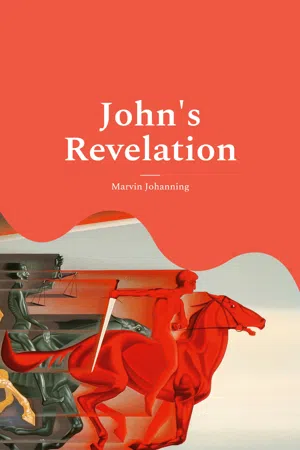
John's Revelation (or Apocalypse) is one of the most fascinating books of the entire New Testament; it is filled to the brim with colourful and powerful imagery and is as suspenseful as any modern story about the end of the world. This new and modern translation aims to turn the Revelation into a novel closely following the original scripture. Inline notes and comments ensure that the reader understands the context of a passage all the while clearly marking which parts of the translation are the translator's comments and suggestions. This way, the book can be read either more fluently or, if so desired, in a more literal translation. It is perfect for those who have yet to start studying the Bible and wish to start by reading the most interesting book the Bible has to offer.
- 112 pages
- English
- ePUB (mobile friendly)
- Available on iOS & Android
eBook - ePub
About this book
Information
The Translation
On translating ancient texts

Translations of the New Testament are plentiful — indeed, the vast majority of translations one can attain nowadays are much more professionally made and have had dozens of people working for hundreds upon hundreds of hours perfecting them. Therefore, it may come as a surprise to some that I — someone who has written what you are about to read in his free-time and who has never “professionally” studied Ancient Greek — would take it upon myself to write my own translation of one of the books of the New Testament.
Thus, in order for you to understand why this particular translation exists and how it differs from other translations, I decided to write this introduction, detailing not only the philosophy behind the manner in which I translate texts, but also the recommended ways of reading my translation.
The first thing I would like to discuss is the text upon which my translation is based. As I do not have access to a large amount of funds, I was required to use a textual basis published in the public domain. Thankfully, a substantial amount of editions of the Greek New Testament are now available in the public domain, which means that there is not a shortage of texts to utilise; finding a digital edition of such a public domain text — that is itself in the public domain — was, however, a slightly more complicated task to accomplish.
As luck would have it, however, a very kind man going by the name of Diego Santos has digitised the 1904 edition of Eberhard Nestle's Novum Testamentum Graece and published it on his website (https://sites.google.com/site/nestle1904/home) in the public domain.
Without the tremendous amount of effort he put into the digitisation of Nestle's 1904 edition, I would not have been able to produce this book. And whilst there have been a great number of revised editions of his work (as of Thursday, 10. February 2022, the most recent one is NA28, i. e. the 28th edition), the changes are minor enough for me to look past them.
Another matter that I believe must be discussed before delving into any translated text is the matter of cultural differences. Translating texts from another language is never as straight-forward as some people might believe; one cannot simply pick up a dictionary, start translating and expect to have a coherent result thereafter. I have met a number of people who sincerely believe that they will be able to study a language by solely learning vocabulary and leaving the acquisition of grammatical concepts to “intuition”.
Such approaches are — in my opinion — bound to fail, unless it is one's goal to part-take in a spelling contest in another language (as some people have, indeed, previously done).
Instead, translating a text requires not only an at least somewhat firm grasp of the language's grammatical concepts — and how they might be translated properly without distorting their meaning too considerably —, but also an understanding of the source text and the cultural background of the people who speak the language being translated from.
Of the above-mentioned skills, however, only two can be harnessed with relative ease, namely the attaining of a firm understanding of the grammatical concepts of the language and of the text being translated; the latter skill — (somewhat) extensive knowledge of the cultural background of the people who spoke the language — is slightly more difficult.
For, indeed, we are unable to take a time-machine and live with the ancient Greeks — or, in this particular instance, those living at around 200 AD. It is, therefore, much more difficult to get an adequate understanding of the cultural background; yet it is still quite possible to get a decent understanding of it through reading history books and reading original texts from that time.
Another aspect that needs considering is the fact that the general populace is most likely unaware of many of the cultural aspects of the people who lived during the time of the events of the New Testament; it is, therefore, imperative to assume that whoever is reading one's translation is oblivious to many of the cultural terms used in the text.
The translator must, therefore, consider which terms are to be explained to the reader and which are not; for explaining every single “strange” term one encounters could lead to the text containing too much of one's personal opinions and viewpoints.
Personally, I explain terms which a modern reader might be confused by (such as the Ancient Greek word δηνάριον, which is the equivalent of the modern-day penny), but do not generally explain those terms that might leave the “uninitiated” slightly mystified, but which make sense when one knows the basics of the Biblical story.
Another matter to discuss is that of general linguistic issues. Despite my having written that the obtaining of a decent understanding of the grammatical concepts of a language is relatively simple, it is, by no means, truly simple — indeed, the word “relatively” is of great import in this sentence. This is especially true when it concerns the translating of a text, particularly one that — as you shall see in the chapter hereafter — contains a not insignificant amount of strange linguistic features.
As the translator, I am forced to consider whether to translate what the original author wrote verbatim, or whether to change its meaning in English to abide by the rules of regular English prose. Frequently, I opt to present the reader with the literal translation and an alternative interpretation (in brackets); a matter I will more fully explain in the How to read this translation section later on.
Indeed, I try staying as close as I possibly can to the base text, as I do not want to “disturb” the original aesthetics of the prose. Yet, there are times where a literal translation would yield something so bizarre and utterly incomprehensible that a modern English speaker would be greatly mystified by it — and in such instances, I do take the liberty of slightly rephrasing the original sentence, all the while keeping the meaning intact as best I can.
My particular approach to translation is a more literal one; this is especially true — and, in my opinion, important — when it concerns important documents such as, in this case, a religious text. The wrong translation — or, indeed, interpretation — may lead to an entirely different outcome; and as religious texts are abound in symbolism that is, frequently, open to interpretation, it is my goal to present the reader not with my own, personal world-view, but rather with an undiluted — but still pleasant-to-read — version of the base text in a language he can understand.
Balancing the “pleasant-to-read” aspect of my translation with linguistic accuracy is a rather delicate task, however, and I generally prefer to err on the side of linguistic accuracy. Frequently, John re-uses the same phrases, expressions and words in close proximity, which is a practice frowned upon by most English speakers when reading prose; and even though I often have the ability to choose a slightly different word for the sake of diversity, I choose to, instead, — in the vast majority of instances, at any rate — use the same repetition as John does too.
Once you have understood the difficulties and challenges associated with the translation of an ancient text and wish you actually begin reading this translation, you can move on to the following section, wherein I will be briefly explaining how to actually read this translation with its many quirks.

But how does one properly read my translation? Firstly, it is important to note that this translation differs substantially from others you might be used to, for it contains a not insignificant amount of notes within parentheses. This approach might be somewhat perplexing to those who are not used to it and I would, therefore, like to explain how to properly read parenthesised text.
Indeed, there are, in actuality, several different types of parenthesised text, all fulfilling slightly different functions. In general, it can, however, be said that the text within parentheses contains my own opinions and interpretations that cannot be found in the base text; and as I do not wish to impose my world-view upon the reader — as mentioned earlier —, these personal viewpoints have been placed in brackets to clearly separate them from the base text.
Should you wish to learn more about the various categories of notes, I shall herein explain them to you. We will begin by covering the “explanatory type’"; this particular category is used to explain strange or unusual text passages or words. An example of this would be the aforementioned “denarius” which is followed by an explanatory parenthesis clarifying its modern-day equivalent meaning (i. e. penny / cent).
Another very frequently-used variety is the “supplementary type”. This particular variety of parenthesised text is used whenever John implies a certain meaning, but does not explicitly write it out; or where an additional phrase makes the sentence sound more natural in English. An example of this can be found in II:4-5, where the addition of “I know’" (“[…] and (I know) that you cannot […]”) clarifies the meaning of the sentence.
The next category of parenthesised text that we shall explore is the “alternative reading type”. Anyone who has ever studied a second language for any length of time will be aware of the fact that words can — depending on context — be translated in a variety of ways. Therefore, whenever I felt that a word or phrase could be translated in a different manner, I add that alternative reading in parentheses behind the word or phrase it is referring to.
Within the alternative reading type, there exists a subset I am unsure what to call — perhaps “uncertain alternative reading type” would be an adequate description. Whenever I suspect there could be a possible alternative r...
Table of contents
- Epigraph
- Table of Contents
- Foreword
- The Translation
- John on the Isle of Patmos
- Letters to the Churches in Ephesus, Smyrna, Pergamum and Thyatira
- Letters to the churches in Sardis, Philadelphia, and Laodicea
- The almighty sitting upon his throne
- The sealed book
- The lamb opens the book
- The sealing of the servants
- The sounding of the first angels
- The star having fallen from heaven
- The angel with the small open book
- The seventh angel sounds
- The woman and the dragon
- The number of the beast
- The reaping of the earth
- The plagues of the angels
- The emptying of the vials
- The Prostitute of Babylon
- The fallen Babylon
- The angel standing in the sun
- The last judgement
- The New Jerusalem
- The river of life
- Further Reading
- Afterword
- Copyright
Trusted by 375,005 students
Access to over 1.5 million titles for a fair monthly price.
Study more efficiently using our study tools.
Frequently asked questions
Yes, you can cancel anytime from the Subscription tab in your account settings on the Perlego website. Your subscription will stay active until the end of your current billing period. Learn how to cancel your subscription
No, books cannot be downloaded as external files, such as PDFs, for use outside of Perlego. However, you can download books within the Perlego app for offline reading on mobile or tablet. Learn how to download books offline
Perlego offers two plans: Essential and Complete
- Essential is ideal for learners and professionals who enjoy exploring a wide range of subjects. Access the Essential Library with 800,000+ trusted titles and best-sellers across business, personal growth, and the humanities. Includes unlimited reading time and Standard Read Aloud voice.
- Complete: Perfect for advanced learners and researchers needing full, unrestricted access. Unlock 1.5M+ books across hundreds of subjects, including academic and specialized titles. The Complete Plan also includes advanced features like Premium Read Aloud and Research Assistant.
We are an online textbook subscription service, where you can get access to an entire online library for less than the price of a single book per month. With over 1.5 million books across 990+ topics, we’ve got you covered! Learn about our mission
Look out for the read-aloud symbol on your next book to see if you can listen to it. The read-aloud tool reads text aloud for you, highlighting the text as it is being read. You can pause it, speed it up and slow it down. Learn more about Read Aloud
Yes! You can use the Perlego app on both iOS and Android devices to read anytime, anywhere — even offline. Perfect for commutes or when you’re on the go.
Please note we cannot support devices running on iOS 13 and Android 7 or earlier. Learn more about using the app
Please note we cannot support devices running on iOS 13 and Android 7 or earlier. Learn more about using the app
Yes, you can access John's Revelation by Marvin Johanning in PDF and/or ePUB format, as well as other popular books in Teología y religión & Religión. We have over 1.5 million books available in our catalogue for you to explore.