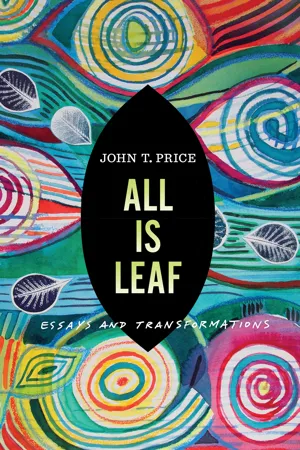
Drawing inspiration and urgency from the storied Goethe Oak tree at Buchenwald concentration camp—and from the leaf as symbol of all change, growth, and renewal—award-winning essayist John Price explores a multitude of dramatic transformations, in his life and in the fragile world beyond: "the how of the organism—that keeps your humanity alive."
He employs an array of forms and voices, whether penning a break-up letter to America or a literary rock-n-roll road song dedicated to prairie scientists, or giving pregame pep talks to his son's losing football team. Here, too, are moving portrayals of his father's last effort as a small-town lawyer to defend the rights of abused women, and his own efforts as a writing teacher to honor the personal stories of his students.
From his Iowa backyard to the edge of the Arctic Circle, from the forgotten recesses of the body to the far reaches of the solar system, this book demonstrates the ways imagination and informed compassion can, as Price describes it, expand thousandfold the boundaries of what we might "have naïvely considered an individual self."
- English
- ePUB (mobile friendly)
- Available on iOS & Android
eBook - ePub
About this book
MY NEAR-DEATH EXPERIENCE/ELVIS TRIBUTE
Appendicized
“Why did you say that about Elvis?” I asked my wife, who was standing beside me at Sgt. Floyd’s monument.1 “Just before my surgery.”
Stephanie didn’t remember saying anything about Elvis before my surgery, which shouldn’t have been a surprise since it was more than twenty years ago.
“What I remember,” she added, “is that you thought it was the prune kolache.”2
That was true. That was, in fact, the first thing I recalled telling the elderly doctor at the rural clinic. “This is probably just the prune kolache I ate this morning,” I told him, dismissively, because what I really needed to do was get back to trying (and failing) to write my dissertation, which was way overdue. The doctor pressed down on my abdomen, released, and a pain shot through my side so intense I actually yelped.
“No, I don’t believe this is the kolache,” he said and walked over to a large wall poster portraying the human digestive track, placing his finger on it. “I think it’s your appendix.”3
I had to lean forward to see what he was pointing at. Far from threatening, it looked like a puppy’s tail or a child’s thumb or a spring worm emerging from the dank soil of the large intestine.4
“No one really knows what the appendix does, except cause serious health problems,” he added.5 “To be safe, I want you to see a surgeon immediately. Do you feel well enough to drive?”
The regional hospital was over an hour away, and I drove there in one of those freak March snowstorms that can occur suddenly in Iowa. The snow blew unobstructed across the fields and rural roadways, often blinding me. Why risk my life for a little indigestion? I wondered. Aside from the abdominal pain, I didn’t have any of the symptoms listed by the clinic doctor: fever, nausea, vomiting, lack of appetite. I was a twenty-eight-year-old grad student in peak health.6 The doctor wanted to play it safe, he said, but was this safe? As the car crawled through the increasingly violent storm, I cursed myself for eating all those pastries, still not believing I was destined for the knife.
“Believe it,” the surgeon pronounced after a quick examination. “What’s worse, I think your appendix is retrocecal, which means the little devil is hiding behind the intestine.”7 His prominent eyebrows lowered, as if steeling himself for battle with an ancient, sentient adversary. “Yes. That would explain the minimal symptoms and the rebound pain—they’re tricky that way. And dangerous. Unfortunately for you, this means we can’t go low-invasive; I’m going to have to open you up for a little search and destroy.8 Nurse Heinrichs, are there any interns around who want to see some old-fashioned gut surgery? Well, call them in and get this young man a phone; he’ll want to contact family.”
I called Stephanie at the rural school where she was teaching and supporting me through grad school.9 She got on the phone just as they were sticking the IV in my hand and placing my clothes in a plastic bag, like they do for traffic fatalities.
“I’m not sure about this,” I told her. “I ate a lot of those prune kolache, so maybe I should get a second opinion. This guy seems a little eager.”
And that’s when she said it.
“Don’t risk it. That’s how Elvis died.”10
“What? Elvis didn’t die because of his appendix.” These were my final words before the surgical nurse took the phone away and let me ride the unspoken question into nothingness: Why Elvis?
During the intervening decades, Stephanie has been unable to answer that question to my satisfaction. Not that I’ve asked very often. Come to think of it, this may have been the first time, standing there at the base of Sgt. Floyd’s monument. That’s another mystery, the reasons why I felt compelled to return to his gravesite for the second time, after ten years. But here on the verge of turning fifty, there’s probably nothing I covet more than a little mystery—too many questions have been answered in my life, and in the life of our species. The appendix is not one of them. Its purpose is still unknown, its destiny unclear.11
Which is how I like to think of myself sometimes.
A little context. The day I asked my wife about Elvis at the base of Sgt. Floyd’s monument, I had that very morning been gazing at my shirtless self in the mirror, studying the fully exposed scar. Its visibility was somewhat of a triumphant moment, the result of many painful hours at the gym(s), but no one else would have appreciated it as such.12 Over the years I have secretly obsessed about that scar, which is indeed large, just as the good doctor promised: nearly five inches, whitish and bullocky, like a string of hills on an otherwise flat landscape. There have been many times, standing shirtless in front of that same mirror, when I have been unable to see it tucked beneath the lower crease of my bulging belly, accessible only to touch, a message in braille all too easily transcribed: get your shit together.
But now that the scar has reemerged into the light, I’m not sure of its easy meaning anymore. Instead of a landscape or a judgment in braille, it may be some kind of message in a bottle, newly washed up on shore, or beads on a prayer chain, or maybe a trail of hardened breadcrumbs leading me back to some lost source. Or just a hidden wound like any other we carry with us until, suddenly, it becomes visible and demands reinterpretation.
I suppose that begins with the original act of surgical articulation. Or rather, exploration. When the surgeon made the first incision, he was entering a landscape that had never been exposed to light, and yet one illuminated by stories and questions, by meaning, that pre-existed us both. What did I personally know of the appendix at the time? Virtually nothing. In the mid 1990s, during the exploding popularity of what my writing professor called “memoirs of malady”—on depression, addiction, cancer, neuromuscular disease, spanking—I had encountered nada by appendicitis victims. Within Western literature as a whole, the appendix had apparently failed to accumulate the privileged symbolic value associated with other body parts—none of the patriarchal power of the phallus or the courage of the spleen or the vulnerability of the heart—though I had seen it mentioned from time to time. I knew, for instance, that the Sylvia Plath poem, “Tulips,” was written while she was recovering from appendicitis, and that Willa Cather used the appendix to kill off a major character in my favorite novel by her, O Pioneers! 13 14 15
What the surgeon knew at the time, I can only guess, but I know now that the surgery itself was a relatively new answer to an old riddle. I know this because during the intervening decades, I’ve obsessively accumulated random bits of research on the subject, which I keep in a brown, overstuffed accordion folder located on top of the basement beer fridge—which has itself been linked to the fluctuating health of my gut. In that accordion folder, you will discover that ancient Egyptians made note of the appendix while preparing bodies for mummification;16 and that in 1492 (a year largely known for other discoveries), Leonardo da Vinci produced the first-known drawings of the appendix;17 and that the first anatomical descriptions of the appendix didn’t occur until 1521; and that in 1886, a Harvard anatomy professor named Reginald Fitz first declared at a meeting of the Association of American Physicians that “appendicitis” (a term he coined) was a distinct and dangerous pathological entity requiring surgery.18 You’ll also find accounts of a surprisingly recent theological debate concerning the appendix.19
From other articles you may glean some appreciation for the countless anonymous individuals who have fallen victim to this entity across time.20 Others zero in on a few celebrity victims, and though Elvis is not among them, Houdini is.21 And Sgt. Charles Floyd, though I’m not sure he could be called a celebrity—the story of his life and death is not well-known, even around here.22
The history, the people, the discoveries, the unanswered questions, the suffering and death, the millions of years of evolution beyond and through our collective consciousness as a species . . . I had no appreciation for any of it when I awoke from surgery later that evening. I’d undergone what I thought was, and always had been, a routine procedure. There was no pain, no doubt. The scar, though certainly long, looked tidy and straight, the edges stapled together like the binding of a magazine or the tracks of a toy train. A definitive conclusion. My wrist was attached by tube to an antibiotic drip and a mechanized syringe full of “pain reliever” that I could release with the push of a button—I certainly wouldn’t need that. I chatted with Stephanie, watched TV, and went to sleep.
The next morning a nursing assistant tried to walk me, to help jump-start my digestive tract.23 When I sat up, however, I was overwhelmed by dizziness and nausea. I couldn’t stand. The NA insisted I walk, and I insisted I couldn’t. Finally, she let me fall back into bed and left the room.24 This ritual was repeated in the afternoon, but the nausea and dizziness had worsened to the point where I could barely raise myself off the pillow. The NA didn’t seem that concerned; she was preoccupied with readying the room for a new patient, Clyde, a sixtyish stroke victim from the small town of What Cheer, who was wheeled in accompanied by half a dozen family members.25
I was annoyed. I certainly hoped Clyde was OK—he wasn’t saying anything—but the chatter and sobs and prayers of his relatives were seriously interfering with my ability to hear the television, my only distraction from the increasing abdominal pain. I’d told the nurse about the pain during her last visit, and she’d responded by inserting a catheter, so I wasn’t inclined to mention it again.26 I’d ride it out, with the help of the television, if only Clyde’s relatives would shut up.
That evening, Clyde was still sleeping, or comatose, but around midnight he woke up.
“Honey?” he said. “Honey?!”
“No one’s here, Clyde,” I responded. “It’s just us.”
“Who’re you?”
“John.”
“I’ll be,” he said, his voice slow and gravelly. “I haven’t seen you since the wedding. Why you married that Phillips girl, I’ll never know—she was never any good. We don’t talk enough, John. Brothers should talk more than we do.”
“I’m not your brother, Clyde.”
“Could you get Carolyn? She’s waiting for me in the truck and I can’t seem to move my legs.”
“Like I said, Carolyn’s not here.”
“Carolyn! Honey! I’m up here with brother John! Can you believe it?!”
The nurse arrived to calm him down and take his vitals. He seemed to fall asleep, and I was finally on the edge of it myself.
“Honey?!”
So it went the rest of our first night together.27
Next morning, Clyde’s family was once again noisily conversing, but this time I didn’t care. The pain had progressed enough that the television no longer served as an adequate distraction; nor did the pain medication, the button for which I’d been working like a video game control. That afternoon, Stephanie’s grandfather, Lloyd, dropped by. He was over ninety, and I told him it was very thoughtful of him to drive the hour from his house, where he lived alone.28 He said he was happy to do it, especially since we were both “appendix survivors”—a designation I suddenly found comforting. Lloyd revealed that, back home in rural Missouri, he had suffered a ruptured appendix around my age and nearly died. “They stuck about five tubes in me to drain the pus out of the abscess,” he said. “It would have been one of the worst times of my life, except my first boy, Gary, was born that same week and I had to get out of bed to assist with the delivery.”29 He added that he’d also survived the 1918 flu epidemic, strep, typhoid fever, and cancer at a time when all were poorly treated and mostly fatal.30
I asked him how he’d done it and without hesitation he replied, “Faith.”
“I don’t usually share this story,” he continued, “but you’re not looking so good and who knows, it might help. One morning, back when I was mining gold in Cripple Creek, Colorado, I was working in a shaft and for some reason I felt sure I was going to die. But then these two figures appeared next to me. They were dressed in glowing white robes, and I just knew they were angels. They didn’t speak a word, but somehow they assured me everything would be alright. So don’t be afraid, John. There are things in this universe we can’t begin to understand.”31
By the time Stephanie arrived later that evening with my parents, sister, and brother-in-law, the pain had gotten worse; I was feverish and my abdomen appeared to be well into the second trimester of pregnancy. I still hadn’t eaten or walked. I must have been moaning or something, because my relatives immediately turned up the volume on the overhead TV, which was showing the Hawkeye basketball game. My mother was an experienced nurse, however, and after taking one look at me, left the room to get help.32
“They’re paging the surgeon at the Hawkeye game,” she said when she returned.
“They don’...
Table of contents
- Cover
- Series Page
- Title Page
- Copyright
- Dedication
- Epigraph
- Contents
- My Grant Application Letter (and Introduction): Concerning This Exceptional Research Project
- My Childhood Ghost Story: The Burnt Plane
- My Rock ’n’ Roll Road Song: Confessions of a Prairie Lounge Singer
- My Wild Animal Attack Story: Peacock, Beware!
- My Essay on the Essay: On Hoagland, Turtles, and the Courage of Simile
- My Guide to Watching Rankin/Bass Christmas Specials: Holidays on Green
- My Science Fiction Horror Story: Secret of the Ninth Planet (A Weird Tale)
- My Graphic Memoir: The Author with Pipe, in Startlement (By His Four-Year-Old Son, Alden James Gale Price)
- My Courtroom Drama: The Last Case
- My Archaeological Dig Site: Among the Ruins of Bethsaida (On Thirty Years of Teaching Creative Nonfiction)
- My Near-Death Experience/Elvis Tribute: Appendicized
- My Break-up Letter: Dear America
- My Arctic Erotica: Fifty Shades of Grímsey
- My Pregame Pep Talks: The Impossible Season
- My Workout Testimonial in the Time of COVID (and Conclusion): Pizza Night on Planet Fitness
- Acknowledgments
- Selected Bur Oak Books
Trusted by 375,005 students
Access to over 1.5 million titles for a fair monthly price.
Study more efficiently using our study tools.
Information
Publisher
University Of Iowa PressYear
2022Print ISBN
9781609388355
Subtopic
Essays on NatureeBook ISBN
9781609388362
Frequently asked questions
Yes, you can cancel anytime from the Subscription tab in your account settings on the Perlego website. Your subscription will stay active until the end of your current billing period. Learn how to cancel your subscription
No, books cannot be downloaded as external files, such as PDFs, for use outside of Perlego. However, you can download books within the Perlego app for offline reading on mobile or tablet. Learn how to download books offline
Perlego offers two plans: Essential and Complete
- Essential is ideal for learners and professionals who enjoy exploring a wide range of subjects. Access the Essential Library with 800,000+ trusted titles and best-sellers across business, personal growth, and the humanities. Includes unlimited reading time and Standard Read Aloud voice.
- Complete: Perfect for advanced learners and researchers needing full, unrestricted access. Unlock 1.5M+ books across hundreds of subjects, including academic and specialized titles. The Complete Plan also includes advanced features like Premium Read Aloud and Research Assistant.
We are an online textbook subscription service, where you can get access to an entire online library for less than the price of a single book per month. With over 1.5 million books across 990+ topics, we’ve got you covered! Learn about our mission
Look out for the read-aloud symbol on your next book to see if you can listen to it. The read-aloud tool reads text aloud for you, highlighting the text as it is being read. You can pause it, speed it up and slow it down. Learn more about Read Aloud
Yes! You can use the Perlego app on both iOS and Android devices to read anytime, anywhere — even offline. Perfect for commutes or when you’re on the go.
Please note we cannot support devices running on iOS 13 and Android 7 or earlier. Learn more about using the app
Yes, you can access All Is Leaf by John T Price in PDF and/or ePUB format. We have over 1.5 million books available in our catalogue for you to explore.