- English
- ePUB (mobile friendly)
- Available on iOS & Android
eBook - ePub
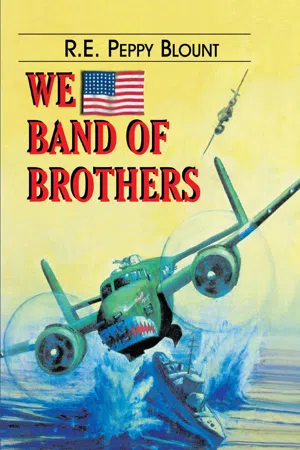
We Band of Brothers
Information
CHAPTER ONE
War Path of the Apaches
You are not going to get peace with millions of armed men. The chariot of peace cannot advance over a road littered with cannon.
Lloyd George
The 345th Bomb Group, Air Apaches, was composed of four squadrons: the 498th Falcons, the 499th Bats Outa Hell, the 500th Rough Raiders, and my squadron, the 501st Black Panthers. In any combat organization there are bound to be differences between the “old men” and the “new men” and the 501st was no exception. As we lost flying crews at an exceptionally high rate, two weeks seniority in the outfit was enough time to afford “old-timer” status and allow one to enjoy the privilege of offering advice to the newcomers. Being in the outfit for a couple of months gave one the chance to speak of the “good ole days.” With our increasing losses, as we started hitting Japanese shipping in the open China sea, our crews were split up so that each aircraft would have some experienced combat personnel.
The first stop of the Air Apaches in their march through the Pacific, was at Port Moresby. A large cloth banner, stretched above the road, proclaimed: “Through these portals pass the best damn mosquito bait in the world.” Following a double strike on Rabaul, the 345th received the following commendation from the Commander-in-Chief of the Southwest Pacific while at Moresby:
“Please accept my heartiest congratulations for all forces involved in the superb double strike at Rabaul. It gives me a sense of great security to have such an indomitable unit in my command. Never give a sucker a break. Keep it up!”
General Douglas MacArthur
The next stop for the Air Apaches was Dobadura, then Nadzab in the Markham Valley, then Biak, New Guinea, Dulag, and then Tacloban, Leyte, and the Philippines — arriving on D-day plus nine. While the pilots and air crew members fought the war daily, the “paddle feet” of the 345th didn’t really experience the shooting war until we reached Tacloban, Leyte, and the Philippines.
The ground personnel of our four squadrons was transported in two Liberty ships (the S.S. Thomas Nelson and the S.S. Morrison Waite) to Leyte from New Guinea. The ground echelon and group headquarters personnel were crowded into the hold, jammed into and under deck-loaded vehicles, scattered under makeshift rigs of tarpaulins and some had even set up temporary housekeeping in the life rafts. Only a few of the fortunate and high-ranking squadron officers found quarters with the officers of the two ships.
The trip to Leyte was pleasant enough, with the anxiety caused by reports of the great naval engagements taking place in the Leyte Gulf and off the coast of Luzon, being alleviated with the good news that our Navy had wiped up the Japanese and sent them running back to Hirohito.
Never before had the Air Apaches followed so closely on the heels of the Navy and Infantry. We were intrigued by the thought of a civilized country and pleased to be so close to what might be called American soil. Overshadowing these thoughts, and more realistic, was the fact we were now putting our heads into the jaws of the Japanese lion. The lion had bases to the south of us on Mindanao, on numerous islands to the west of us, and powerful Luzon forces to the north. If the Japanese had fought so suicidally for the small bases of Pelelieu and Biak, how big an effort and battle would be mounted for the thousand islands comprising the Philippines? This would be war as we had never seen it. We would have few takers on our offer to let others crawl into our B-25s and take our places on the firing line from now on.
There were more than two hundred Red Alerts, warnings of enemy aircraft approaching the Leyte harbor, in the two weeks the S.S. Nelson and Waite sat waiting to be unloaded. At the first few alerts the men headed for the holds according to instructions, but as alert after alert passed with no evidence that the Jap planes were interested in attacking shipping in the harbor, our people became bolder. Only a few would retire below decks with their helmets and life preservers when the whistle sounded, and the rest would either roll over in their sacks and go back to sleep, or line the port rail to watch the ack-ack, tracers, and fireworks display over the airdromes ashore. All the alerts went by in this manner, and then — it happened.
On Sunday, November 12, 1944, with the harbor at Leyte filled to overflowing with the ships of our invasion forces, the hierarchy of the Japanese Imperial Air Force decided this an ideal moment to introduce their Japanese Special Attack Corps, otherwise known as suicide pilots or Kamikaze. For the first time in World War II, they launched a flight of forty to fifty Kamikaze aircraft, probably from Clark Field to the north in Luzon. Major “Bing Bang” Bong, legendary Marine pilot, and his mates, intercepted this air armada with their P-38s and dispatched thirty-six of these suicidal maniacs to their happy hunting grounds before they reached the harbor at Leyte. However, the four suicide pilots who succeeded in infiltrating our air defenses wreaked havoc and left the ignominious memory of the first Kamikaze attack in World War II stamped indelibly in the minds and memories of the 345th Bomb Group personnel forever.
The four Zekes, seemingly coming from nowhere, dove from the sky. The first Jap suicide pilot flew his Zeke into the S.S. Leonidas Merritt some eight hundred yards in front as two red streaks of tracers flashed parallel to the starboard rail of the S.S. Nelson. Two of the Jap suicide planes had come in low and unnoticed, and were making a strafing run on the S.S. Nelson. There had been no warning, and our men were caught unprepared. One of the planes peeled off and crashed into the stern of a nearby LST. The second plane continued parallel to the ship and suddenly banked sharply, striking the S.S. Nelson at the number five hatch where the majority of the enlisted men were quartered in makeshift tents. The ship shuddered from her deck plates to the keel, the violent explosion of the bomb welded to the underside of the plane knocking flat those men who were left standing. No sooner had the second plane hit, when a third screamed in at the stern, spraying the afterdeck with machine-gun and 20-mm fire. The afterdeck became a raging inferno and most of the men rushed back to assist the ship’s crew in keeping the flames away from the gasoline and bombs stowed below.
Having been critically hit by two Kamikaze aircraft, fore and aft, during those first hectic moments, no one could be certain as to whether or not the Nelson would go up in one gigantic explosion. Those men who were not engaged in fighting the fire, carried the dead and wounded men to the forward part of the ship. Because the squadron medical supplies were completely destroyed by the fire and the ship’s emergency equipment was rendered totally inadequate, the remaining uninjured men improvised bandages from any and everything at hand. They worked valiantly throughout the remaining air attacks until outside aid came an hour or so later.
At 1818 (6:18 P.M.) of the same day, the red alert sounded, announcing the approach of bandits, and two enemy planes were sighted coming in from the port side of the S.S. Morrison Waite. As the two planes came up even with the stern, one of them peeled off to make a pass at the Waite. The ship’s guns, along with guns of every other ship in the harbor, opened fire and scored several hits, but they could neither blow the Kamikaze from the sky nor cause him to alter his course. As the Nip came abreast of the ship he made a deliberate suicidal dive into the side of the Waite. The force of the impact was so great that the Jap aircraft was carried through the hull into the bowels of the ship.
When the alert had sounded, all personnel were ordered into the hold. The men didn’t care for the idea as there were only two wooden staircases for exits. They were aware of what might happen if the ship was hit. Their presence on deck, however, would have offered an attractive target but they would have preferred to have taken their chances, and at least been able to have jumped overboard. (Hindsight is always 20-20.) Nevertheless, they were ordered into the hold and there they remained.
There were one hundred-twenty men below decks at the time of the attack. The enemy plane, plunging into the hold, immediately burst into flames as its bomb exploded. The concussion blew the hatch covers from the main deck causing them and shattered parts of the aircraft to fall into the lower hold. The trucks and vehicles that were stored on the top deck were bounced around but amazingly enough, didn’t fall into the hold.
The Kamikaze attacks on the S.S. Nelson and Waite in the harbor of Tacloban, Leyte, caused the greatest loss of personnel from any single event in the overseas history of the Air Apaches. With tragic accuracy these suicidal maniacs killed a total of ninety-two men and wounded one hundred fifty-six. Of those wounded, fifteen died either en route to, or in, hospitals. During a catastrophe of this magnitude, some men are giants. We had many who could qualify, and though wounded themselves, administered first aid or helped clear wreckage or lower stretchers into the holds or over the sides of the ships without considering themselves heroes. In their words, “We were only taking care of our buddies who would do the same for us!”
This being our furthest thrust from Port Moresby and Guadalcanal toward the Japanese mainland, ninety-five percent of all the American aircraft in the Pacific, heavy, medium, and light bombers, as well as fighters, were based, and operated for several months, off the “metal strips” laid down on the beach to form our runway at Tacloban. Had the Japanese only known, twenty to thirty Jap Betty bombers could have delivered a load of para-fragmentation bombs to efficiently destroy a major portion of the U.S. aircraft in the Pacific. As it was, they kept us pretty busy.
One night in early November, 1944, a Jap Tess-type transport, which closely resembled our C-47, entered the downwind leg and landed at Tacloban airstrip. An infantry guard opened the door of the plane and was shot between the eyes. Jap soldiers poured out of the ship and rushed toward one of the infantry camps, intent upon wiping it out. There was much excitement until these sons of Nippon were eradicated, but the damage to nerves was done. Later in the week a load of Jap paratroopers landed and surrounded Fifth Bomber Command Headquarters. Machine guns immediately appeared in every window to defend Fifth Bomber Headquarters. Some of us would’ve enjoyed seeing all that brass, (who usually flew desks and sent us out to hit targets of their choice) defend themselves as we did daily, on the firing line. The infantry dispatched the Jap paratroopers in quick order, however, and we never got to see the Fifth Bomber Headquarter personnel fire a barrel. Someone observed later, that it was “just as well, —they might’ve shot themselves!”
A week or so later, before the engineers had the “metal” landing strip at Tacloban completed, one of our carriers in the Leyte Gulf was sunk, leaving all its aircraft airborne with nowhere to land. They circled our strip for an hour or so, like a bunch of chicks looking for a mother hen, and as their gas ran out they crash-landed on the strip or on the beach. As they slid to a stop following a wheels-up landing for ultimate safety, the bulldozers of the Seabees and Army Engineers pushed them off into the sea to make room for the next stranded, shipless airplane to belly land. Over two hundred various and assorted aircraft crash-landed on the strip or beach that day, at least $500 million dollars worth of armed services hardware and American taxes. That was a lot of war bonds! The next day a C-46, which had just taken off, was hit by a low flying L-5 and the twenty-two passengers aboard the transport were killed in the ensuing fire. That night, a string of frags from a Jap bomber completely demolished a row of aircraft. We were strafed and bombed so often by the little yellow brothers (and always right at chow time en route to the mess tent), that we started wearing our dirtiest clothing. When we hit the foxholes — that never held less than two feet of water — we no longer dirtied clean uniforms.
I flew my first combat mission from Tacloban airstrip as the copilot for First Lieutenant Charles Thatcher, one of the “old-timers” of the squadron. I was as new, anxious and eager as he was cool, calm and collected. The front of Thatcher’s uniform proved to be a topic of conversation that broke the ice and put two strangers at ease.
“What’s all that glue-looking paste on the front of your shirt and pants?” I asked.
“That’s not glue,” responded Thatcher, continuing to enter the names of the crew on Form I, “that’s oatmeal!”
“I’ll admit it tastes better on the outside than on the inside,” I answered, “but on the front of your shirt?”
“It wasn’t by choice,” said Thatcher, “I was eating my oatmeal, half asleep and minding my own damn business, when ‘Washing Machine Charley,’ the little yellow sonofabitch, strafed the mess tent, causing me to spill all my oatmeal down my front. I had to crawl in it on my belly under the table!”
“Yeah! I ate with the second group and they said they’d had a little excitement earlier,” I replied, “but they said nobody got hurt!”
“Just scared everybody shitless, including the cooks! I don’t know what it’ll do for the food but it’s got to make it better!” said Thatcher.
“How’s that?”
“It can’t get any worse!”
With the entire Fifth Air Force, and practically all the U.S. Air Corps in the South Pacific based on the beach at Leyte, it was a real problem getting clearance to land and take off. The eight airplanes in my first combat mission were stacked up, wings interlocking, taking up as little space as possible but still keeping the wheels on the metal decking atop the sandy beach. All of us making this strike were waiting for takeoff clearance. After a fifteen-minute wait, the tower instructed us to cut our engines. The cause for the delay was suddenly and graphically seen in the form of a huge cloud of black smoke at the far end of the runway.
The pilot of a C-47 transport, loaded with forty Army personnel, in his haste to get airborne, had forgotten to remove the chock to the vertical stabilizer which froze the rudder. Designed to prevent wind damage on the ground, the chock was routinely inserted to protect the rudder while the airplane was parked and neither the pilot nor ground crew, in their haste to get airborne, had remembered to remove it before takeoff. The pilot had violated a cardinal rule of flying: never get in your airplane for takeoff without walking around and minutely inspecting it for airworthiness from stern to stern! The C-47 had taken off, climbed to about one hundred-fifty feet and spun-in, killing all aboard and tying up all air traffic for over an hour until the wreckage could be removed from the end of the strip.
I had learned the lesson: check your aircraft before takeoff, from an extraordinary primary flying instructor at Oxnard, California. Even after graduating to combat flying, with eight or ten men of an engineering crew constantly servicing and checking the airplane, as well as ...
Table of contents
- Cover
- Title Page
- Copyright Page
- Contents
- Dedication
- Epigraph
- List of Illustrations
- Foreword
- Preface
- Introduction
- 1. Warpath Of The Apaches
- 2. And There Was Class
- 3. The Prayer Meeting
- 4. A Full Baptism
- 5. Never To Sydney For Love
- 6. Odd Man Out
- 7. We Were Expendable
- 8. The Will That Says Hold On
- 9. Too Close To The Grim Reaper
- 10. A Leap In The Dark
- 11. Preparation For Suicide
- 12. Coup De Grâce At Saigon
- Epilogue
Trusted by 375,005 students
Access to over 1.5 million titles for a fair monthly price.
Study more efficiently using our study tools.
Frequently asked questions
Yes, you can cancel anytime from the Subscription tab in your account settings on the Perlego website. Your subscription will stay active until the end of your current billing period. Learn how to cancel your subscription
No, books cannot be downloaded as external files, such as PDFs, for use outside of Perlego. However, you can download books within the Perlego app for offline reading on mobile or tablet. Learn how to download books offline
Perlego offers two plans: Essential and Complete
- Essential is ideal for learners and professionals who enjoy exploring a wide range of subjects. Access the Essential Library with 800,000+ trusted titles and best-sellers across business, personal growth, and the humanities. Includes unlimited reading time and Standard Read Aloud voice.
- Complete: Perfect for advanced learners and researchers needing full, unrestricted access. Unlock 1.5M+ books across hundreds of subjects, including academic and specialized titles. The Complete Plan also includes advanced features like Premium Read Aloud and Research Assistant.
We are an online textbook subscription service, where you can get access to an entire online library for less than the price of a single book per month. With over 1.5 million books across 990+ topics, we’ve got you covered! Learn about our mission
Look out for the read-aloud symbol on your next book to see if you can listen to it. The read-aloud tool reads text aloud for you, highlighting the text as it is being read. You can pause it, speed it up and slow it down. Learn more about Read Aloud
Yes! You can use the Perlego app on both iOS and Android devices to read anytime, anywhere — even offline. Perfect for commutes or when you’re on the go.
Please note we cannot support devices running on iOS 13 and Android 7 or earlier. Learn more about using the app
Please note we cannot support devices running on iOS 13 and Android 7 or earlier. Learn more about using the app
Yes, you can access We Band of Brothers by R E Peppy Blount in PDF and/or ePUB format, as well as other popular books in History & Military & Maritime History. We have over 1.5 million books available in our catalogue for you to explore.