- English
- ePUB (mobile friendly)
- Available on iOS & Android
eBook - ePub
Information
Topic
Theology & ReligionSubtopic
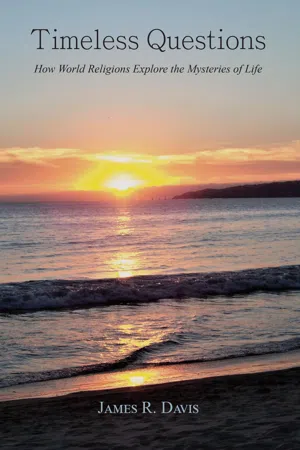
Comparative ReligionTimeless Questions
How World Religions Explore the Mysteries of Life
James R. Davis
The publisher cannot verify the accuracy or website URLs used in this book beyond the date of publication.
This Book is Dedicated to Julianne Davis Robinson, PsyD.
Acknowledgments
When I started to write this book, I shared some chapters in the early stages with my grown daughter Julie, and she became very interested in the project and began to offer unsolicited edits and comments on the subject. I was delighted but surprised at her interest, and as it turned out she became the perfect first reader and editor for this book. She is a fine example of a well-educated person (undergraduate Phi Beta Kappa, summa cum laude, earning a Graduate Doctorate of Psychology Degree), who through no fault of her own knows little about the field of religion but is eager to learn. She was able to identify places in my writing where I was being unclear, making assumptions about what readers know, employing language that might be too technical or inappropriate, running on with too much detail, or using humor that wasn’t funny. She not only made criticisms but supplied new language much of which appears in this final copy. In other words, she made this book user friendly, and we all have her to thank for that. Therefore, this book is dedicated to Julianne Davis Robinson, PsyD, and her family: the legacy of grandchildren and great grandchildren that she and her husband Scott have provided for me.
I also want to acknowledge the continuing help of my wife Adelaide B. Davis, who proofed the entire manuscript and added all of those pesky diacritical accent marks for words from languages other than English. She managed the computer complexities that often baffle me and also provided the cover and author photos.
Thanks also to Carl Condit and James Clois Smith, Jr. at Sunstone Press. I’ve published many books, and I know how rare it is to be able to pick up the phone and work through details informally with such competent, easy-going, and friendly publishers as they are.
Preface
This is an unusual book. It contains the interesting research of many scholars presented in an informal question-and-answer style. The idea has been in my heart and on my mind for a long time. The pandemic gave me the isolated days needed to write it. To understand this book better, you may wish to take a moment to learn something about me as the author. So, let’s get acquainted.
After earning an undergraduate degree in history from Oberlin College, I studied for three years at Yale University Divinity School, preparing to be a Christian minister, and I actually served as parish minister of a Congregational Church (United Church of Christ) in Springfield, Ohio. I left after two years to teach at the nearby historically-black (HBCU) Wilberforce University, serving there for six years as an assistant professor of religion and academic dean as well as a minority white person in the black community during the Civil Rights Movement. My career had taken a turn away from preaching to teaching and administration, and I went on to earn my Ph.D. in Higher Education Administration at Michigan State University with related studies in religion. At Wilberforce I commuted fifty miles at night once a week to Miami University in Oxford, Ohio, to take four graduate seminars in world religions, one each in Hinduism, Buddhism, Chinese Religions, and Islam; and those studies changed my outlook on religion and life completely. The remainder of my career was spent as a professor, administrator, and eventual dean of the adult education college at the University of Denver. My fascination with the study of religion as a window into the meaning of human existence never ceased. I am not affiliated with a church or religious organization; I just continue to read and ponder life.
When I think of how much I have been able to learn about religion, the sheer fun of it, and the importance it has had for examining my own life, and then notice how little acquaintance the typical adult has with the world’s religions, I am inspired to try to provide a resource to stimulate more contemplation and eventual discussion of life’s mysteries.
I am an experienced writer, having written eight academic books on college teaching, training, and university leadership, as well as two novels published by Sunstone Press.
Note, however, that I am not an academic specialist in religious studies, and the true scholars in the field may scowl at the sprawling scope of this book and its oversimplification of complexities. But the goal is not to provide either a comprehensive or specialized book on world religions, but to present a more general book that enables the reader to discover relevant knowledge for exploring life’s fundamental questions while experiencing a sense of joy in learning something new.
Religion is a personal matter—I understand that—but being better informed is always helpful on the journey from shallow convictions to reasoned preferences. Going through life without having thought deeply or talked seriously about life’s mysteries or timeless questions is like skiing down a steep mountain in the dense fog of a sudden whiteout blizzard. (I’ve done that on Aspen Mountain in Colorado.) You know that the goal is to “get down safely,” but you don’t know what trail you are on, what turn to take, or exactly where you will end up. You can only see a few feet ahead, so you slip and slide along slowly, taking it a few feet at a time, hoping not to fall off the edge of a cliff. Life should be more than going downhill blindly in a blizzard. Although life will always involve navigating the unexpected, the person who wishes to live more deliberately, with greater insight, clarity, and understanding, will surely profit from pondering carefully the mysteries of life and timeless questions.
Before: The Guide for the Perplexed
Some readers don’t like introductions and skip over them. So to replace “Introduction,” I have stolen a title for this chapter from a famous Jewish philosopher, Maimonides: The Guide for the Perplexed. He was trying to help Jewish followers understand Aristotle. (See Chapter 9.) The more modest goal here is simply to help you understand this book. I can guarantee that if you skip over this brief chapter, you will not only be perplexed, but confused, puzzled, baffled, bewitched, bothered, and bewildered—and maybe even flummoxed.
If you read this very brief guide, you will know what is meant by “mysteries of life” and “timeless questions.” You will understand which of the world religions are explored and why. You will meet the questioner and the narrator-professor. And you will know what can be learned from reading this book. Without this guide, you may need to read several chapters to discover that no one is trying to convince you to “believe” anything, although knowing what to believe surely keeps us perplexed. You will probably figure things out by the fifth or sixth chapter, but why be perplexed at all when you can begin here?
Timeless Questions and the Mysteries of Life
What is meant by timeless questions and mysteries of life? Certain mysteries surround our huma...
Table of contents
- Preface
Trusted by 375,005 students
Access to over 1.5 million titles for a fair monthly price.
Study more efficiently using our study tools.
Frequently asked questions
Yes, you can cancel anytime from the Subscription tab in your account settings on the Perlego website. Your subscription will stay active until the end of your current billing period. Learn how to cancel your subscription
No, books cannot be downloaded as external files, such as PDFs, for use outside of Perlego. However, you can download books within the Perlego app for offline reading on mobile or tablet. Learn how to download books offline
Perlego offers two plans: Essential and Complete
- Essential is ideal for learners and professionals who enjoy exploring a wide range of subjects. Access the Essential Library with 800,000+ trusted titles and best-sellers across business, personal growth, and the humanities. Includes unlimited reading time and Standard Read Aloud voice.
- Complete: Perfect for advanced learners and researchers needing full, unrestricted access. Unlock 1.5M+ books across hundreds of subjects, including academic and specialized titles. The Complete Plan also includes advanced features like Premium Read Aloud and Research Assistant.
We are an online textbook subscription service, where you can get access to an entire online library for less than the price of a single book per month. With over 1.5 million books across 990+ topics, we’ve got you covered! Learn about our mission
Look out for the read-aloud symbol on your next book to see if you can listen to it. The read-aloud tool reads text aloud for you, highlighting the text as it is being read. You can pause it, speed it up and slow it down. Learn more about Read Aloud
Yes! You can use the Perlego app on both iOS and Android devices to read anytime, anywhere — even offline. Perfect for commutes or when you’re on the go.
Please note we cannot support devices running on iOS 13 and Android 7 or earlier. Learn more about using the app
Please note we cannot support devices running on iOS 13 and Android 7 or earlier. Learn more about using the app
Yes, you can access Timeless Questions by James R. Davis in PDF and/or ePUB format, as well as other popular books in Theology & Religion & Comparative Religion. We have over 1.5 million books available in our catalogue for you to explore.