eBook - PDF
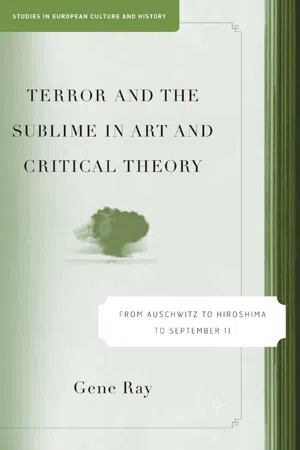
Terror and the Sublime in Art and Critical Theory
From Auschwitz to Hiroshima to September 11
- 194 pages
- English
- PDF
- Available on iOS & Android
eBook - PDF
About this book
The eleven interconnected essays of this book penetrate the dense historical knots binding terror, power and the aesthetic sublime and bring the results to bear on the trauma of September 11 and the subsequent War on Terror. Through rigorous critical studies of major works of post-1945 and contemporary culture, the book traces transformations in art and critical theory in the aftermath of Auschwitz and Hiroshima. Critically engaging with the work of continental philosophers, Theodor W. Adorno, Jacques Derrida, and Jean-Francois Lyotard and of contemporary artists Joseph Beuys, Damien Hirst, and Boaz Arad, the book confronts the shared cultural conditions that made Auschwitz and Hiroshima possible and offers searching meditations on the structure and meaning of the traumatic historical 'event'. Ray argues that globalization cannot be separated from the collective tasks of working through historical genocide. He provocatively concludes that the current US-led War on Terror must be grasped as a globalized inability to mourn.
Information
Topic
ArtSubtopic
Art GeneralTable of contents
- Cover
- Contents
- Preface
- Acknowledgments
- Abbreviations
- Introduction: The Hit
- Chapter One: Reading the Lisbon Earthquake: Adorno, Lyotard, and the Contemporary Sublime
- Chapter Two: Joseph Beuys and the “After-Auschwitz” Sublime
- Chapter Three: Ground Zero: Hiroshima Haunts “9/11”
- Chapter Four: Mirroring Evil: Auschwitz, Art and the “War on Terror”
- Chapter Five: Little Glass House of Horrors: Taking Damien Hirst Seriously
- Chapter Six: Blasted Moments: Remarking a Hiroshima Image
- Chapter Seven: Installing a “New Cosmopolitics”: Derrida and the Writers
- Chapter Eight: Working Out and Playing Through: Boaz Arad’s Hitler Videos
- Chapter Nine: Listening with the Third Ear: Echoes from Ground Zero
- Chapter Ten: Conditioning Adorno: “After Auschwitz” Now
- Notes
- Index
Trusted by 375,005 students
Access to over 1.5 million titles for a fair monthly price.
Study more efficiently using our study tools.
Frequently asked questions
Yes, you can cancel anytime from the Subscription tab in your account settings on the Perlego website. Your subscription will stay active until the end of your current billing period. Learn how to cancel your subscription
No, books cannot be downloaded as external files, such as PDFs, for use outside of Perlego. However, you can download books within the Perlego app for offline reading on mobile or tablet. Learn how to download books offline
Perlego offers two plans: Essential and Complete
- Essential is ideal for learners and professionals who enjoy exploring a wide range of subjects. Access the Essential Library with 800,000+ trusted titles and best-sellers across business, personal growth, and the humanities. Includes unlimited reading time and Standard Read Aloud voice.
- Complete: Perfect for advanced learners and researchers needing full, unrestricted access. Unlock 1.5M+ books across hundreds of subjects, including academic and specialized titles. The Complete Plan also includes advanced features like Premium Read Aloud and Research Assistant.
We are an online textbook subscription service, where you can get access to an entire online library for less than the price of a single book per month. With over 1.5 million books across 990+ topics, we’ve got you covered! Learn about our mission
Look out for the read-aloud symbol on your next book to see if you can listen to it. The read-aloud tool reads text aloud for you, highlighting the text as it is being read. You can pause it, speed it up and slow it down. Learn more about Read Aloud
Yes! You can use the Perlego app on both iOS and Android devices to read anytime, anywhere — even offline. Perfect for commutes or when you’re on the go.
Please note we cannot support devices running on iOS 13 and Android 7 or earlier. Learn more about using the app
Please note we cannot support devices running on iOS 13 and Android 7 or earlier. Learn more about using the app
Yes, you can access Terror and the Sublime in Art and Critical Theory by G. Ray in PDF and/or ePUB format, as well as other popular books in Art & Art General. We have over 1.5 million books available in our catalogue for you to explore.