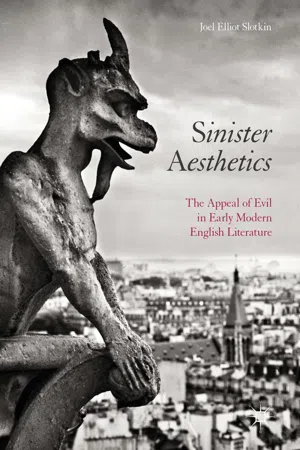
This engrossing volume studies the poetics of evil in early modern English culture, reconciling the Renaissance belief that literature should uphold morality with the compelling and attractive representations of evil throughout the period's literature. The chapters explore a variety of texts, including Spenser's Faerie Queene, Shakespeare's Richard III, broadside ballads, and sermons, culminating in a new reading of Paradise Lost and a novel understanding of the dynamic interaction between aesthetics and theology in shaping seventeenth century Protestant piety. Through these discussions, the book introduces the concept of "sinister aesthetics": artistic conventions that can make representations of the villainous, monstrous, or hellish pleasurable.
eBook - PDF
Sinister Aesthetics
The Appeal of Evil in Early Modern English Literature
- 295 pages
- English
- PDF
- Available on iOS & Android
eBook - PDF
About this book
Information
Table of contents
- Sinister Aesthetics
- 1 Introduction: Representing Evil in Early Modern England
- 2 “Dreadful Harmony”: The Poetics of Evil in Sidney, Tasso, and Spenser
- 3 Honeyed Toads: Sinister Aesthetics in Richard III
- 4 Monsters and the Pleasures of Divine Justice in English Popular Print, 1560–1675
- 5 Satanic Sensibilities in Paradise Lost
- 6 Milton’s Sinister God: Poetic Justice and Chiaroscuro in Paradise Lost
- 7 Epilogue: The Sinister After Milton
- Bibliography
- Index
Trusted by 375,005 students
Access to over 1.5 million titles for a fair monthly price.
Study more efficiently using our study tools.
Frequently asked questions
Yes, you can cancel anytime from the Subscription tab in your account settings on the Perlego website. Your subscription will stay active until the end of your current billing period. Learn how to cancel your subscription
No, books cannot be downloaded as external files, such as PDFs, for use outside of Perlego. However, you can download books within the Perlego app for offline reading on mobile or tablet. Learn how to download books offline
Perlego offers two plans: Essential and Complete
- Essential is ideal for learners and professionals who enjoy exploring a wide range of subjects. Access the Essential Library with 800,000+ trusted titles and best-sellers across business, personal growth, and the humanities. Includes unlimited reading time and Standard Read Aloud voice.
- Complete: Perfect for advanced learners and researchers needing full, unrestricted access. Unlock 1.5M+ books across hundreds of subjects, including academic and specialized titles. The Complete Plan also includes advanced features like Premium Read Aloud and Research Assistant.
We are an online textbook subscription service, where you can get access to an entire online library for less than the price of a single book per month. With over 1.5 million books across 990+ topics, we’ve got you covered! Learn about our mission
Look out for the read-aloud symbol on your next book to see if you can listen to it. The read-aloud tool reads text aloud for you, highlighting the text as it is being read. You can pause it, speed it up and slow it down. Learn more about Read Aloud
Yes! You can use the Perlego app on both iOS and Android devices to read anytime, anywhere — even offline. Perfect for commutes or when you’re on the go.
Please note we cannot support devices running on iOS 13 and Android 7 or earlier. Learn more about using the app
Please note we cannot support devices running on iOS 13 and Android 7 or earlier. Learn more about using the app
Yes, you can access Sinister Aesthetics by Joel Elliot Slotkin in PDF and/or ePUB format, as well as other popular books in Literature & English Literary Criticism. We have over 1.5 million books available in our catalogue for you to explore.