eBook - PDF
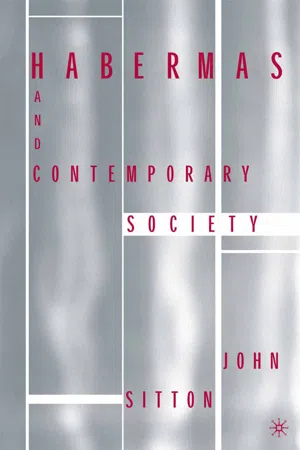
Habermas and Contemporary Society
About this book
Over the last four decades Jürgen Habermas has forged an innovative and much-discussed theory of contemporary capitalist society. Building on Max Weber's thesis that the dynamic of capitalism actually erodes individual freedom and the meaningfulness of social life - famously resulting in a culture of 'specialists without spirit, sensualists without heart' - Habermas traces contemporary social conflict to resistance to this dynamic by a variety of social groups. His theory of 'communicative action' attempts to show the possibilities in contemporary society for moving toward a more balanced social life that, unlike other political currents today, would not sacrifice the truly progressive features of complex modern societies. By marginalizing methodological and other more specialized theoretical concerns, this book focuses on Habermas's substantive portrayal of contemporary society and its discontents.
Information
Topic
PhilosophySubtopic
Philosophy History & TheoryTable of contents
- Cover
- Contents
- Acknowledgments
- Preface
- 1 Weber and Modernity
- 2 Weber and Western Marxism
- 3 Rationality and Communicative Action
- 4 Society as Lifeworld and System
- 5 Social Conflict and Progressive Politics
- 6 Contested Terrain: Language, Art, and Gender
- 7 The Limitations of Habermas’s Social and Political Argument
- 8 Habermas and the Politics of the Twenty-First Century
- Notes
- Works Cited
- Index
Trusted by 375,005 students
Access to over 1.5 million titles for a fair monthly price.
Study more efficiently using our study tools.
Frequently asked questions
Yes, you can cancel anytime from the Subscription tab in your account settings on the Perlego website. Your subscription will stay active until the end of your current billing period. Learn how to cancel your subscription
No, books cannot be downloaded as external files, such as PDFs, for use outside of Perlego. However, you can download books within the Perlego app for offline reading on mobile or tablet. Learn how to download books offline
Perlego offers two plans: Essential and Complete
- Essential is ideal for learners and professionals who enjoy exploring a wide range of subjects. Access the Essential Library with 800,000+ trusted titles and best-sellers across business, personal growth, and the humanities. Includes unlimited reading time and Standard Read Aloud voice.
- Complete: Perfect for advanced learners and researchers needing full, unrestricted access. Unlock 1.5M+ books across hundreds of subjects, including academic and specialized titles. The Complete Plan also includes advanced features like Premium Read Aloud and Research Assistant.
We are an online textbook subscription service, where you can get access to an entire online library for less than the price of a single book per month. With over 1.5 million books across 990+ topics, we’ve got you covered! Learn about our mission
Look out for the read-aloud symbol on your next book to see if you can listen to it. The read-aloud tool reads text aloud for you, highlighting the text as it is being read. You can pause it, speed it up and slow it down. Learn more about Read Aloud
Yes! You can use the Perlego app on both iOS and Android devices to read anytime, anywhere — even offline. Perfect for commutes or when you’re on the go.
Please note we cannot support devices running on iOS 13 and Android 7 or earlier. Learn more about using the app
Please note we cannot support devices running on iOS 13 and Android 7 or earlier. Learn more about using the app
Yes, you can access Habermas and Contemporary Society by J. Sitton in PDF and/or ePUB format, as well as other popular books in Philosophy & Philosophy History & Theory. We have over 1.5 million books available in our catalogue for you to explore.