This volume ethnographically explores the relation between secularities and religious subjectivities. As a consequence of the demise of secularization theory, we live in an interesting intellectual moment where the so-called 'post-secular' coexists with the secular, which in turn has become pluralized and historicized. This cohabitation of the secular and post-secular is revealed mainly through political dialectical processes that overshadow the subjective and inter-subjective dimensions of secularity, making it difficult to pinpoint concrete sites, agents, and objects of expression.
Drawing on cases from South America, Africa, and Europe, contributors apply key insights from religious studies debates on the genealogies and formations of both religion and secularism. They explore the spaces, persons, and places in which these categories emerge and mutually constitute one another.
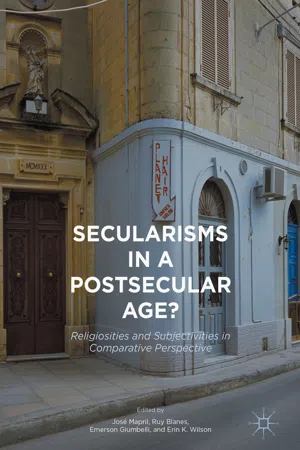
eBook - PDF
Secularisms in a Postsecular Age?
Religiosities and Subjectivities in Comparative Perspective
- 303 pages
- English
- PDF
- Available on iOS & Android
eBook - PDF
Secularisms in a Postsecular Age?
Religiosities and Subjectivities in Comparative Perspective
About this book
Information
Table of contents
- Contents
- Notes on Contributors
- Chapter 1: Introduction: Secularities, Religiosities, and Subjectivities
- Chapter 2: Secular Selves and Bodies: The Case of State Agents in Charge of Implementing the Fight against Marriages of Convenience in Brussels
- Chapter 3: A Secular Religion within an Atheist State: The Case of Afro-Cuban Religiosity and the Cuban State
- Chapter 4: Islam and the Tablighi Jama’at in Spain: Ghosts of the Past, Limits of Representation, and New Developments
- Chapter 5: Embodying Religiosities and Subjectivities: The Responses of Young Spanish Muslims to Violence and Terrorism in the Name of Islam
- Chapter 6: Public Renderings of Islam and the Jihadi Threat: Political, Social, and Religious Critique in Civil Society in Fla ders, Belgium
- Chapter 7: What Is Spirituality for? New Relations between Religion, Health and Public Spaces
- Chapter 8: Managing Mosques in the Netherlands: Constitutional versus Culturalist Secularism
- Chapter 9: Governing the Poor: Secular and Religious Practices in Debate
- Chapter 10: The “Culture of Justification” in the Production of Public Religiosities in Brazil
- Chapter 11: Transformations in Argentinean Catholicism, from the Second Half of the Twentieth Century to Pope Francis
- Chapter 12: Caregiving as Spiritual Expertise: Spirituality and Lived Religion among Portuguese Hospital Chaplains
- Chapter 13: Religion Out of Place: Social Regulation of Evangelical Expansion in Buenos Aires
- Index
Trusted by 375,005 students
Access to over 1.5 million titles for a fair monthly price.
Study more efficiently using our study tools.
Frequently asked questions
Yes, you can cancel anytime from the Subscription tab in your account settings on the Perlego website. Your subscription will stay active until the end of your current billing period. Learn how to cancel your subscription
No, books cannot be downloaded as external files, such as PDFs, for use outside of Perlego. However, you can download books within the Perlego app for offline reading on mobile or tablet. Learn how to download books offline
Perlego offers two plans: Essential and Complete
- Essential is ideal for learners and professionals who enjoy exploring a wide range of subjects. Access the Essential Library with 800,000+ trusted titles and best-sellers across business, personal growth, and the humanities. Includes unlimited reading time and Standard Read Aloud voice.
- Complete: Perfect for advanced learners and researchers needing full, unrestricted access. Unlock 1.5M+ books across hundreds of subjects, including academic and specialized titles. The Complete Plan also includes advanced features like Premium Read Aloud and Research Assistant.
We are an online textbook subscription service, where you can get access to an entire online library for less than the price of a single book per month. With over 1.5 million books across 990+ topics, we’ve got you covered! Learn about our mission
Look out for the read-aloud symbol on your next book to see if you can listen to it. The read-aloud tool reads text aloud for you, highlighting the text as it is being read. You can pause it, speed it up and slow it down. Learn more about Read Aloud
Yes! You can use the Perlego app on both iOS and Android devices to read anytime, anywhere — even offline. Perfect for commutes or when you’re on the go.
Please note we cannot support devices running on iOS 13 and Android 7 or earlier. Learn more about using the app
Please note we cannot support devices running on iOS 13 and Android 7 or earlier. Learn more about using the app
Yes, you can access Secularisms in a Postsecular Age? by José Mapril, Ruy Blanes, Emerson Giumbelli, Erin K. Wilson, José Mapril,Ruy Blanes,Emerson Giumbelli,Erin K. Wilson in PDF and/or ePUB format, as well as other popular books in Social Sciences & Sociology. We have over 1.5 million books available in our catalogue for you to explore.