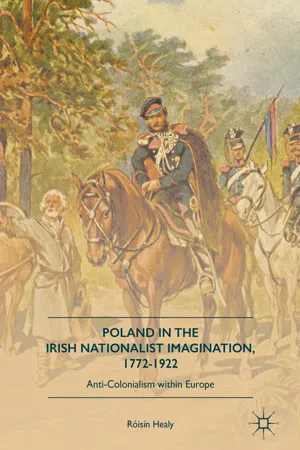
Poland in the Irish Nationalist Imagination, 1772–1922
eBook - PDF

Poland in the Irish Nationalist Imagination, 1772–1922

Anti-Colonialism within Europe

  1. English
  2. PDF
  3. Available on iOS & Android
eBook - PDF

Poland in the Irish Nationalist Imagination, 1772–1922

Anti-Colonialism within Europe

About this book

This book explores the assertions made by Irish nationalists of a parallel between Ireland under British rule and Poland under Russian, Prussian and Austrian rule in the long nineteenth century. Poland loomed large in the Irish nationalist imagination, despite the low level of direct contact between Ireland and Poland up to the twenty-first century. Irish men and women took a keen interest in Poland and many believed that its experience mirrored that of Ireland. This view rested primarily on a historical coincidence—the loss of sovereignty suffered by Poland in the final partition of 1795 and by Ireland in the Act of Union of 1801, following unsuccessful rebellions. It also drew on a common commitment to Catholicism and a shared experience of religious persecution. This study shows how this parallel proved politically significant, allowing Irish nationalists to challenge the legitimacy of British rule in Ireland by arguing that British governments were hypocritical to condemn in Poland what they themselves practised in Ireland.

Frequently asked questions

Yes, you can cancel anytime from the Subscription tab in your account settings on the Perlego website. Your subscription will stay active until the end of your current billing period. Learn how to cancel your subscription.
No, books cannot be downloaded as external files, such as PDFs, for use outside of Perlego. However, you can download books within the Perlego app for offline reading on mobile or tablet. Learn more here.
Perlego offers two plans: Essential and Complete
  • Essential is ideal for learners and professionals who enjoy exploring a wide range of subjects. Access the Essential Library with 800,000+ trusted titles and best-sellers across business, personal growth, and the humanities. Includes unlimited reading time and Standard Read Aloud voice.
  • Complete: Perfect for advanced learners and researchers needing full, unrestricted access. Unlock 1.4M+ books across hundreds of subjects, including academic and specialized titles. The Complete Plan also includes advanced features like Premium Read Aloud and Research Assistant.
Both plans are available with monthly, semester, or annual billing cycles.
We are an online textbook subscription service, where you can get access to an entire online library for less than the price of a single book per month. With over 1 million books across 1000+ topics, we’ve got you covered! Learn more here.
Look out for the read-aloud symbol on your next book to see if you can listen to it. The read-aloud tool reads text aloud for you, highlighting the text as it is being read. You can pause it, speed it up and slow it down. Learn more here.
Yes! You can use the Perlego app on both iOS or Android devices to read anytime, anywhere — even offline. Perfect for commutes or when you’re on the go.
Please note we cannot support devices running on iOS 13 and Android 7 or earlier. Learn more about using the app.
Yes, you can access Poland in the Irish Nationalist Imagination, 1772–1922 by Róisín Healy in PDF and/or ePUB format, as well as other popular books in History & British History. We have over one million books available in our catalogue for you to explore.

Information

Table of contents

  1. Dedication
  2. Acknowledgements
  3. Contents
  4. List of Figures
  5. Chapter 1: Introduction: Poland and Irish Anti-­Colonialism
  6. Chapter 2: The Era of the Partitions, 1772–1798
  7. Chapter 3: From the United Irishmen Rebellion to the November Uprising in Poland, 1798–1832
  8. Chapter 4: The Repeal Movement and Young Ireland, 1832–1860
  9. Chapter 5: From the January Uprising to the First Home Rule Bill, 1860–1886
  10. Chapter 6: The Home Rule Bills and Minorities Policy, 1886–1914
  11. Chapter 7: Paths to Statehood, 1914–1922
  12. Chapter 8: Conclusion
  13. Bibliography
  14. Index