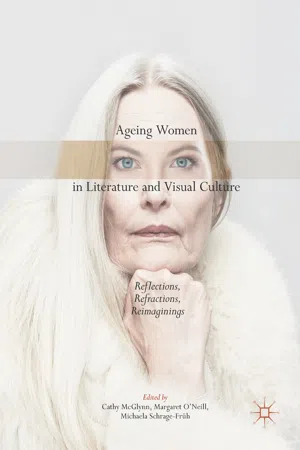
This timely collection engages with representations of women and ageing in literature and visual culture. Acknowledging that cultural conceptions of ageing are constructed and challenged across a variety of media and genres, the editors bring together experts in literature and visual culture to foster a dialogue across disciplines. Exploring the process of ageing in its cultural reflections, refractions and reimaginings, the contributors to Ageing Women in Literature and Visual Culture analyse how artists, writers, directors and performers challenge, and in some cases reaffirm, cultural constructions of ageing women, as well as give voice to ageing women's subjectivities. The book concludes with an afterword by Germaine Greer which suggests possible avenues for future research.
eBook - PDF
Ageing Women in Literature and Visual Culture
Reflections, Refractions, Reimaginings
- 338 pages
- English
- PDF
- Available on iOS & Android
eBook - PDF
Ageing Women in Literature and Visual Culture
Reflections, Refractions, Reimaginings
About this book
Information
Table of contents
- Acknowledgements
- Contents
- Editors and Contributors
- List of Figures
- Chapter 1 Introduction
- Part I Narratives of Ageing
- Chapter 2 Making the Invisible Visible: The Presence of Older Women Artists in Early Modern Artistic Biography
- Chapter 3 Losing One’s Self: The Depiction of Female Dementia Sufferers in Iris (2001) and The Iron Lady (2011)
- Chapter 4 “Embarking, Not Dying”: Clare Boylan’s Beloved Stranger as Reifungsroman
- Chapter 5 The Age Performances of Peggy Shaw: Intersection, Interoception and Interruption
- Part II Social Roles: Mothers, Widows, Spinsters
- Chapter 6 Closing In: Restrictive Spaces for Ageing Mothers in Jane Austen’s Novels
- Chapter 7 “No One Noticed Her”: Ageing Spinsters and Youth Culture in Sylvia Townsend Warner’s Short Stories
- Chapter 8 Stories of Motherhood and Ageing in ABC’s Television Programme Once Upon a Time
- Chapter 9 “She Says She’s Thirty-Five but She’s Really Fifty-One”: Rebranding the Middle-Aged Postfeminist Protagonist in Helen Fielding’s Bridget Jones: Mad about The Boy
- Part III The Body and Embodiment
- Chapter 10 Older Women and Sexuality On-Screen: Euphemism and Evasion?
- Chapter 11 A Certain Truth in Fiction: Perceptions of the Ageing Process in Irish Women’s Fiction
- Chapter 12 Future and Present Imaginaries: The Politics of the Ageing Female Body in Lena Dunham’s Girls (HBO, 2012–Present)
- Chapter 13 The New Model Subject: “Coolness” and the Turn to Older Women Models in Lifestyle and Fashion Advertising
- Chapter 14 Performances of Situated Knowledge in the Ageing Female Body
- Part IV Class, ‘Race’ and Agency
- Chapter 15 “I Become Shameless as a Child”: Childhood, Femininity and Older Age in J.M. Coetzee’s Age of Iron
- Chapter 16 African American Humour and the Construction of a Mature Female Middle-Class Identity in Clarence Major’s Such Was the Season
- Chapter 17 “This Is How Time Unfolds When You Are Old”: Ageing, Subjectivity and Joseph O’Connor’s Ghost Light
- Chapter 18 The Visibility of Women’s Ageing and Agency in Suzanne Lacy’s The Crystal Quilt (1987) and Silver Action (2013)
- Chapter 19 Afterword
- Index
Trusted by 375,005 students
Access to over 1.5 million titles for a fair monthly price.
Study more efficiently using our study tools.
Frequently asked questions
Yes, you can cancel anytime from the Subscription tab in your account settings on the Perlego website. Your subscription will stay active until the end of your current billing period. Learn how to cancel your subscription
No, books cannot be downloaded as external files, such as PDFs, for use outside of Perlego. However, you can download books within the Perlego app for offline reading on mobile or tablet. Learn how to download books offline
Perlego offers two plans: Essential and Complete
- Essential is ideal for learners and professionals who enjoy exploring a wide range of subjects. Access the Essential Library with 800,000+ trusted titles and best-sellers across business, personal growth, and the humanities. Includes unlimited reading time and Standard Read Aloud voice.
- Complete: Perfect for advanced learners and researchers needing full, unrestricted access. Unlock 1.5M+ books across hundreds of subjects, including academic and specialized titles. The Complete Plan also includes advanced features like Premium Read Aloud and Research Assistant.
We are an online textbook subscription service, where you can get access to an entire online library for less than the price of a single book per month. With over 1.5 million books across 990+ topics, we’ve got you covered! Learn about our mission
Look out for the read-aloud symbol on your next book to see if you can listen to it. The read-aloud tool reads text aloud for you, highlighting the text as it is being read. You can pause it, speed it up and slow it down. Learn more about Read Aloud
Yes! You can use the Perlego app on both iOS and Android devices to read anytime, anywhere — even offline. Perfect for commutes or when you’re on the go.
Please note we cannot support devices running on iOS 13 and Android 7 or earlier. Learn more about using the app
Please note we cannot support devices running on iOS 13 and Android 7 or earlier. Learn more about using the app
Yes, you can access Ageing Women in Literature and Visual Culture by Cathy McGlynn, Margaret O'Neill, Michaela Schrage-Früh, Cathy McGlynn,Margaret O'Neill,Michaela Schrage-Früh in PDF and/or ePUB format, as well as other popular books in Social Sciences & Literary Criticism. We have over 1.5 million books available in our catalogue for you to explore.