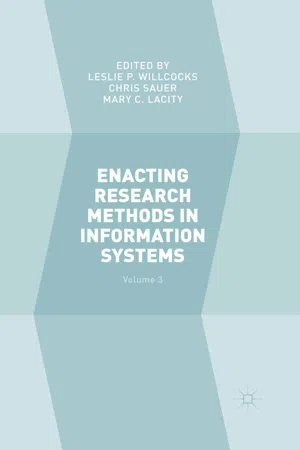
Enacting Research Methods in Information Systems: Volume 3
eBook - PDF

Enacting Research Methods in Information Systems: Volume 3

  1. English
  2. PDF
  3. Available on iOS & Android
eBook - PDF

Enacting Research Methods in Information Systems: Volume 3

About this book

This edited three volume edition brings together significant papers previously published in the Journal of information Technology (JIT) over its 30 year publication history. The three volumes of Enacting Research Methods in Information Systems celebrate the methodological pluralism used to advance our understanding of information technology's role in the world today. In addition to quantitative methods from the positivist tradition, JIT also values methodological articles from critical research perspectives, interpretive traditions, historical perspectives, grounded theory, and action research and design science approaches.

Volume 1 covers Critical Research, Grounded Theory, and Historical Approaches. Volume 2 deals with Interpretive Approaches and also explores Action Research. Volume 3 focuses on Design Science Approaches and discusses Alternative Approaches including Semiotics Research, Complexity Theory and Gender in IS Research.

The Journal of Information Technology (JIT) was started in 1986 by Professors Frank Land and Igor Aleksander with the aim of bringing technology and management together and bridging the 'great divide' between the two disciplines. The Journal was created with the vision of making the impact of complex interactions and developments in technology more accessible to a wider audience. Retaining this initial focus, the JIT has gone on to extend into new and innovative areas of research such as the launch of JITTC in 2010. A high impact journal, JIT shall continue to publish leading trends based on significant research in the field.

Frequently asked questions

Yes, you can cancel anytime from the Subscription tab in your account settings on the Perlego website. Your subscription will stay active until the end of your current billing period. Learn how to cancel your subscription.
No, books cannot be downloaded as external files, such as PDFs, for use outside of Perlego. However, you can download books within the Perlego app for offline reading on mobile or tablet. Learn more here.
Perlego offers two plans: Essential and Complete
  • Essential is ideal for learners and professionals who enjoy exploring a wide range of subjects. Access the Essential Library with 800,000+ trusted titles and best-sellers across business, personal growth, and the humanities. Includes unlimited reading time and Standard Read Aloud voice.
  • Complete: Perfect for advanced learners and researchers needing full, unrestricted access. Unlock 1.4M+ books across hundreds of subjects, including academic and specialized titles. The Complete Plan also includes advanced features like Premium Read Aloud and Research Assistant.
Both plans are available with monthly, semester, or annual billing cycles.
We are an online textbook subscription service, where you can get access to an entire online library for less than the price of a single book per month. With over 1 million books across 1000+ topics, we’ve got you covered! Learn more here.
Look out for the read-aloud symbol on your next book to see if you can listen to it. The read-aloud tool reads text aloud for you, highlighting the text as it is being read. You can pause it, speed it up and slow it down. Learn more here.
Yes! You can use the Perlego app on both iOS or Android devices to read anytime, anywhere — even offline. Perfect for commutes or when you’re on the go.
Please note we cannot support devices running on iOS 13 and Android 7 or earlier. Learn more about using the app.
Yes, you can access Enacting Research Methods in Information Systems: Volume 3 by Leslie P. Willcocks, Chris Sauer, Mary C. Lacity, Leslie P. Willcocks,Chris Sauer,Mary C. Lacity in PDF and/or ePUB format, as well as other popular books in Computer Science & Computer Science General. We have over one million books available in our catalogue for you to explore.

Table of contents

  1. Cover
  2. Half-Title
  3. Title
  4. Copyright
  5. Contents
  6. List of Figures and Tables
  7. Introduction
  8. Section VI Design Science
  9. Section VII Alternative Approaches