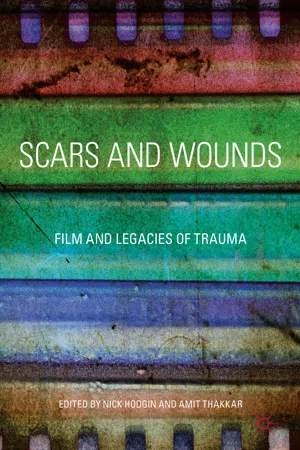
This book examines recent cinematic representations of the traumatic legacies of national and international events and processes. Whilst not ignoring European and Hollywood cinema, it includes studies of films about countries which have been less well-represented in cinematic trauma studies, including Australia, Rwanda, Chile and Iran. Each essay establishes national and international contexts that are relevant to the films considered. All essays also deal with form, whether this means the use of specific techniques to represent certain aspects of trauma or challenges to certain genre conventions to make them more adaptable to the traumatic legacies addressed by directors. The editors argue that the healing processes associated with such legacies can helpfully be studied through the idiom of 'scar-formation' rather than event-centred 'wound-creation'.
eBook - PDF
Scars and Wounds
Film and Legacies of Trauma
- 307 pages
- English
- PDF
- Available on iOS & Android
eBook - PDF
About this book
Information
Subtopic
Film & VideoTable of contents
- Contents
- Notes on Contributors
- List of Figures
- Chapter 1: Introduction: Trauma Studies, Film and the Scar Motif
- Chapter 2: Trauma in Recent Algerian Documentary Cinema: Stories of Civil Conflict Told by the Living Dead
- Chapter 3: Elusive Figures: Children’s Trauma and Bosnian War Cinema
- Chapter 4: Conferring Visibility on Trauma within Rwanda’s National Reconciliation: Kivu Ruhorahoza’s Disturbing and Salutary Camera
- Chapter 5: Proximity and Distance: Approaching Trauma in Katrina Films
- Chapter 6: ‘Our Long National Nightmare Is Over’?: The Resolution of Trauma and Male Melodrama in The Tree of Life
- Chapter 7: Listening to the Pain of Others: Isabel Coixet’s La vida secreta de las palabras (The Secret Life of Words)
- Chapter 8: Australian Postcolonial Trauma and Silences in Samson and Delilah
- Chapter 9: Trauma’s Slow Onslaught: Sound and Silence in Lav Diaz’s Florentina Hubaldo, CTE
- Chapter 10: Flesh and Blood in the Globalised Age: Pablo Trapero’s Nacido y criado (Born and Bred) and Carancho (The Vulture)
- Chapter 11: Unclaimed Experience and the Implicated Subject in Pablo Larraín’s Post Mortem
- Chapter 12: Persepolis: Telling Tales of Trauma
- Index
Trusted by 375,005 students
Access to over 1.5 million titles for a fair monthly price.
Study more efficiently using our study tools.
Frequently asked questions
Yes, you can cancel anytime from the Subscription tab in your account settings on the Perlego website. Your subscription will stay active until the end of your current billing period. Learn how to cancel your subscription
No, books cannot be downloaded as external files, such as PDFs, for use outside of Perlego. However, you can download books within the Perlego app for offline reading on mobile or tablet. Learn how to download books offline
Perlego offers two plans: Essential and Complete
- Essential is ideal for learners and professionals who enjoy exploring a wide range of subjects. Access the Essential Library with 800,000+ trusted titles and best-sellers across business, personal growth, and the humanities. Includes unlimited reading time and Standard Read Aloud voice.
- Complete: Perfect for advanced learners and researchers needing full, unrestricted access. Unlock 1.5M+ books across hundreds of subjects, including academic and specialized titles. The Complete Plan also includes advanced features like Premium Read Aloud and Research Assistant.
We are an online textbook subscription service, where you can get access to an entire online library for less than the price of a single book per month. With over 1.5 million books across 990+ topics, we’ve got you covered! Learn about our mission
Look out for the read-aloud symbol on your next book to see if you can listen to it. The read-aloud tool reads text aloud for you, highlighting the text as it is being read. You can pause it, speed it up and slow it down. Learn more about Read Aloud
Yes! You can use the Perlego app on both iOS and Android devices to read anytime, anywhere — even offline. Perfect for commutes or when you’re on the go.
Please note we cannot support devices running on iOS 13 and Android 7 or earlier. Learn more about using the app
Please note we cannot support devices running on iOS 13 and Android 7 or earlier. Learn more about using the app
Yes, you can access Scars and Wounds by Nick Hodgin, Amit Thakkar, Nick Hodgin,Amit Thakkar in PDF and/or ePUB format, as well as other popular books in Media & Performing Arts & Film & Video. We have over 1.5 million books available in our catalogue for you to explore.