Style: An Approach to Appreciating Theatre offers brief, readable chapters about the basics of theatre as a starting point for discussion, and provides new adaptations of classic plays that are both accessible to students learning about theatre and fit for production.
In this text, style is the word used to describe the various ways in which theatre is done in real space and time by humans in the physical presence of other humans. The book uses style, the "liveness" of theatre that makes it distinct from literature or history, as a lens to see how playwrights, directors, designers, and actors bring scripts to life on stage. Rather than focusing on theatre history or literary script analysis, it emphasizes actual theatrical production through examples and explores playscripts illustrating four theatrical styles: Realism, Theatricalism, Expressionism, and Classicism. Susan Glaspell's Realistic play Trifles is presented as written, while The Insect Play by the Brothers ?apek, The Hairy Ape by Eugene O'Neill, and Antigone by Sophocles are original, full-length adaptions.
Style: An Approach to Appreciating Theatre is the perfect resource for students of Theatre Appreciation, Introduction to Theatre, Theatrical Design, and Stagecraft courses.
If you are reading this book, you are probably taking a class called Theatre Appreciation or maybe Introduction to Theatre. In high school, these kinds of courses are often called “Drama” class; in college, they are more often called “Theatre” courses. Why do you think that is? The two terms are used interchangeably in everyday conversation. But in this book, we’re going to make a distinction. For our purposes, “drama” refers to ideas, while “theatre” refers to actions. Theatre is what this book is all about, but first, let’s talk about drama.
Drama
Drama starts with the playwright. We’ll talk more about what playwrights do and how they do it in Chapter 8, but, in the end, a playwright produces a written script—ideas on a page. Because a playscript uses regular words that we can all read, it might at first seem like a short story or a novel. But, in many ways, a playscript is less like a book and more like a piece of sheet music.
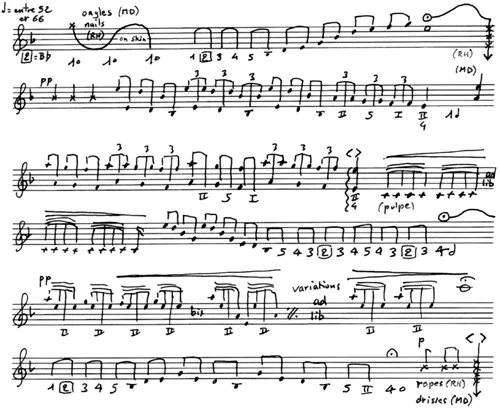
Some of you can read music. Some can’t. If you can’t, then, while you can recognize Figure 1.1 as a piece of music, it probably makes little sense to you in terms of what the music would sound like.
1.1 A piece of sheet music.
Those of you who can read music can look at it with understanding: what notes should be played and what they sound like, how loud or soft they should be, what the tempo is, how the rhythm changes. You have an idea of the music in your head. But no one would say that the idea is the same thing as hearing the music performed. We know that the ideas written on a piece of sheet music (notated using notes, sharps and flats, numbers, lines, etc.) are meant to be put into practice by performers for an audience. That’s exactly what a playscript is. It’s not something that was created to be read. Like a piece of sheet music, it’s a plan for a performance.
However, playscripts are sometimes studied and treated not as detailed plans for a live, dynamic performance, but as literature. You’ve probably read a Shakespeare play, for example, but might never have seen one performed. In fact, in many universities, “Shakespeare” courses are taught in the English Department. That’s an interesting situation: Shakespeare himself would probably be slightly confused by the idea of someone reading his plays with no intention of producing them. Sometimes, in these Shakespeare courses, the performative nature of the script—the idea that it’s really a plan for a performance—is treated as an afterthought, a curiosity. While the plays of Shakespeare are so rich that you can gain understanding by reading them, it’s a mistake to study Shakespeare, or any play, without truly appreciating what it really is.
For example, in Romeo and Juliet, most of the important characters are onstage in the final scene, either alive or dead: Romeo, Juliet, Paris, Friar Lawrence, the Prince, both of Juliet’s parents, and Romeo’s father. Why not Romeo’s mother?
Romeo’s father says, upon entering the scene, “Alas, my liege, my wife is dead to-night; Grief of my son’s exile hath stopp’d her breath” (Act V, Scene 3, lines 218–219). So, we hear that Lady Montague has dropped dead over what’s going on with her son and his girlfriend. We don’t see this happen, but the audience notices that Romeo’s mother is missing from the final scene. (Her absence is a part of the spectacle of the play—more on that later.) You could attempt a literary analysis of why Shakespeare made this choice. Maybe he is making a moral commentary or using this offstage death to reinforce the themes of the play. You could probably write a good scholarly paper making a literary argument about why Lady Montague dies. Or, you could look at Elizabethan theatrical practices and speculate that an actor was “doubling” the part—that is, playing both Lady Montague and another character (maybe one more important to the scene than Lady M.). Since the actor could not appear onstage as both characters at the same time, the one who was more important to the scene appears and the noticeable absence of Romeo’s mother is explained in the dialogue. In other words, there is a practical, theatrical reason, rather than a literary or dramatic one. Again, all of this is not to suggest that the play has none of the qualities of literature or that it’s somehow wrong to simply read Shakespeare rather than performing him. While his plays have literary merit, they are at the core plans for performance. It’s important to always keep that in mind.
Another example of this is the film adaptation of Alfred Uhry’s play, Driving Miss Daisy. The play is part of Uhry’s “Atlanta Trilogy,” which deals with important events in Atlanta’s history. It is set during the Civil Rights Era and makes references to the Atlanta Temple bombing in 1958 and a speech given in the city by Martin Luther King, Jr., in 1964. It’s about the relationship that grows between Hoke, an older African American man, and Miss Daisy, an elderly, wealthy Jewish woman. Hoke is hired by Boolie, Miss Daisy’s son, to work as a chauffeur for Miss Daisy, who doesn’t think she needs one. Uhry adapted his own play for film.
The movie, which won many awards, including Oscars for Best Picture and Best Adapted Screenplay, wonderfully portrays Atlanta from the late 1940s through the early 1970s. It includes beautifully shot scenes in the succession of cars that Hoke drives for Miss Daisy and in wealthy Atlanta neighborhoods, both in Miss Daisy’s home and in that of Boolie and his wife Florine. Minor characters in the film include Florine, Miss Daisy’s cook Idella, Miss Daisy’s friends, and Boolie’s secretary. But the original play only has three characters: Hoke, Miss Daisy, and Boolie. So, while in the film it’s a more obvious comment on Florine’s character that Boolie frequently appears alone, apologizing about why she couldn’t be there (she always has some excuse), when you look at the original play, there is a more practical reason—a theatrical reason. The play was written in part to be produced relatively easily with only three actors. As with Romeo’s mother, the stage absence of other people in the character’s lives is explained through theatrical dialogue.
Just as a play is ultimately not a novel or a film, it is also not dance, musical performance, singing, puppetry, stand-up comedy, an educational lecture, or a sport. Each of the many types of performing arts has its own qualities. The differences between theatre and other art forms will become clearer as we go along, but for now, we’re still talking about drama.
Aristotle
Very important to our understanding of drama is the work of Aristotle, a 4th-century b.c.e. Greek philosopher. In his work Poetics, he identified what have come to be known as the Six Elements of Drama (note the use of that word instead of Theatre). These elements are:
1.2 A statue of Aristotle in Thessaloniki, Greece.
Plot—the events that occur onstage in the play. You might also include events that occur offstage (such as the death of Romeo’s mother), but you wouldn’t include things that happened before the events of the play or that you could imagine happening afterwards. Willie Loman kills himself at the end of Death of a Salesman. We don’t see his suicide, but we could include that as the climax of the plot of the play. We couldn’t include Willie’s childhood or what his family might do after the funeral at the end of the play. Aristotle considered plot the most important of the six elements.
Character—the agents of the action of the play. Their decisions, words, and actions make the plot happen.
Language—the words the characters use. This would include specific word choice (having a character say, “Let’s get outta here” instead of “Let’s go”) as well as overall style of language. Some plays are meant to seem like everyday life, so those characters would speak using words and phrases appropriate to the setting of the play. Other plays use language that’s very flowery, or poetic, or somehow unlike the way people “really talk.” At the climax of Star Wars Episode II: Attack of the Clones, when Yoda says, “Around the survivors a perimeter create,” that’s not the way people normally talk. But it is the way Yoda talks in the Star Wars universe. It’s not a flaw; it’s a choice.
Theme—the larger ideas of the play. This goes beyond plot. A theme of Romeo and Juliet, for example, wouldn’t be “Romeo and Juliet fall in love” or “Romeo’s mother dies.” The play is about passionate love, family loyalties, unintended and unexpected consequences, gang violence, murder, suicide, death. These are some of the thematic issues the play grapples with. It’s better to understand theme in terms of ideas and questions rather than messages and answers. Try not to think of theme as “the moral of the story,” like “Don’t judge a book by its cover.” Good plays tend to ask questions, requiring the audience to think, rather than providing easy answers.
Rhythm—the tempo and “feel” of the play in performance. Rhythm is found in the actions of the characters as well as the language they use. Is a scene in the play fast or slow? Does it build in intensity over time? Do characters move in graceful arcs or pace frantically? Like we discussed with a piece of music, a play has rhythm and mood—really, a variety of rhythms and moods. And, like music, rhythm includes the sounds we hear when watching a play: things like the actor’s voices, sound effects, and music. In fact, Aristotle used the term “music” for this element, and was mostly referring to actual music. In modern usage, we’ve broadened the term.
Spectacle—everything you see and experience when you attend a play. This includes of course sets, costumes, makeup, lighting, props—all things we’ll discuss later. But it also includes things you might not immediately think of. Imagine yourself sitting in a theatre, watching a play. What is literally in your field of vision besides the things mentioned above? The stage itself. The walls of the theatre building. The seats. Other audience members. What can you hear? Smell? Everything you experience while watching the play is part of the overall spectacle. Again, this is very much connected to the idea that theatre is essentially about live performance.
It might have become obvious when reading the descriptions above that the last two elements stand apart from the first four. Plot, character, language, and theme are all created by the playwright. She comes up with a plot, peoples it with characters, chooses specific language for those characters to use, and—whether consciously and intentionally or not—develops thematic ideas. But rhythm and spectacle can only be suggested by the playwright. A play might have stage directions about how characters look or move, or how the set or lighting should look. The dialogue might contain clues: one character might say to another, “That red dress looks incredible on you.” In that case, the woman clearly needs to be wearing a red dress. But, what shade of red? What kind of dress? That’s something that, in an actual production of the play, people other than the playwright will make final decisions about. Rhythm and spectacle are ultimately determined by directors, designers, and actors. Now we’re getting beyond ideas and into action.
Theatre
One of the primary points of this book is the understanding that theatre (as opposed to “drama”) is about action. It’s a live event: one or more human beings (actors) moving around in space (the set and the theatre itself) and time (the duration of the performance), performing (the script) for, and in...
Table of contents
Cover
Half-Title
Title
Copyright
Contents
Prologue
Acknowledgments
1 Introduction
2 Style
3 Realism
4 Theatricalism
5 Expressionism
6 Classicism
7 Musical Theatre
8 The Playwright
9 The Director
10 The Designers
11 The Actor and Other Collaborators
Bibliography
Glossary
Index
Trusted by 375,005 students
Access to over 1.5 million titles for a fair monthly price.
Study more efficiently using our study tools.
Frequently asked questions
Yes, you can cancel anytime from the Subscription tab in your account settings on the Perlego website. Your subscription will stay active until the end of your current billing period. Learn how to cancel your subscription
No, books cannot be downloaded as external files, such as PDFs, for use outside of Perlego. However, you can download books within the Perlego app for offline reading on mobile or tablet. Learn how to download books offline
Perlego offers two plans: Essential and Complete
Essential is ideal for learners and professionals who enjoy exploring a wide range of subjects. Access the Essential Library with 800,000+ trusted titles and best-sellers across business, personal growth, and the humanities. Includes unlimited reading time and Standard Read Aloud voice.
Complete: Perfect for advanced learners and researchers needing full, unrestricted access. Unlock 1.5M+ books across hundreds of subjects, including academic and specialized titles. The Complete Plan also includes advanced features like Premium Read Aloud and Research Assistant.
Both plans are available with monthly, semester, or annual billing cycles.
We are an online textbook subscription service, where you can get access to an entire online library for less than the price of a single book per month. With over 1.5 million books across 990+ topics, we’ve got you covered! Learn about our mission
Look out for the read-aloud symbol on your next book to see if you can listen to it. The read-aloud tool reads text aloud for you, highlighting the text as it is being read. You can pause it, speed it up and slow it down. Learn more about Read Aloud
Yes! You can use the Perlego app on both iOS and Android devices to read anytime, anywhere — even offline. Perfect for commutes or when you’re on the go. Please note we cannot support devices running on iOS 13 and Android 7 or earlier. Learn more about using the app
Yes, you can access Style: An Approach to Appreciating Theatre by E. Bert Wallace in PDF and/or ePUB format, as well as other popular books in Medien & darstellende Kunst & Darstellende Kunst. We have over 1.5 million books available in our catalogue for you to explore.