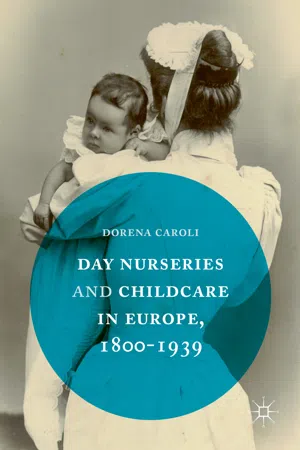
Day Nurseries & Childcare in Europe, 1800–1939
eBook - PDF

Day Nurseries & Childcare in Europe, 1800–1939

  1. English
  2. PDF
  3. Available on iOS & Android
eBook - PDF

Day Nurseries & Childcare in Europe, 1800–1939

About this book

This book traces the birth and evolution of the crèche in France, England, Germany, Russia and Italy from the mid-nineteenth century to the eve of the Second World War, in an attempt to understand from a transnational viewpoint the history of an institution for very young children that was very different from what we know today. These institutions had the two-fold goal of combatting the two phenomena that had for centuries characterised the history of infancy – infant mortality and the abandonment of babies. 
Drawing on a wealth of printed sources and in the light of the most recent and authoritative historical investigations, Dorena Caroli discusses the origins of the first crèche, established in Paris in 1844 by Firmin Marbeau, going on to compare and contrast the reception of the French model of care and assistance for babies and infants in a number of different European countries – England, Germany, Russia and Italy. 
This book fills a significant lacuna in the studies of infant history and the educational institutions designed for infants, providing a clear and broad picture not only of the practices followed but also of the evolution of "puericulture" and medical theories about very young children held in Europe in the nineteenth and twentieth centuries. It represents not only a valuable contribution to the history of these institutions but also a useful manual for students in the field of infant care.

Frequently asked questions

Yes, you can cancel anytime from the Subscription tab in your account settings on the Perlego website. Your subscription will stay active until the end of your current billing period. Learn how to cancel your subscription.
At the moment all of our mobile-responsive ePub books are available to download via the app. Most of our PDFs are also available to download and we're working on making the final remaining ones downloadable now. Learn more here.
Perlego offers two plans: Essential and Complete
  • Essential is ideal for learners and professionals who enjoy exploring a wide range of subjects. Access the Essential Library with 800,000+ trusted titles and best-sellers across business, personal growth, and the humanities. Includes unlimited reading time and Standard Read Aloud voice.
  • Complete: Perfect for advanced learners and researchers needing full, unrestricted access. Unlock 1.4M+ books across hundreds of subjects, including academic and specialized titles. The Complete Plan also includes advanced features like Premium Read Aloud and Research Assistant.
Both plans are available with monthly, semester, or annual billing cycles.
We are an online textbook subscription service, where you can get access to an entire online library for less than the price of a single book per month. With over 1 million books across 1000+ topics, we’ve got you covered! Learn more here.
Look out for the read-aloud symbol on your next book to see if you can listen to it. The read-aloud tool reads text aloud for you, highlighting the text as it is being read. You can pause it, speed it up and slow it down. Learn more here.
Yes! You can use the Perlego app on both iOS or Android devices to read anytime, anywhere — even offline. Perfect for commutes or when you’re on the go.
Please note we cannot support devices running on iOS 13 and Android 7 or earlier. Learn more about using the app.
Yes, you can access Day Nurseries & Childcare in Europe, 1800–1939 by Dorena Caroli in PDF and/or ePUB format, as well as other popular books in Education & Early Childhood Education. We have over one million books available in our catalogue for you to explore.

Information

Table of contents

  1. Acknowledgements
  2. Contents
  3. Glossary of Foreign Words
  4. Preface
  5. Part I: The Origins of Crèches and Modern Childcare in France and Italy
  6. Part II: The Origins and Spread of Day Nurseries in England, Germany and Russia
  7. Conclusion
  8. Bibliography
  9. Index