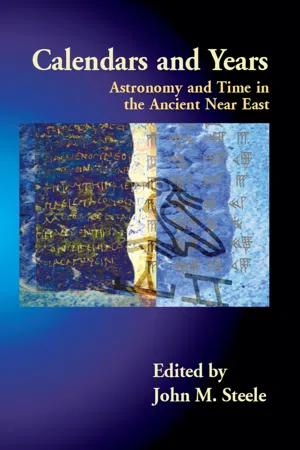
Dates form the backbone of written history. But where do these dates come from? Many different calendars were used in the ancient world. Some of these calendars were based upon observations or calculations of regular astronomical phenomena, such as the first sighting of the new moon crescent that defined the beginning of the month in many calendars, while others incorporated schematic simplifications of these phenomena, such as the 360-day year used in early Mesopotamian administrative practices in order to simplify accounting procedures. Historians frequently use handbooks and tables for converting dates in ancient calendars into the familiar BC/AD calendar that we use today. But very few historians understand how these tables have come about, or what assumptions have been made in their construction. The seven papers in this volume provide an answer to the question what do we know about the operation of calendars in the ancient world, and just as importantly how do we know it? Topics covered include the ancient and modern history of the Egyptian 365-day calendar, astronomical and administrative calendars in ancient Mesopotamia, and the development of astronomical calendars in ancient Greece. This book will be of interest to ancient historians, historians of science, astronomers who use early astronomical records, and anyone with an interest in calendars and their development.
- 176 pages
- English
- ePUB (mobile friendly)
- Available on iOS & Android
eBook - ePub
About this book
Trusted by 375,005 students
Access to over 1.5 million titles for a fair monthly price.
Study more efficiently using our study tools.
Information
Subtopic
Ancient HistoryIndex
HistoryCalendars and Years in Ancient Egypt: The Soundness of Egyptian and West Asian Chronology in 1500–500 BC and the Consistency of the Egyptian 365-Day Wandering Year
My fellow historians of antiquity! The state of traditional ancient chronology is strong. There always have been episodes of doubt. There always will be need for introspection and verification. But the standard chronology found in all the textbooks will prevail!
What follows is an exercise in introspection of the chronological kind. The focus is on a fundamental tenet of the reigning chronology of ancient Egypt. By this tenet, the Egyptian calendar shifted or wandered with absolute consistency at a rate of about one day in four years in relation to the seasons throughout Egyptian history, for more than 3000 years, from the early third millennium BC onward. Back to about 500 BC, there is hardly a doubt about the veracity of the absolute consistency of the Egyptian calendar’s wandering. The present concern is with the millennium that immediately precedes 500 BC, namely the time-period 1500–500 BC. The objective of this paper is to argue in favour of the veracity of absolute consistency for that time-period as well.
The following logic is fundamental to the organization of this paper’s argument. The standard ancient chronology for the time-period 1500–500 BC implies absolute consistency of the Egyptian calendar’s wandering. At the same time, the chronology of 1500–500 BC seems secure for reasons independent of the consistency of the Egyptian year’s wandering. Therefore, logically speaking, to the extent that the chronology of 1500–500 BC can be considered secure, the absolute consistency of the Egyptian year’s wandering in that same time-period is also secure by inference, because the former logically implies the latter. A principal concern of the present paper is therefore the theoretical model that has produced the chronology of 1500–500 BC. The structure of the chronology of that time-period is analysed in section 5 of this paper.
In addition, the time-period 1500–500 BC will be placed in a larger context by treating milestones in the history of the Egyptian 365-day calendar and in the history of the study of that calendar from before and after 1500–500 BC. The present treatment of these milestones may serve as a sort of prolegomena to a more comprehensive survey of the history of the Egyptian 365-day calendar. Four milestones will precede the analysis of the chronology of 1500–500 BC in sections 1, 2, 3, and 4. One milestone will follow in section 6.
As for the order in which the milestones will be treated, the following organizational principle rules. History is a story. Stories are best told forward in time. As the backbone of history, chronology is all about time. Yet, unlike history proper, chronology is best told backward, from the present back into the past. By moving backward, one only follows the sound scientific principle of proceeding from what is more certain to what is less certain. Accordingly, the following six milestones will be treated below in reverse chronological order.
- (1) FIRST MILESTONE (AD 1820s) Champollion discovers the seasonal month names in hieroglyphic sources
- (2) SECOND MILESTONE (AD 1806) Ideler first fully evaluates the chronological data in Ptolemy
- (3) THIRD MILESTONE (AD 1578) Crusius puts Ptolemy’s era of Nabonassar in order
- (4) FOURTH MILESTONE (Fifth Century BC) Babylonian and Egyptian dates as a rule match in Aramaic double dates
- (5) FIFTH MILESTONE (1500–500 BC) Why is Egyptian and West Asian chronology in 1500–500 BC sound? The Amarna and Assyrian Connections
- (6) SIXTH MILESTONE (Early Third Millennium BC) The origin of the Egyptian 365-day calendar

0. Preface
0.1. The Limits of Induction
Intellectual disciplines operate by theoretical models. Only the deductive models of mathematics and mathematical logic are absolutely certain. And that does not even include the axioms on which chains of deductive steps are built. All other models are inductive. Inductive models consist of patterns of regularity emerging from repeated observation of facts. Facts are typically instances of contact between the senses and the world outside the senses. Inductive models may come quite near to certainty. But they are never entirely divested of probability. And that includes the laws of nature, which are inductive.
There is always room for skeptics to doubt inductive models. To be successful, inductive models need to earn and win the disinterested, unsolicited, and unforced consensus of a number of independent observers. Absolute certainty does not exist. Universal consensus is not possible. But there is winning and there is losing. A winning model allows a majority of observers to stand their ground confidently over the decades and over the centuries against the inevitable skepticism. One measure of a model’s success is its ability to dominate the textbooks. Then again, inductive models are never permanently established. The need for confronting certain kinds of persistent skepticism never vanishes. Accordingly, creationism will always pose a challenge to evolution theory. An inductive model is a dynamic process. There is a never-ending exchange between its advocates and its skeptics. But in this process, certain models remain on top while rival theories are relegated to the status of also-rans.
Unforced and unsolicited consensus has a peculiar way of overpowering skepticism, however loudly proclaimed. The power of consensus has much to do with how consensus may be quantified. An agreement between two (2) observers may be counted as one (1) unit of consensus. Marginal models are often publicized so loudly that they seem to drown out the standard model. But in spite of the loudness, no two observers can be found to agree on the same marginal model. The consensus quote of such marginal models is therefore zero. And zero is still infinitely larger than a consensus of just a handful of keen observers. Disagreeing is not too difficult. There is always room for skepticism. But earning the consensus of other observers regarding the exact formulation of an alternative chronological model is less easy.
Our modern calendar, instituted by Caesar in 45 BC, provides a kind of continuity down to the present time that makes chronology much less of a concern to AD historians than to BC historians.1 Handbooks of ancient history all agree on the outline of BC chronology. This universal agreement sharply contrasts with an almost equally universal lack of awareness of how this outline was obtained.
The standard ancient chronology is a product of an inductive chronological model. This model is an intellectual structure. The structure consists of various components that are built upon one another in a logical sequence. Some components are logically prior to other components and therefore more fundamental.
No inductive model is above constant verification. Chronological models, being inductive as they are, are no exception. Reluctance to verify the standard model of ancient chronology may engender suspicion that all is not well with ancient chronology. Such suspicion in fact keeps spawning wholesale rejections of the standard chronology in the margins of the field of history.
Lacking proper understanding of the standard model’s foundation and structure, historians cannot defend themselves against refutations of the model. Whether the standard model is true or false is at first irrelevant. What matters at the outset is that the model is very real in the following fundamental respect. It is responsible for the fact that all the history books agree when Ramses II reigned. The model is the hidden engine that drives all the dates in all the textbooks. This engine’s internal workings are grasped to their full extent by hardly anyone. The discipline of ancient studies would be stronger if more people understood how the model works.
Towards this aim, I have portrayed the model of ancient chronology back to about 500 BC in four recent contributions, each endowed with its own distinct focus. The first contribution is an article entitled “Ancient Chronology’s Alpha and Egyptian Chronology’s Debt to Babylon”, to appear in a Festschrift published by Eisenbrauns. Its focus is specifically to outline the model. The second contribution is a shorter and popular version of this first contribution, addressed to a wider audience, and published under the title “How to Date a Pharaoh” in the issue of July/August 2005 of the magazine Archaeology Odyssey, at pp. 27–33. The third contribution consists of two chapters entitled “Foundations of Day-exact Chronology” and “Saite and Persian Egypt, 664–332 BC (Dynasties 26–31, Psammetichus I to Alexander’s Conquest of Egypt)” in the new handbook of Egyptian chronology for the series Handbuch der Orientalistik (now just out as Depuydt (2006a) and (2006b)). The objective of these two chapters is to survey the chronology of 664–332 BC. The fourth contribution is an article entitled “The Shifting Foundation of Ancient Chronology” in the acts of a session held at the Ninth Annual Meeting of the European Association of Archaeologists in 2003 in St. Petersburg.2 This contribution puts more than four centuries of modern study of chronology, beginning in the early seventeenth century AD, in perspective by focusing on how the fundaments on which the entire structure of ancient chronology rests are shifting and will be shifting in the years ahead from Ptolemy’s Royal Canon to the Babylonian astronomical diaries and related sources.
The aim of these four contributions was to make the chronology back to about 500 BC more transparent and accessible. The aim of the present paper is to move this boundary back to about 1500 BC, in th...
Table of contents
- Title Page
- Copyright Page
- Table of Contents
- Preface
- A Star’s Year: The Annual Cycle in the Ancient Egyptian Sky
- Calendars and Years in Ancient Egypt: The Soundness of Egyptian and West Asian Chronology in 1500–500 BC and the Consistency of the Egyptian 365-Day Wandering Year
- The 360-Day Year in Mesopotamia
- The Astrolabes: Astronomy, Theology, and Chronology
- Calendars, Intercalations and Year-Lengths in Mesopotamian Astronomy
- The Length of the Month in Mesopotamian Calendars of the First Millennium BC
- On Greek Stellar and Zodiacal Date-Reckoning
Frequently asked questions
Yes, you can cancel anytime from the Subscription tab in your account settings on the Perlego website. Your subscription will stay active until the end of your current billing period. Learn how to cancel your subscription
No, books cannot be downloaded as external files, such as PDFs, for use outside of Perlego. However, you can download books within the Perlego app for offline reading on mobile or tablet. Learn how to download books offline
Perlego offers two plans: Essential and Complete
- Essential is ideal for learners and professionals who enjoy exploring a wide range of subjects. Access the Essential Library with 800,000+ trusted titles and best-sellers across business, personal growth, and the humanities. Includes unlimited reading time and Standard Read Aloud voice.
- Complete: Perfect for advanced learners and researchers needing full, unrestricted access. Unlock 1.5M+ books across hundreds of subjects, including academic and specialized titles. The Complete Plan also includes advanced features like Premium Read Aloud and Research Assistant.
We are an online textbook subscription service, where you can get access to an entire online library for less than the price of a single book per month. With over 1.5 million books across 990+ topics, we’ve got you covered! Learn about our mission
Look out for the read-aloud symbol on your next book to see if you can listen to it. The read-aloud tool reads text aloud for you, highlighting the text as it is being read. You can pause it, speed it up and slow it down. Learn more about Read Aloud
Yes! You can use the Perlego app on both iOS and Android devices to read anytime, anywhere — even offline. Perfect for commutes or when you’re on the go.
Please note we cannot support devices running on iOS 13 and Android 7 or earlier. Learn more about using the app
Please note we cannot support devices running on iOS 13 and Android 7 or earlier. Learn more about using the app
Yes, you can access Calendars and Years by John M. Steele in PDF and/or ePUB format, as well as other popular books in History & Ancient History. We have over 1.5 million books available in our catalogue for you to explore.