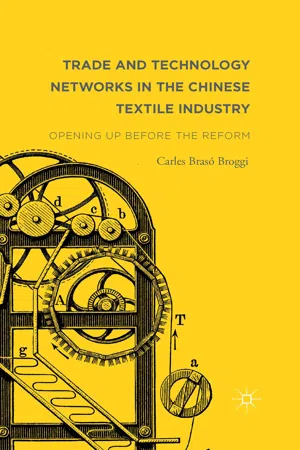
The aim of this book is to track the historical origins of China's economic reforms. From the 1920s and 1930s strong ties were built between Chinese textile industrialists and foreign machinery importers in Shanghai and the Yangzi Delta. Despite the fragmentation of China, the contribution of these networks to the modernization of the country was important and longstanding. Facing the challenge of growing in a fragmented country, Chinese textile firms such as Dafeng, Dacheng and Lixin focused on urban markets and also on importing technology for upgrading their production. When the war against Japan blocked trade routes inside China, these networks were concentrated in Shanghai where they envisaged an export-oriented development strategy for China that was based on importing machinery and exporting manufactured products. However, this strategy was only implemented precariously in Shanghai, while the city stood as a neutral space in the first years of the Japanese occupation, but was only consolidated in Hong Kong in the late 1940s, where textile industrialist and most of the foreign importers migrated. These networks were thus reestablished in Hong Kong, where they contributed to the city's industrialization in the Cold War period. Meanwhile, the Chinese industrialists that stayed in Shanghai and the Yangzi Delta had to adapt to the Maoist regime and were progressively incorporated into the state-owned companies or the local government agencies such as the United Front or the Textile bureaus. However, from the early 1970s, the links between Hong Kong and Shanghai were reactivated and these networks played, again, a key role in the modernization of China, especially regarding the imports of technology and exports of manufactured goods. The book ends with the first joint-ventures between Hong Kong businessmen and Chinese local administrations that took place in the beginnings of China's economic reforms in 1979.
eBook - PDF
Trade and Technology Networks in the Chinese Textile Industry
Opening Up Before the Reform
- 228 pages
- English
- PDF
- Available on iOS & Android
eBook - PDF
Trade and Technology Networks in the Chinese Textile Industry
Opening Up Before the Reform
About this book
Information
Table of contents
- Cover
- Title Page
- Copyright Page
- Table of Contents
- Acknowledgments
- Pronunciation Guide
- List of Abbreviations
- Introduction
- 1 The Origins of Dafeng, Lixin, and Dacheng
- 2 Technology Networks in the Yangzi Delta
- 3 Integrated Firms in a Dual Market
- 4 War and Isolation
- 5 The Great Leap Outwards
- 6 The Socialist Transition and the Shanghai–Hong Kong Network
- 7 Trade and Industrialization in Hong Kong
- 8 Networks in the Reform and Opening Up
- Conclusion
- Glossary
- Notes
- References
- Index
Trusted by 375,005 students
Access to over 1.5 million titles for a fair monthly price.
Study more efficiently using our study tools.
Frequently asked questions
Yes, you can cancel anytime from the Subscription tab in your account settings on the Perlego website. Your subscription will stay active until the end of your current billing period. Learn how to cancel your subscription
No, books cannot be downloaded as external files, such as PDFs, for use outside of Perlego. However, you can download books within the Perlego app for offline reading on mobile or tablet. Learn how to download books offline
Perlego offers two plans: Essential and Complete
- Essential is ideal for learners and professionals who enjoy exploring a wide range of subjects. Access the Essential Library with 800,000+ trusted titles and best-sellers across business, personal growth, and the humanities. Includes unlimited reading time and Standard Read Aloud voice.
- Complete: Perfect for advanced learners and researchers needing full, unrestricted access. Unlock 1.5M+ books across hundreds of subjects, including academic and specialized titles. The Complete Plan also includes advanced features like Premium Read Aloud and Research Assistant.
We are an online textbook subscription service, where you can get access to an entire online library for less than the price of a single book per month. With over 1.5 million books across 990+ topics, we’ve got you covered! Learn about our mission
Look out for the read-aloud symbol on your next book to see if you can listen to it. The read-aloud tool reads text aloud for you, highlighting the text as it is being read. You can pause it, speed it up and slow it down. Learn more about Read Aloud
Yes! You can use the Perlego app on both iOS and Android devices to read anytime, anywhere — even offline. Perfect for commutes or when you’re on the go.
Please note we cannot support devices running on iOS 13 and Android 7 or earlier. Learn more about using the app
Please note we cannot support devices running on iOS 13 and Android 7 or earlier. Learn more about using the app
Yes, you can access Trade and Technology Networks in the Chinese Textile Industry by Carles Brasó Broggi in PDF and/or ePUB format, as well as other popular books in Business & International Business. We have over 1.5 million books available in our catalogue for you to explore.