Among the societies that experienced a political transition away from authoritarianism in the 1980s, South Korea is known as a paragon of 'successful democratization.' This achievement is considered to be intimately tied to a new institution introduced with the 1987 change of regime, intended to safeguard fundamental norms and rights: the Constitutional Court of Korea. While constitutional justice is largely celebrated for having achieved both purposes, this book proposes an innovative and critical account of the court's role. Relying on an interpretive analysis of jurisprudence, it uncovers the ambivalence with which the court has intervened in the major dispute opposing the state and parts of civil society after the transition: (re)defining enmity. In response to this challenge, constitutional justice has produced both liberal and illiberal outcomes, promoting the rule of law and basic rights while reinforcing the mechanisms of exclusion bounding South Korean democracy in the name of national security.
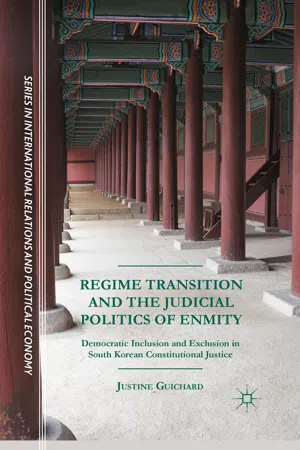
eBook - PDF
Regime Transition and the Judicial Politics of Enmity
Democratic Inclusion and Exclusion in South Korean Constitutional Justice
- 263 pages
- English
- PDF
- Available on iOS & Android
eBook - PDF
Regime Transition and the Judicial Politics of Enmity
Democratic Inclusion and Exclusion in South Korean Constitutional Justice
About this book
Information
Table of contents
- Cover
- Title Page
- Copyright Page
- Table of Contents
- List of Illustrations
- Acknowledgments
- Note on the Romanization of Korean Nouns and Names
- Prologue
- One Interrogating Constitutional Justice: Contingency and Ambivalence of the South Korean Court’s Role as Guardian of the Constitution
- Two Transitioning by Amendment: The 1987 Revision of Constitutional Norms and Institutions
- Three Post-Authoritarian Contentious Politics: Constitutional Empowerment from Below
- Four Reviewing How the Enemy is Defined: From the Security of the State to the “Basic Order of Free Democracy”
- Five Reviewing the Contours of the National Community: The Body Politic Beyond and Below the 38th Parallel
- Six Reviewing How the Enemy is Treated: Criminal Rights Even for National Security Offenders
- Seven Reviewing the Exigencies of National Defense: Citizens’ War-Related Rights and Duties
- Epilogue
- Chronology
- Notes
- Bibliography
- Index
Trusted by 375,005 students
Access to over 1.5 million titles for a fair monthly price.
Study more efficiently using our study tools.
Frequently asked questions
Yes, you can cancel anytime from the Subscription tab in your account settings on the Perlego website. Your subscription will stay active until the end of your current billing period. Learn how to cancel your subscription
No, books cannot be downloaded as external files, such as PDFs, for use outside of Perlego. However, you can download books within the Perlego app for offline reading on mobile or tablet. Learn how to download books offline
Perlego offers two plans: Essential and Complete
- Essential is ideal for learners and professionals who enjoy exploring a wide range of subjects. Access the Essential Library with 800,000+ trusted titles and best-sellers across business, personal growth, and the humanities. Includes unlimited reading time and Standard Read Aloud voice.
- Complete: Perfect for advanced learners and researchers needing full, unrestricted access. Unlock 1.5M+ books across hundreds of subjects, including academic and specialized titles. The Complete Plan also includes advanced features like Premium Read Aloud and Research Assistant.
We are an online textbook subscription service, where you can get access to an entire online library for less than the price of a single book per month. With over 1.5 million books across 990+ topics, we’ve got you covered! Learn about our mission
Look out for the read-aloud symbol on your next book to see if you can listen to it. The read-aloud tool reads text aloud for you, highlighting the text as it is being read. You can pause it, speed it up and slow it down. Learn more about Read Aloud
Yes! You can use the Perlego app on both iOS and Android devices to read anytime, anywhere — even offline. Perfect for commutes or when you’re on the go.
Please note we cannot support devices running on iOS 13 and Android 7 or earlier. Learn more about using the app
Please note we cannot support devices running on iOS 13 and Android 7 or earlier. Learn more about using the app
Yes, you can access Regime Transition and the Judicial Politics of Enmity by Justine Guichard in PDF and/or ePUB format, as well as other popular books in Politics & International Relations & Law Theory & Practice. We have over 1.5 million books available in our catalogue for you to explore.