- 303 pages
- English
- PDF
- Available on iOS & Android
eBook - PDF
About this book
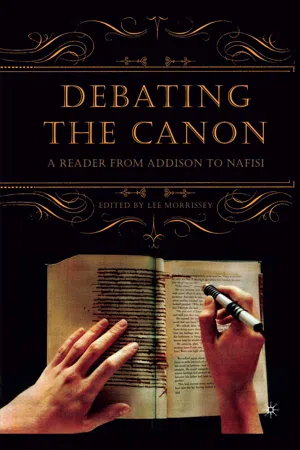
Over the past two decades, the debate over the 'Great Books' has been one of the key public controversies concerning the cultural content of higher education. Debating the Canon provides a primary-source overview of these ongoing arguments. Many of these contributions to this debate have achieved 'canonical' status themselves; through the focus on the canon, the full spectrum of approaches to literary studies can be seen in the essays. Therefore, this collection places the recent debate within a larger context of literary criticism's development of a canon, going back to the eighteenth century.
Information
Table of contents
- Cover
- Title
- Copyright
- Contents
- Introduction: “The Canon Brawl: Arguments over the Canon”
- 1. Joseph Addison (1672–1719): from The Tatler, No. 108 (Thursday, December 15, to Saturday, December 17, 1709)
- 2. David Hume (1711–1776): from “Of the Standard of Taste,” Essays(1757)
- 3. Samuel Johnson (1709–1784): from “Preface to the Plays of William Shakespeare” (1765)
- 4. Red Jacket (c.1750–1830): “Why not all agree, as you can all read the book?” from a speech to the Boston Missionary Society (1828)
- 5. Matthew Arnold (1822–1888): from “The Function of Criticism at the Present Time,” Essays in Criticism(1865)
- 6. T.S. Eliot (1888–1965): “Tradition and the Individual Talent,” The Sacred Wood(1919)
- 7. F.R. Leavis (1895–1978): from Mass Civilization and Minority Culture(1933)
- 8. Mortimer J. Adler (1902–2001): “Reading and the Growth of the Mind,” How to Read a Book(1940)
- 9. Erich Auerbach (1892–1957): from “Odysseus’ Scar,” Mimesis (1946; trans. 1953)
- 10. Leo Strauss (1899–1973): from “Persecution and the Art of Writing,” Persecution and the Art of Writing(1952)
- 11. Frantz Fanon (1925–1961): from “On National Culture,” Wretched of the Earth(1961)
- 12. Theodor Adorno (1903–1969): from “Commitment: The Politics of Autonomous Art,” New Left Review(1962)
- 13. Chinua Achebe (1930–): “Colonialist Criticism,” Hopes and Impediments (1974, 1988)
- 14. Elaine Showalter (1941–): from “The Female Tradition,” A Literature of Their Own(1977)
- 15. Annette Kolodny (1941–): from “A Map for Rereading: Or, Gender and the Interpretation of Literary Texts,” New Literary History(1980)
- 16. Pierre Bourdieu (1930–2002): from “The Field of Cultural Production, Or: The Economic World Reversed,” The Field of Cultural Production(1983)
- 17. William J. Bennett (1943–): from “To Reclaim a Legacy,” American Education(1985)
- 18. Elizabeth Meese (1943–): from “Sexual Politics and Critical Judgment,” in Gregory S. Jay and David L. Miller, Eds., After Strange Texts(1985)
- 19. Jane Tompkins (1940–): from “ ‘But Is It Any Good?’: The Institutionalization of Literary Value,” Sensational Designs (1985)
- 20. Martin Bernal (1937–): from “Volume I: Introduction,” Black Athena: The Afroasiatic Roots of Classical Civilization (1987)
- 21. Allan Bloom (1936–1992): “The Student and the University,” The Closing of the American Mind(1987)
- 22. E. D. Hirsch, Jr. (1928–): from “Rise of the Fragmented Curriculum,” Cultural Literacy: What Every American Needs to Know (1987)
- 23. Frank Kermode (1919–): from “Canon and Period,” History and Value (1988)
- 24. Barbara Herrnstein Smith (1932–): from “Contingencies of Value,” Contingencies of Value(1988)
- 25. Arnold Krupat (1941–): from “The Concept of the Canon,” The Voice in the Margin (1989)
- 26. Charles Altieri (1942–): from “An Idea and Ideal of Literary Canon,” Canons and Consequences(1990)
- 27. Alvin Kernan (1923–): from “Introduction: The Death of Literature,” Death of Literature(1990)
- 28. Roger Kimball (1953–): from “Speaking Against the Humanities,” Tenured Radicals: How Politics Has Corrupted Our Higher Education (1990; rev. 1998)
- 29. Paul Lauter (1932–): from “Canon Theory and Emergent Practice,” Canons and Contents(1991)
- 30. Katha Pollitt (1949–): “Why We Read: Canon to the Right of Me . . . ,” The Nation(1991)
- 31. Henry Louis Gates, Jr. (1950–): from “The Master’s Pieces: On Canon Formation and the African-American Tradition,” Loose Canons: Notes on the Culture Wars(1992)
- 32. Gerald Graff (1937–): from “Introduction: Conflict in America,” Beyond the Culture Wars: How Teaching the Conflicts Can Revitalize American Education (1992)
- 33. John Guillory: from “Preface” and “Canonical and Noncanonical: The Current Debate,” Cultural Capital: The Problem of Literary Canon Formation (1993)
- 34. Vassilis Lambropoulos (1953–): from “The Rites of Interpretation,” The Rise of Eurocentrism(1993)
- 35. Edward Said (1935–2003): from “Connecting Empire to Secular Interpretation,” Culture and Imperialism(1994)
- 36. Michael Bérubé (1961–): from “Higher Education and American Liberalism,” Public Access(1994)
- 37. Harold Bloom (1930–): from “An Elegy for the Canon,” The Western Canon: The Books and the School of Ages(1994)
- 38. Jacques Derrida (1930–): from “To Whom To Give To,” The Gift of Death (1992, trans. 1995)
- 39. Marjorie Garber (1944–): from “Greatness,” Symptoms of Culture (1998)
- 40. Richard Rorty (1931–): from “On The Inspirational Value of Great Works of Literature,” Achieving Our Country: Leftist Thought in Twentieth-Century America (1998)
- 41. Robert Scholes (1929–): from “A Flock of Cultures: A Trivial Proposal,” The Rise and Fall of English(1998)
- 42. Azar Nafisi (1950–): from Sections 16, 17, 18, and 19 of Part II, “Gatsby,” Reading Lolita in Tehran: A Memoir in Books (2002)
- Permissions
- Index
Trusted by 375,005 students
Access to over 1.5 million titles for a fair monthly price.
Study more efficiently using our study tools.
Frequently asked questions
Yes, you can cancel anytime from the Subscription tab in your account settings on the Perlego website. Your subscription will stay active until the end of your current billing period. Learn how to cancel your subscription
No, books cannot be downloaded as external files, such as PDFs, for use outside of Perlego. However, you can download books within the Perlego app for offline reading on mobile or tablet. Learn how to download books offline
Perlego offers two plans: Essential and Complete
- Essential is ideal for learners and professionals who enjoy exploring a wide range of subjects. Access the Essential Library with 800,000+ trusted titles and best-sellers across business, personal growth, and the humanities. Includes unlimited reading time and Standard Read Aloud voice.
- Complete: Perfect for advanced learners and researchers needing full, unrestricted access. Unlock 1.5M+ books across hundreds of subjects, including academic and specialized titles. The Complete Plan also includes advanced features like Premium Read Aloud and Research Assistant.
We are an online textbook subscription service, where you can get access to an entire online library for less than the price of a single book per month. With over 1.5 million books across 990+ topics, we’ve got you covered! Learn about our mission
Look out for the read-aloud symbol on your next book to see if you can listen to it. The read-aloud tool reads text aloud for you, highlighting the text as it is being read. You can pause it, speed it up and slow it down. Learn more about Read Aloud
Yes! You can use the Perlego app on both iOS and Android devices to read anytime, anywhere — even offline. Perfect for commutes or when you’re on the go.
Please note we cannot support devices running on iOS 13 and Android 7 or earlier. Learn more about using the app
Please note we cannot support devices running on iOS 13 and Android 7 or earlier. Learn more about using the app
Yes, you can access Debating the Canon by L. Morrissey in PDF and/or ePUB format, as well as other popular books in Literature & Higher Education. We have over 1.5 million books available in our catalogue for you to explore.